
Anniversary of the March Pogrom: The day when centuries of culture and history disappeared in flames
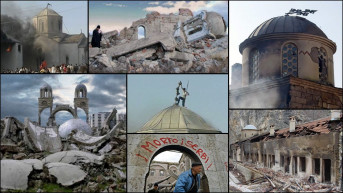
Another anniversary of the March Pogrom is being marked, a three-day wave of violence by Albanian extremists against Serbs in Kosovo. On that March 17, 22 years ago, before the eyes of the entire world and thousands of soldiers of international forces, an “avalanche” was set in motion that, in just a few hours, shook the very foundations of the survival of the Serbian people in Kosovo.
The toll of this unprecedented violence remains a deep wound that has not healed even 22 years later.
In three days, eight Serbs were killed, at least 170 were injured, and more than 4,000 were expelled. Nearly 900 Serbian houses were destroyed, and 35 religious buildings were set on fire, including 18 cultural monuments. Numerous icons and cultural assets were permanently destroyed. Several areas were ethnically cleansed.
Centuries of culture and history disappeared in flames. From Prizren, through Kosovo Polje and Caglavica, all the way to North Mitrovica and the Devic Monastery in Drenica, everything bearing the Serbian name was burning. Villages such as Svinjare and Slatina were practically erased from the map of settlements, and the return of those who lost everything that March is still measured only in fractions of a percent.
In clashes with members of international security forces, 11 Albanians were also killed. Dozens of members of international forces were injured in confrontations with local Albanians.
What preceded the March Pogrom?
The pogrom was preceded by reports in Kosovo media on March 16, 2004, that three Albanian boys, aged 8, 11, and 12, had drowned in the Ibar River in the village of Cabra, near Zubin Potok, allegedly fleeing from Serbian attackers.
However, UNMIK Spokesperson Derek Chappell denied that the boys died while fleeing from Serbs and assessed that the violence had been planned.
Under the pretext of revenge for the drowning of the three Albanian boys in the Ibar River, more than 50,000 extremists launched a destructive campaign.
March 17
That day at noon, several thousand Kosovo Albanians crossed the bridge over the Ibar and attacked Serbs in North Mitrovica. They used automatic and sniper weapons and threw Molotov cocktails at UNMIK vehicles.
Attacks on Serbs also began in Caglavica and surrounding Serbian villages, Pristina, Podujevo, Vucitrn, Istok, Djakovica, Lipljan, Urosevac, Vitina, Suva Reka, Obilic, Prizren, Gnjilane, Kosovska Kamenica, Pec...
In Obilic, a school was attacked and set on fire while about thirty pupils were in class.
The burning of religious sites and mass destruction continued on March 18. The image of the cross being broken on the Church of St. Ilija in Podujevo became one of the symbols of Serbian suffering.
Grim statistics of suffering
After three days of violence, only ruins remained. Lives taken, burned houses, monasteries, churches, icons, cultural monuments... Serbs who, within three days, lost everything they had built over a lifetime.
Killed Serbs
In the municipality of Kosovska Mitrovica (today North Mitrovica), Borivoje Spasojevic (1941) and Jana Tucev (1968) were killed; in Lipljan Nenad Vesic (1951); in Drajkovce, municipality of Strpce, father and son Dobrivoje (1955) and Borko (1984) Stolic; in Gnjilane Boban Peric (1952), a physical education teacher from the village of Kusce; in the municipality of Kosovo Polje Zlatibor Trajkovic (1942) from Kosovo Polje; and in the municipality of Prizren, at the Prizren Seminary, Dragan Nedeljkovic (1943).
Destroyed and damaged churches and monasteries
In Prizren, the following were destroyed: the Our Lady of Ljevis (14th century), the Church of the Holy Savior (14th century), the Cathedral Church of St. Great Martyr George (1856), the Church of St. Nicholas Tutucev (14th century), the Church of St. George Runovic (16th century), the Church of St. Nedelja (14th century), the Church of St. Panteleimon (14th century), the Church of Sts. Cosmas and Damian (14th century), the Church of St. Nedelja in Zivinjane, the Monastery of the Holy Archangels (14th century), as well as the building of the St. Cyril and Methodius Seminary and the Episcopal residence. In Orahovac, the Church of St. Nedelja (Kirijake, 1852) in Brnjaca was destroyed. In Djakovica, the Church of the Dormition of the Most Holy Mother of God (16th century) with the parish home, the Cathedral Church of the Holy Trinity and the Church of St. Prince Lazar in Piskote were damaged. In Srbica, the Devic Monastery (15th century) was set on fire. In Pec, the metropolitanate with the parish home of the Church of St. John the Forerunner and Baptist, the Church of the Presentation of the Most Holy Mother of God in Belo Polje, and the Church of St. John the Baptist in Pecka Banja were destroyed. In Urosevac, the Church of Emperor Uros was damaged; in Kosovska Kamenica, churches in Donja Slapasnica and Talinovce; in Stimlje, the Church of St. Archangel Michael. In Pristina, the Church of St. Nicholas (19th century) was burned; in Kosovo Polje, the Church of St. Nicholas, and in nearby Bresje, the Church of St. Catherine. In Vucitrn, the Church of St. Ilija was destroyed. In Obilic, a new church was damaged. In Kosovska Mitrovica, the Church of St. Sava was destroyed, and in Podujevo, a church from 1930.
Political background?
In a publication by the Security Intelligence Agency prepared two years ago, it is stated that attempts by Albanian extremists to present the March 2004 pogrom of Serbs as a spontaneous reaction to the tragic drowning of Albanian boys from Cabra in the Ibar River, for which Serbs were maliciously blamed, represent only a cover for a previously well-planned and prepared operation of ethnic cleansing of Serbs from Kosovo and the destruction of national and cultural identity, that is, the erasure of traces of centuries-long existence in that area.
The March events in Kosovo were condemned at the time by the United Nations Security Council and the European Union, but only after everything had ended. During a visit to Obilic on March 23, then head of UNMIK Harri Holkeri stated that Albanian extremists “had a ready plan” for the violence, while NATO’s commander for southern Europe, Admiral Gregory Johnson, described the violence in Kosovo as clearly “organized”.
However, the political background of the organized attack on an entire people has remained unresolved.
A crime without punishment
After the pogrom against Serbs, 270 Albanians were arrested, 143 persons were convicted, most receiving fines, and 67 were sentenced to prison, but not the organizers and instigators, so justice, as is often the case, remained out of reach.
Today, March 17 remains a symbol of suffering, but also a warning that a latent peace cannot be firm, while the years after the Pogrom have shown that the persecution of the Serbian people in Kosovo, in one way or another, has never ceased.
To ensure that the pogrom against Serbs is never forgotten, a central commemoration ceremony is being held today in Gracanica.
The anniversary of the March Pogrom will also be marked in North Mitrovica, while in Belgrade, at the National Theatre, the Day of Remembrance for March 17 will be marked.

0 comments