
Popovic: Scientific truth testifies to who built the Serbian churches in Kosovo
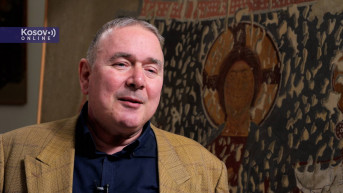
Art historian and head of the Gallery of Frescoes of the National Museum of Serbia, Bojan Popovic, told Kosovo Online that the desecration of Serbian religious sites in Kosovo over the past decades has been motivated by damnatio memoriae, or the erasure of the past.
“If you want to have a future narrated the way you prefer, while showing no respect and seeking to misuse the past, then that is how you will act,” Popovic emphasizes.
Today marks 45 years since the arson attack on the residence (konak) of the Patriarchate of Pec, and Popovic notes that since the end of the Second World War, both openly and quietly, efforts have been made to suppress everything Serbian in Kosovo.
“It is enough to say that when the residence of the Patriarchate of Pec burned, it was not permitted to speak about it publicly, so jokes circulated claiming that the burning of the residence was the work of ‘a little fire-starter’. This was an allusion suggesting that Albanian terrorists were responsible, since that could not be stated openly,” Popovic points out.
If the period from 1945 to 1981, which he describes as a time of relative peace, is examined, it becomes clear that many things that would normally have been expected were not done.
“For example, archaeology was not conducted in many areas. Also, if archaeological research did begin, especially if it was successful—as was the case in Novo Brdo—those archaeological campaigns would be interrupted. It is enough to say that we have never properly carried out archaeological research of the Nemanjic courts around Urosevac, the famous ones mentioned in historical sources such as Pauni, Nerodimlja, and Svrcin. That alone is a sufficient indication that something was certainly not right during that period,” Popovic states.
He points out that today there is a complete distortion of the past regarding Serbian churches in Kosovo, through claims that they were built on imaginary Albanian–Illyrian–Thracian structures that never existed. At the same time, he stresses that scientific evidence clearly testifies to who built them and which culture the space belongs to.
“What is most important from the perspective of scholarship is that we know we are completely in the right. We must insist on the truth. Truth is our first and last word. That is unequivocal. If that were not the case, we would have lost them during the voting at UNESCO on whose monuments they are. I must commend my profession, which made an effort to explain that this was not something erected long ago solely by decree of our rulers, but rather a network in which our entire country and our people were involved. Moreover, it was not a phenomenon limited only to the 14th century, but something that has existed from ancient times up to the present day,” Popovic notes.
Speaking about ways to prevent the rewriting and erasure of the past in an era when unverified or deliberately misleading information spreads easily through social media, Popovic says that this can be countered with clear and well-argued scholarly texts that accurately reflect reality.
“If you are able to fully explain what is located there, it will ultimately have to be acknowledged. We have long had a problem that in the West everything there is often wrapped in a Byzantine veneer and described simply as Byzantine art, which amounts to a substitution of theses. Of course, it may be art in the Byzantine style, just as it may be art of the Raska or Raska-Gothic style, as in the case of Decani, but the essence is that it is Serbian art of the medieval and early modern periods,” Popovic explains.


0 comments