
Rakocevic: All those who thought the flames of the Patriarchate of Pec meant the end of Serbian culture in Kosovo were mistaken
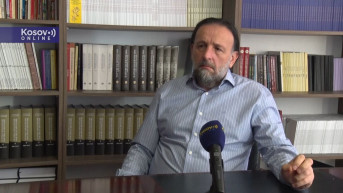
Journalist and writer from Gracanica, Zivojin Rakocevic, marking the 45th anniversary of the arson attack on the residence of the Patriarchate of Pec, says that those flames deeply shook every member of the Serbian people from within, because everyone, regardless of whether they were an atheist or a believer, felt that the mother of Serbian churches was burning. He adds that all those who believed that the flames of the Patriarchate of Pec meant the end or the beginning of the end of Serbian culture, spirituality, and civilization in Kosovo and Metohija were mistaken.
Rakocevic sees the fire at the Patriarchate of Pec on the night between March 15 and 16, 1981, as a culmination of misfortunes that befell the Serbian Orthodox Church, the Serbian people, spirituality, and culture.
“The burning of the Patriarchate of Pec is a kind of point at which thousands of hectares of seized land and God knows how much property converged. In the fire of the Patriarchate of Pec were exiled monks, imprisoned priests, and stripped rights. All the misfortune from 1941 to 1981 gathered there. It represents an entire set of injustices, discrimination, exclusion from public life and attempts to eliminate the Serbian Orthodox Church, its spirituality and values, and our cultural heritage. The burning of the Patriarchate of Pec was the moment when we realized that the mother of Serbian churches says: ‘I exist, even if it is in this fire’. That fire was not any beginning, but a sum of the misfortunes that had happened to us. From it we count a certain time, unfortunately, and after that time new storms began and what could be described as fatal blows to a civilization that is alive,” Rakocevic says.
He recalls a sentence that describes the social context in which the burning of the Patriarchate of Pec occurred: “State firefighters arrived without water.” He says that sentence remained both in the poetry of Darinka Jevric and in the memories of nuns and people from that area.
“That is our eternal fate, that the systems in which we lived, in which the Patriarchate of Pec lived and in which it lives even today, are not there to take care, to protect, or at least to leave it in peace. Even today, the situation is almost the same. Certain systems came without water to extinguish fires in which they themselves participated and for which they are very much responsible,” our interlocutor says.
According to him, today there are two parallel processes of destroying Serbian cultural heritage in Kosovo. The first is field-based, brutal, and physical, which destroys what it sees in front of it, and the second is on the theoretical and spiritual level, which is designed and precise and represents attempts to falsify everything that those who intend to destroy cannot physically demolish.
“These two parallel processes run through our entire century and clash with something called civilization. Our civilization in Kosovo and Metohija is made up of a million pieces in a mosaic that we see and identify as Kosovo and Metohija. Each of those pieces is, in a way, very important, some of them even of global importance, and that is why this conflict is so complex and why those two levels must exist. While we are talking here, somewhere a monument is being destroyed, someone is devising an idea to make what is ours become theirs, because that civilization is devoted to renewal and dialogue with others. It has never frustrated anyone and clearly testifies who its owner is. And that is the problem,” Rakocevic points out.
He adds that because of this the angles of attack will continue to expand, but in perspective, in the digital age where everything is visible and renewable, they cannot destroy a civilization.
“It is too late for that. But that we will face problems, that we will have a struggle and that it will last for a very, very long time is certain. And that is what we have been prepared for from 1941 until today. In that mosaic of misfortunes these symbols and markers appear: the burning of the Patriarchate of Pec appears, then 1999, then 2004, and those points when accumulated evil turns against values. That value is there to endure attack and fire and to be renewed. And it is being renewed,” he concludes.
Recalling an anecdote from a visit to the Patriarchate of Pec with Nenad Jankovic, who while looking at the reliquaries of archbishops, patriarchs and saints asked at one moment why we had not disappeared like the Maya civilization, the Inca civilization and so many other peoples, Rakocevic says that we have not disappeared because our faith is alive and our civilization is enduring.
“We did not disappear because those saints from the Patriarchate of Pec are closely connected with a man who today lives in Gorazdevac or Osojane, in complete solitude and isolation. We are almost certain that this spiritual, civilizational and cultural level communicates with those people whom only God knows and whom only they themselves know, and in that relationship they live and survive. Our culture is alive, a culture of resurrection and of true and essential renewal that cannot be destroyed,” the writer said.

0 comments