
Presidential mandate in post-election calculations – A consolation prize for Kurti or the onset of a new political crisis?
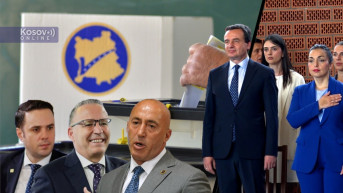
Following Self-Determination’s failure to form a government, analysts assess that the December elections could bring the opposition to power, yet that Albin Kurti would still remain an unavoidable factor in post-election negotiations—above all regarding the presidential post. While some warn that such a balance of power could lead to a new institutional crisis, others believe that the presidency could serve as Kurti’s “consolation prize” for a peaceful departure from office.
Written by: Petar Rosic
Political analyst Azdren Shala believes that the outcome of the extraordinary parliamentary elections on 28 December will not differ significantly from the results of the previous elections held on 9 February, but that Self-Determination’s support will decline.
Analyst Shënoll Muharremi also stated that he does not believe Kurti will secure another mandate, adding that the 28 December elections will be a race between Bedri Hamza and Lumir Abdixhiku. However, he stresses, this does not mean that Self-Determination will be “out of the game.”
Muharremi said that without major compromise, there will be no solution—and no functioning institutions—and that Kurti has solid chances of becoming President of Kosovo next year.
Two-Thirds Majority
Political analyst Nexhmedin Spahiu told Kosovo Online that the method of electing the President of Kosovo is a constant obstacle to the development of Kosovar society, and that the president should be elected by direct popular vote. As he explains, only Kosovo and Albania in the Balkans elect their presidents in parliament. “The election of the President of Kosovo will always hinder societal development, because everywhere in the Balkans—from Turkey to Romania and Slovenia—presidents are elected by direct vote. Only in Kosovo and Albania does parliament decide,” Spahiu said.
He added that in Albania a president may be elected by a simple majority, whereas in Kosovo a two-thirds majority is required—something he sees as a major problem. “For this reason, the system must change and the president must be elected directly by the people. In two rounds, a winner will always emerge,” Spahiu stated.
Director of the NGO Casa, Miodrag Marinkovic, warns that precisely because of the current system of electing the president, Kosovo may again fall into institutional crisis after the December elections. He told Kosovo Online that there is no stable majority capable of supporting any presidential candidate—least of all Albin Kurti.
According to Marinkovic, political calculations are already well underway. “We are already living through these calculations; there is a clear risk that any majority formed in December could collapse by early spring, because there will not be enough MPs to elect a president,” he said.
Electoral Mathematics
Marinkovic added that Kosovo is already in a deep institutional crisis and that there is only one way out of the deadlock: for Self-Determination to win fewer than 40 seats, which would allow the opposition to obtain full political legitimacy.
“Under one condition this crisis can be resolved without further delays and new elections: if Self-Determination wins fewer than 40 seats in the new assembly. This would marginalize them to the extent that they could not form a government, nor would they have enough votes to block the election of a president,” he explained.
Anything above 40 seats for Self-Determination, he added, means a continuation of Kosovo’s institutional crisis. Commenting on speculation that Kurti might abandon the prime minister’s post in order to run for president, Marinkovic said he does not see realistic support for such an outcome. “I hope not,” he said, though he admits that political calculations are unpredictable.
“Judging by the statements of the opposition, their values and policies, I am not convinced they are prepared to support such a choice,” he noted. He emphasized that previous presidents of Kosovo did not possess the political heft they had as party leaders, and that he expects the same this time.
He added that public opinion surveys show declining support for Self-Determination, while the opposition is gaining ground. “I am certain the opposition will have mathematical, statistical, and political influence over the presidential election, and in that case, I am not convinced Kurti has any chance of becoming president—assuming he even wants the position,” Marinkovic concluded.
Director of Strategy at the European Policy Centre in Belgrade, Miloš Pavkovic, likewise believes that the presidential election will become the central topic of political negotiations after the parliamentary vote.
He points out that the president is elected by a two-thirds majority in parliament, so parties—most of which will only have a minimal majority for government formation—will need far broader support. Consequently, he told Kosovo Online, Self-Determination “enters the game.”
“Self-Determination had more than 40 percent in the previous parliamentary elections; it will probably have less now, but it will still be a significant political actor and, in that sense, an unavoidable partner in negotiations over the presidency. In such a scenario, this could be some sort of consolation prize for Albin Kurti—who is unlikely to secure another mandate as prime minister but may obtain the support of other parties to become president, in exchange for supporting another candidate for prime minister,” Pavkovic explained.
A Rational Scenario
He stressed that compromise over the presidential election is essential in order to avoid new extraordinary elections.
“If the president is not elected in the first or second round, the government falls and new elections are called. Therefore, an agreement with Self-Determination is necessary. Even if other parties form a government without Self-Determination, they could not elect a president without them. This is why the issue will be a key part of coalition and post-election negotiations,” Pavkovic said.
Speaking about potential compromises, Pavkovic emphasized that if parties wish to exit the crisis without entering a new one, they will inevitably have to negotiate with Self-Determination on the presidency.
“In this context, I believe parties will think rationally and will not run head-first into new political uncertainty and a new political crisis,” he said.
He noted that this is the “rational scenario,” but that there is always a significant possibility of a new crisis if negotiations with Self-Determination fail.
“If Kurti—true to form—remains adamant and continues to insist that Self-Determination must hold the prime minister’s position, this could lead to another political crisis. However, by giving the mandate for prime minister to Konjufca, he signaled willingness to compromise. I would not be surprised if Self-Determination were ready for such a compromise, which would allow Kurti a peaceful and gradual departure from power,” he explained.
On the other hand, he noted that the opposition has no clearly defined stance on whether they want a complete break with Self-Determination or are ready for compromise. The final outcome, he said, will depend heavily on the parliamentary election results.
“If Self-Determination achieves a strong result, they will be unavoidable in negotiations over the presidency, and the opposition will simply have to adjust its position accordingly. If, however, Self-Determination suffers a catastrophic defeat, then a scenario in which Kurti is completely sidelined becomes possible,” Pavkovic concluded.



0 comments