
Rakocevic: The peak of discrimination is when a people fear using their mother tongue
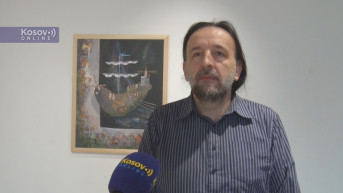
The height of discrimination is when a people fear using their mother tongue, assessed journalist and writer Zivojin Rakocevic for Kosovo Online. He says that in Kosovo, perfectly transcribed European laws are not applied at all levels, and the same goes for the Law on Language Use.
"All of us here question at least once a week whether we can now say something in our Serbian mother tongue. If you go to any of our enclaves and meet a high school student, a child, and say to them a simple 'good day', several unnatural moments pass until they respond to you with 'good day'. And what hides in those few moments? That child is checking who you are, that child is checking if they can respond to you, that child has learned instinctive caution in using their mother tongue," Rakocevic explains.
The Law on Language Use, he claims, is absolutely not respected, with numerous examples.
"A police officer at a checkpoint, anywhere, asks you and questions you 'Why don't you speak Albanian', and you pay taxes so that police officer can simply say 'good day' to you. He even went to some schools, which are established according to international principles again, to not get a job until he says in the official language, for example, 'good day' or basic things, but this is brutally not applied. Try to go to Vucitrn, Glogovac, Kacanik, Pristina..., anywhere. It is simply a fact in which your mother tongue, your Serbian language, is a trigger for your unhappiness, and 25 years after the conflict, it's the alarm after which you are thrown out of life. You enter an institution and say 'good day' or ask for something in your mother tongue, or call when they cut off your electricity, as is done in Osojane and returnee villages. As soon as they hear you speak your mother Serbian language, there's immediately the barrier, there's immediately the obstacle. This society is not prepared for others, this society is not prepared for laws that are transcribed and only formally exist on paper and in the Constitution and serve only as a cover, and their perfection is as great as the repression towards us," Rakocevic said.
Although complaints about non-compliance with the Law on Language Use are present, institutions are not willing to solve that problem, as Rakocevic claims.
"We constantly repeat, especially the media community and people from culture, that there is no language, that the most common announcements are that these institutions do not meet basic standards and norms. We simply cannot go beyond that because this is the space where heads were lost due to language use in most cases. This is the space where language use was charged 100 German marks in Pec and up to 30 marks in Kamenica... People went and listened to what language you spoke. It has now become instinct, it has become a way of life, 25 years you reflexively observe who speaks what language," Rakocevic explains.
It has become "normal" for Serbs, he emphasizes, wherever they are, to listen to what language is spoken.
"There are some legal norms, there are language commissioners, but, imagine, what can he do? Who was punished, where is that administration? And those translations we get – it's a humiliation of language; it's an Albanized Serbian language. Look at the names of places, look at the names, look at all that force that is simply inertia, that grinds, and the peak of discrimination is when your language rebels in you and says, 'How is it possible that you who speak me have such treatment toward me, how is it possible that I as your language to you, perhaps, at one point, your biggest enemy?' These are difficult rebellions in us, these are difficult psychological states. It is not easy to survive; people find ways to cope, they get silent," Rakocevic says.
Silence, he explains, has become normal when Serbs in Kosovo find themselves in predominantly Albanian environments and public places.
"People in transport, officials of the international community traveling in public transport from Pristina to some of our places, are silent as logs and dare not say anything. We still don't use public transportation. Why? Because your language will betray you, you will come into trouble because of your language, and you will not want to face that humiliation at all. What has happened to us in these 25 years, but somewhere at the base and in the circle of evil that surrounds us, that feeling that your language is your enemy and that you dare not speak it and use it properly is the very peak of discrimination," Rakocevic claims.
He explains that a language is not learned to avoid repression or to keep your head on your shoulders.
"I don't know any German language, but no one harasses me because at the airport or somewhere in a store or museum in Austria, I don't know the German language, and, on the contrary, everyone tries to help me and do something in that regard, which is a friendly gesture. Here, the language is a trigger. Of course, I would like to read Kadare in Albanian, but I would never share his political views, which are disastrous and bad. On the other hand, you don't learn a language to avoid repression, you don't learn and know a language to keep your head alive. If I have to do that, then I will never learn that language, and that is the resistance," he emphasizes.
He notes that learning a language cannot be equated with compulsion.
"No, we don't have to know the Albanian language, as the Serbian language is the constitutive language of this area. Every stone built into the cities of Kosovo and Metohija, among others, is built, with the Serbian language, and in the Serbian language, not to mention all the other things. So, where this language has reached its great achievements, where it has developed, where it has lived, no one can tell you that you have to know a language so that the policeman doesn't harass you, so that the customs officer doesn't treat you like this, so that the officials don't discriminate against you. This is contrary to any normal relationship in communication, this is contrary to the modern world, but this is all far from the modern world," Rakocevic concludes.


0 comments