
Resolution 1244 adopted 26 years ago, what was said at the UN Security Council session that day?
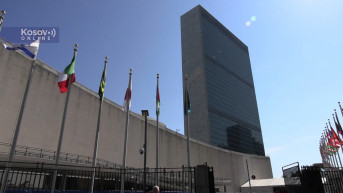
Western countries supported it 26 years ago, but today they rarely mention it unless they must; Pristina almost never does, while Belgrade persistently reminds that United Nations Security Council Resolution 1244 guarantees the sovereignty and territorial integrity of Serbia as the successor of the Federal Republic of Yugoslavia. This document was adopted on this day in 1999.
At the time of the resolution's adoption, alongside the five permanent members of the Security Council – Russia, China, the United States, the United Kingdom, and France – the non-permanent members were: Gambia, Argentina, Bahrain, Brazil, Canada, Gabon, Malaysia, Namibia, the Netherlands, and Slovenia.
The document was adopted with 14 votes in favor. China abstained.
Speaking at the Security Council session on June 10, 1999, China's representative Shen Guofang stated that the draft resolution did not fully reflect China’s principled stance and legitimate concerns, nor did it mention the disaster caused by NATO’s bombing of the Federal Republic of Yugoslavia.
Nevertheless, since the FRY had already accepted the peace plan and NATO had ceased the bombing, the Chinese delegation did not block the adoption of the resolution, but abstained.
Guofang emphasized that NATO, without Security Council authorization, launched military strikes against the sovereign state of the FRY, and that the war, waged in the name of humanitarianism, actually caused the largest humanitarian catastrophe in Europe since World War II and seriously disrupted peace and stability in the Balkans.
He stressed that ethnic problems within states should be resolved by governments and peoples and must not be used as a pretext for external intervention.
"By undertaking this action, NATO seriously violated the UN Charter and norms of international law, thereby setting an extremely dangerous precedent in the history of international relations," the Chinese representative said, noting that China’s embassy in Yugoslavia, protected under international convention, had become one of the bombing targets.
As Russia’s ambassador to the UN at the time, Sergey Lavrov stated during the session that the document clearly confirms the commitment of all countries to the sovereignty and territorial integrity of the Federal Republic of Yugoslavia.
"The main significance of the resolution lies in the fact that it returns the Kosovo solution to the political track along with the central role of the United Nations. This is the only possible way to overcome the crisis in and around the Yugoslav province of Kosovo. Russia consistently advocated precisely this approach to resolving the Kosovo issue, demanding an end to NATO’s unlawful military action against Yugoslavia as an absolute condition for a political solution," Lavrov said at the time.
After the vote on Resolution 1244, the US representative said that America would work to ensure "that the people of Kosovo are given the autonomy they deserve, as envisioned in the Rambouillet Accords."
“It’s important to note that this resolution envisions that the civilian and military mission will remain until the Security Council decides that conditions exist for their conclusion,” the US representative stated.
What does the resolution say?
In the preamble of the document, it confirms the commitment of all member states to the sovereignty and territorial integrity of the FRY and other countries in the region.
The FRY was required to begin and complete a phased withdrawal from Kosovo of all military, police, and paramilitary forces.
The next provision states that after the withdrawal, an agreed number of Yugoslav and Serbian military and police personnel would be allowed to return to Kosovo. Their duties were defined: liaison with the international civilian mission and the international security presence, marking and clearing minefields, presence at sites of Serbian cultural heritage, and maintaining a presence at major border crossings.
Article 5 provided for the deployment of civil and security presence in Kosovo under UN auspices.
The resolution also called for the demilitarization of the KLA and other armed groups of Kosovo Albanians, as well as the establishment of a secure environment in which refugees and displaced persons could return to their homes.
“The people of Kosovo will be able to enjoy substantial autonomy within the FRY,” Article 10 states.
Resolution 1244 was adopted the day after the signing of the Kumanovo Agreement, which ended NATO’s aggression against the FRY, which began on March 24, 1999.
Before that, FRY President Slobodan Milosevic had accepted a peace proposal delivered to Belgrade by international mediators Martti Ahtisaari and Viktor Chernomyrdin. On June 3, 1999, the Serbian National Assembly adopted the Document for Achieving Peace, i.e., the US, EU, and Russian plan for the deployment of international forces under a UN mandate in Kosovo. Acceptance of this document was a precondition for halting NATO’s aggression against the FRY.


0 comments