
Rohde: There is no alternative to dialogue; CSM is the path for the integration of the Serbian minority
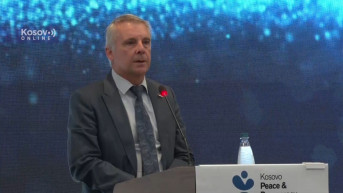
The German Ambassador to Pristina, Jorn Rohde, stated that there is no alternative to dialogue between Belgrade and Pristina and that "dynamic changes" are needed in this process, which will include integration, reconciliation, and compromise.
"What we need are integration, reconciliation, and compromise. The path to achieving this is on the table. As Jeff (Hovenier, US Ambassador) said, there is no alternative to dialogue," Rohde said.
He referred to the Brussels and Ohrid agreements, emphasizing the need for renewed and urgent engagement on these issues.
"There is a new team in Brussels that will take over the enlargement portfolio. And I repeat this over and over: Kosovo needs to be proactive regarding the CSM because that is the clear path to integrating the Serbian minority in Kosovo and showing that this agreement is 'alive' for them," Rohde stressed.
Speaking at the Kosovo Peace and Democracy Summit in Pristina, Rohde said that after four years of serving in Pristina, he sees the same nationalistic policies and heightened tensions not only in Kosovo but across the Western Balkans.
"I've been here for four years, and, you know, I have seen ups and downs. When looking at the current Kosovo-Serbia relationship, today you see inflammatory statements, extreme language, and the use of extreme positions. But verbal tensions are flaring not just between Kosovo and Serbia but on other fronts in the region as well," Rohde stated.
He emphasized that such tensions are also visible in the relations between North Macedonia and Bulgaria, as well as in the Republic of Srpska.
"Others are not without blame either," Rohde highlighted.
He added that he had seen that in a recent speech by Serbian President Aleksandar Vucic, as well as in the statements of Kosovo politicians.
"The constant use of extreme terms like 'ethnic cleansing' and 'repression' to describe the situation in the north doesn't help, nor does the banning of the NGO-led 'Miredita, Dobar Dan' festival in Serbia. I see similar expressions when Kosovo politicians describe the situation in the 'Presevo Valley.' Clearly, there are things happening that are not helpful," Rohde pointed out.
In this context, he also commented on yesterday’s anniversary of the events in Banjska, where a street was named after a fallen policeman.
"I see identity politics. Do streets in Banjska need to be named after the killed policeman on the anniversary? I'm not so sure," Rohde said.
He added that Banjska had been a "turning point" because it had shown raw violence, and as a result, NATO’s presence in the north had been increased.
"The good news is that we see a significantly reduced possibility of malicious actors causing violent harm," Rohde clarified.
Rohde assessed that the biggest obstacle to the normalization of relations is the complete absence of political will for the normalization.
"Serbia is essentially defending the status quo, while Kosovo wants to change it. And I would say rightfully so. We also want a sovereign Kosovo and aim for Kosovo to become a member of all organizations – NATO, the EU, the Council of Europe," Rohde concluded.

0 comments