
Selakovic: Since 1999, 156 churches and monasteries and 255 Serbian cemeteries destroyed in Kosovo
Serbian Minister of Culture Nikola Selakovic stated yesterday that since 1999 in Kosovo, 156 Serbian churches and monasteries and 255 Serbian cemeteries have been destroyed, while more than 10,000 icons and various church items have been stolen or destroyed, Novosti reported.
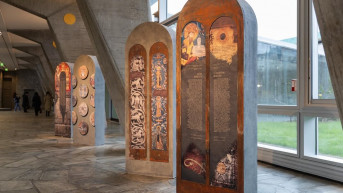
Speaking at the opening of an exhibition about endangered Serbian medieval monasteries in Leskovac, organized as part of the marking of the 20th anniversary of the inscription of the Visoki Decani Monastery in the UNESCO register of immovable cultural heritage of importance for humanity, Selakovic emphasized that the destruction of Serbian cultural heritage took place before the eyes of the international public and peacekeepers and that no one has ever been held accountable.
“The Albanian people with whom we lived together and who live today in Kosovo and Metohija have been present for a little more than 320 years. During those 320 years they have not created anything that can be called Albanian cultural heritage, while in less than two centuries we created so much that what has survived to this day shines so brightly that the whole of humanity can see it,” Selakovic said.
He added that whatever happens on the political level cannot change that, Novosti reports.
“The only thing that can change the truth is the loss of our awareness that everything in Kosovo and Metohija that testifies to the continuity of our ethnic and national presence, our statehood and our culture originally and first and above all belongs to us, and can become someone else’s only when we renounce it. This exhibition is a clear signal, a clear voice and a clear commitment of this generation to loyalty and devotion to the Kosovo covenant and a message that we neither renounce nor can renounce what has been ours for centuries,” Selakovic said.
He recalled that in 2024 it was 20 years since the inscription of Visoki Decani in the UNESCO register, and that in the following three years the Patriarchate of Pec, Gracanica Monastery and Church of Our Lady of Ljevis were also entered in that register.
“What is important to say this year is that this year marks 20 years since these four jewels of Serbian medieval culture, art and sacred architecture were inscribed in the UNESCO register of cultural heritage of importance for humanity in danger. We are not talking about the Near or the Middle East, we are not talking about other war zones across Europe and the world. We are talking about Kosovo and Metohija, where war events supposedly ended 27 years ago. We have World Heritage of importance for humanity in danger there,” Selakovic said.
He emphasized that the exhibition about endangered Serbian medieval monasteries was first presented in Paris at the UNESCO headquarters on November 24, 2024, and later at the Serbian Cultural and Information Center in Paris.
“The main goal of this exhibition at the moment when we presented it to the world public and began visiting many European cities and capitals with it was to present our endangered cultural treasure exposed to attacks, destruction and historical falsification to as many peoples around the world as possible in the first quarter, that is in the first half of the 21st century,” the minister said.
In addition, he added, the aim was also to first present the exhibition to those countries that support Serbia in its efforts to preserve the Serbian people, the Serbian state and Serbian national interests in Kosovo. After Paris, it was also shown in Bucharest, Bratislava, Timisoara, Banja Luka, Sarajevo, and Budapest, while by the end of the year it should also be presented in Thessaloniki, Athens, Nicosia, Moscow, Beijing and Mexico City.
The minister warned about a particularly specific aspect of the endangerment of Serbian medieval monuments in Kosovo, including those that are part of the World Cultural Heritage, and that is through historical fabrications and falsifications.
“The Serbian people have already faced something several times that cannot be called anything other than culturicide. This evil does not want to destroy only the culture of one people, but culture as identity itself. And it goes as far as the eradication of the existence of an entire people. As a people, we have been exposed to it several times in our history, and during the 20th century perhaps more than before,” Selakovic said.
As he explained, in the first step of culturicide, there is the physical destruction of culture and the banning of culture, which is often an introduction to genocide or ethnic cleansing.
“In the second step, history is falsified and culture is erased. Ethnic cleansing becomes the cleansing of culture from those to whom that culture originally belongs. Finally, in the third step, what escaped destruction and whose origin was erased is taken from the victim and appropriated as the heritage of the perpetrator. This could be called the cleansing of history, the cleansing of history from the traces of the victim, so that culturicide ultimately becomes the perfect crime,” Selakovic explained.
He added that according to that pattern, culturicide in Kosovo appears to be in its final stage.
“In reality, the terrible experience of the Serbian people from the Second World War, especially in the then Independent State of Croatia, as well as during the 1990s, shows that the seizure of cultural heritage is not only the end but also an announcement of a new infernal cycle even worse than violence. This must be stopped. That is a mission that necessarily belongs to us and to which history has dedicated us. In the name of preserving exceptional universal value and in the name of historical truth, this exhibition stands against every form of violence and falsification and testifies to the necessity and nobility of the mission to protect the cultural heritage of our Serbian people as well as of all humanity,” Selakovic concluded.

0 comments