
Simic: An attack on the SOC is an attack on every one of us; the law must apply equally to everyone
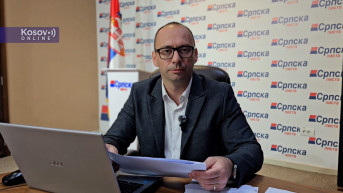
The demolition of cottages at Lake Gazivode is yet another example of institutional violence and the selective application of the law against the Serbian people, as the structures were demolished before court proceedings had been completed and before the owners had the opportunity to use an effective legal remedy, says Igor Simic, Vice President of the Serb List, stressing that the law must apply equally to everyone. Simic also warned that the attacks on the Serbian Orthodox Church are a dangerous attempt to declare Serbian Orthodox churches as Albanian.
"It is unacceptable to demolish only in areas where Serbs live, while hundreds of buildings near other lakes and thousands of illegally constructed buildings across Kosovo and Metohija have remained untouched for years. That selectivity clearly shows that this is not about urban planning, but about politically motivated pressure, intimidation, and an attempt to drive Serbs from areas they have inhabited for centuries. The reactions of representatives of the international community confirmed what the Serb List and the people have been warning about for a long time - that the authorities in Pristina do not respect the rule of law in northern Kosovo and Metohija. It is particularly important that the EU acknowledged that the buildings at Gazivode were demolished while the owners had already initiated court proceedings and called for an immediate halt to all further demolitions, forced evictions and property seizures," Simic said in an interview with Novosti.
He said the time has come for the international community to physically protect the Serbs and their property.
"We welcome every clear condemnation, but we expect concrete action. International representatives need to use the mechanisms at their disposal to prevent further unilateral actions, such as the demolition of more than 20 garages in the urban center of North Mitrovica. We have reached the point where the international community must physically protect the Serbs and their property," Simic emphasized.
He said that the authorities in Pristina are trying to undermine the electoral will of citizens in Serb-majority municipalities.
"In the elections, the Serbs clearly expressed whom they trust and who should govern their local municipalities, but now those municipalities are being prevented from independently deciding on public space, the use of their budgets and the implementation of major investment projects. Rejecting a request to paint a mural of Patriarch Pavle, arresting and expelling artists, while at the same time imposing installations and symbols against the will of the majority population, is not an administrative issue. It is an attempt to deprive the Serbs of their right to their own identity and to demonstrate that their electoral will means nothing," Simic explained.
He stressed that this can be overcome through the consistent implementation of local self-government rights, direct institutional and political pressure on Pristina, and demands that all budget funds belonging to municipalities be made available without political conditions.
"At the same time, this is an example of why we need the Community of Serb Municipalities. It is essential that the CSM finally be established with substantive powers, as agreed in Brussels. The CSM must not become an NGO or an empty shell, but rather a mechanism for the collective, institutional and economic protection of the Serbian people," Simic underlined.
Asked about what he described as ongoing attacks not only against citizens and their property in Kosovo, but also against the Serbian Orthodox Church, now in the form of a fake Albanian bishop, he stressed that the Serbian Orthodox Church is one of the pillars of the survival of the Serbian people in Kosovo, and that every Serb experiences an attack on it as an attack on themselves and their family.
"The activities of a man falsely presenting himself as an Orthodox priest or bishop should not be viewed as an isolated incident. This is a dangerous attempt to declare Serbian Orthodox churches in areas where there is no longer a Serbian population to be Albanian and place them under the control of nonexistent and canonically unrecognized religious organizations," Simic said.
He recalled that the Eparchy of Raska and Prizren clearly stated that Nikola Xhufka's claims are false, that the Serbian Orthodox Church has not lost any rights over its holy sites, and that appropriate legal proceedings have been initiated over the forcible intrusions.
"This is an attempt to create a precedent. Today it is a church in an Albanian-populated area, but tomorrow the same model could be used to challenge the Serbian Orthodox Church's rights over other churches and monasteries. Serbian holy sites are not abandoned property that anyone can appropriate. They have a canonical, historical and legal owner - the Serbian Orthodox Church. That is why we expect KFOR, EULEX, the OSCE, UNESCO and other international organizations to prevent any trespassing, usurpation and falsification of the historical and religious identity of our holy sites," Simic explained.
Asked whether he is optimistic about the formation of Kosovo's institutions, given that a constitutive session of the Assembly has been scheduled, he said he does not see any willingness among Albanian political representatives to respect democratic procedures.
"I am not optimistic until we see a genuine willingness on the part of Albanian political representatives to respect democratic procedures, the electoral will of the citizens and the rights of the Serbian people. The constitutive session is scheduled for August 6, but the date itself does not mean that the political crisis will be resolved. Experience has taught us that the political vacuum in Pristina does not prevent unilateral actions against the Serbs. On the contrary, the provisional institutions continue to make decisions that directly endanger our people even while serving in a caretaker capacity," Simic said.
He recalled that the Serb List had been subjected to institutional and political pressure both before and after the elections, including attempts to prevent it from participating and efforts to hand Serbian parliamentary seats to those who do not have the support of the Serbian people.
"We were subjected to enormous pressure from the entire Kosovo system, its intelligence services and foreign intelligence services, as well as various smear campaigns... We went through an ordeal because we love our country and our people. Despite that, the Serb List won nine out of the ten seats guaranteed to the Serbian community, confirming whom the Serbian people trust. In fact, we won all ten, but then Albanian and other votes from areas where there are no Serbs were added, and one of our seats was taken away. Our MPs will use every available political and legal means to highlight the endangered position of the Serbs, prevent harmful decisions from being adopted, and demand respect for the collective and individual rights of our people," Simic announced.
He also stressed that the judiciary must not become an instrument of political revenge or ethnic pressure.
He recalled that the Brussels Agreement provided for the integration of Serbian judges and prosecutors so that the judiciary would enjoy legitimacy and the trust of the Serbian community.
"If their return is now being prevented, then both the Brussels Agreement and the rule of law are being directly undermined. We expect the EU, as the mediator, to ensure that the agreements reached are respected," Simic emphasized.
0 comments