
Simic: Illegal and illegitimate decisions of the CEC to the detriment of the Serbian people and the Serb List
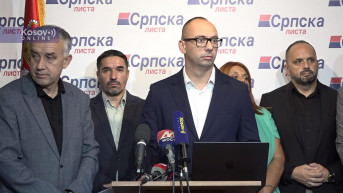
The Vice President of the Serb List, Igor Simic, emphasized today that the Central Election Commission (CEC) has adopted illegal and illegitimate decisions detrimental to the Serbian people and the Serb List, which is overwhelmingly supported by the Serbian community. According to him, these decisions concern the allocation of seats in polling station committees, as well as the number of registered voters in municipalities with a Serb majority. Simic announced that, due to violations of laws and CEC rules, the Serb List has filed a complaint with the Election Complaints and Appeals Panel (ECAP).
At a press conference, Simic presented specific examples regarding the allocation of committee seats and the number of registered voters in Serb-majority municipalities. He displayed a table showing a drastic decline in the number of voters in the upcoming local elections, compared to previous Kosovo elections, in Serb communities.
He pointed out that in the municipality of Leposavic, the number of voters was reduced by 1,508, and in North Mitrovica by 1,264.
“The largest number of voters has been removed from the polling center at the ‘St. Sava’ Elementary School, where the majority of Serbs cast their ballots, which can directly influence the election of the mayor and municipal councilors,” he explained.
Simic underlined that it was particularly striking that at the time when the international community was calling for steps to remove the mayors, the number of voters was on the rise, whereas now that number has clearly been reduced.
He further noted that in Zubin Potok the number of voters dropped by 379, and in Zvecan by 374, while in contrast, in Serb municipalities south of the Ibar River, the number of voters has increased.
“In Gracanica, the number of voters has risen by 10 percent, or 2,444 voters, although it is biologically impossible for so many people to suddenly reach voting age,” said Simic.
He recalled that the Serb List had previously warned of “strange developments” in Gracanica when discussions about local elections began, but they had not expected the number to increase to such an extent as to threaten the legitimacy of the elections.
Two days ago, the Serb List stated that, during a session of the CEC in Pristina, there was an attempt—by violating laws and electoral rules—to forcibly reduce the number of polling station chairpersons delegated by the Serb List, particularly in North Mitrovica and Gracanica, for the upcoming local elections.
Simic added that the CEC also refused to respond to questions raised by the Serb List’s representative within the Commission concerning the number of voters.
“Moreover, she was not even given the agenda in advance; it was handed to her five minutes before the session, leaving us no time to analyze it. Once we did, the data proved to be shocking,” he stressed.
He pointed to the paradoxical situation in Novo Brdo, where the Serb List had won 60 percent of the vote in parliamentary elections but will not hold a single chairperson position in any of the 23 polling stations.
“We are missing members in nine polling station committees, which means that in nine classrooms the Serb List will have no ability to monitor the electoral process,” Simic warned.
At the same time, he noted that the Self-Determination Movement, with 16.9 percent of the vote in that municipality, will have six chairpersons, the same number as the PDK and LDK, even though in the February elections they won just 5.8 and 10 percent of the vote, respectively. The Alliance for the Future of Kosovo (AAK), with only 1.7 percent of the vote, will nonetheless have five chairpersons.
Regarding Leposavic, he said that out of 25 polling stations, the Serb List will have only six chairpersons, despite winning 68.7 percent of the vote in the parliamentary elections. Meanwhile, the PDK, with just 0.36 percent of the vote, will have the same number of chairpersons. The Party for Freedom, Justice, and Survival—despite winning nearly 14 times fewer votes than the Serb List—will also have the same number of chairpersons in the October 12 elections, Simic emphasized.
He added that in Strpce, the Serb List will have chairpersons in only two of the 17 polling stations, while in six polling stations they will have neither a chairperson nor a member, even though they had won 60.6 percent of the vote in February. In that municipality, Self-Determination will have seven chairpersons despite winning only 12.8 percent, five times fewer votes than the Serb List. The Party for Freedom, Justice, and Survival will have the same number, even with six times fewer votes. The PDK and LDK will have twice as many chairpersons, although they had won only 7.59 and 3.23 percent, respectively.
Similar irregularities, he said, exist in Zubin Potok, where the Serb List will have chairpersons in only two of 15 polling stations, while in four they will have no members at all. Meanwhile, Self-Determination will have four chairpersons with only 5.5 percent of the vote seven months ago, and the PDK the same, with just 3.39 percent.
In Zvecan, despite winning 74.87 percent of the vote in February, the Serb List will have only three chairpersons out of 11 polling stations.
As the most blatant example of electoral manipulation, Simic cited the municipality of Partesh, where the Serb List will have only one chairperson out of seven polling stations, despite winning 89.16 percent of the vote in February.
“To make matters worse, Self-Determination, with only 0.25 percent of the vote, will have two chairpersons, as will the PDK and LDK, which did not win a single vote in the parliamentary elections. In that municipality, the CEC even changed the Municipal Election Commission, adding a member from an Albanian party who is not even a resident of that municipality,” Simic pointed out.
He also explained that in North Mitrovica, the Serb List will have only three chairpersons out of 22 polling stations, despite winning 56.21 percent of the vote.
“Self-Determination, with 13 percent of the vote, will have twice as many chairpersons, as will the PDK and LDK,” he added.
In Gracanica, out of 34 polling stations, the Serb List will not have oversight in 10 of them.
“This means we will not be able to monitor nearly one-third of polling stations, representing around 8,000 voters, on election day. We will have only four chairpersons, despite winning 68.51 percent of the vote. Self-Determination, with 5.68 percent, along with the PDK (2.84 percent) and LDK (2.95 percent), will each have seven chairpersons, while the AAK will have as many as six, despite winning just 0.49 percent,” Simic clarified.
He further pointed out that in Pec, out of 139 polling stations, the Serb List will not have a single chairperson and only two committee members. In Klokot-Vrbovac, they will have only two chairpersons out of eight polling stations.
“Although the Serb List duly registered and certified candidates in Klina, Istok, Lipljan, Kosovo Polje, Gnjilane, and Kamenica, we have neither chairpersons nor members in polling station committees in these municipalities. Clearly, someone did not want the Serb List to monitor the electoral process in the same way as other parties,” Simic observed.
He stressed that the composition of municipal counting centers is also to the detriment of the Serb List, especially in Serb-majority municipalities.
Since all of this, he said, runs contrary to the Law on General Elections, the Law on Local Elections, and CEC rules, the Serb List has filed an appeal with the ECAP.
He recalled that before the parliamentary elections, the ECAP had also ruled in favor of the Serb List, but the CEC did not amend its decision, claiming that deadlines had expired, leaving the Serb List unable to appoint other members or take any action.
“The deadline now is September 12. There is sufficient time for the ECAP to respond and for the CEC to implement its decision, as prescribed by electoral rules. The rules clearly state that the CEC must ensure fair representation for all communities in polling station committees, based on two criteria—the population size of the municipality and the votes won by each community’s political entities, at both Kosovo and municipal levels. We have now seen how the CEC applies these rules in practice,” Simic underlined.
He appealed to the ECAP to act urgently, for the CEC to amend its decision, and for the international community—particularly those engaged in election monitoring—to become directly involved in resolving this issue.
“This is not some minor decision; it is a decision that discriminates against the strongest Serbian party and constitutes an attempt at political engineering to prevent citizens from voting for their legitimate representatives and having them tomorrow in municipal assemblies or as mayors. There is a real danger it will be too late if no one reacts,” Simic warned.
He reminded that the election campaign had already begun with attacks on Serb List candidates, while investigations into two such cases are still ongoing.
“This is systematic and institutional violence aimed at preventing Serbs from having legal and legitimate representatives in local institutions,” he stated.
Answering journalists’ questions, Simic said that the Serb List reacted immediately upon learning of this formula.
“Our representative in the CEC first requested a pause to review the material, then called for compliance with CEC rules, after which attacks began from all Albanian parties. Without arguments or answers to concrete questions, they hurled a barrage of insults at our representative simply because she is a Serb and a member of the Serb List,” he noted.
He added that while the session was underway, the Serb List informed all international representatives of the problem so they could react, but two hours later the session concluded with decisions contrary to the interests of the Serbian people.
When asked what the Serb List would do under these circumstances, Simic said the party has an obligation to its citizens to fight, regardless of the conditions.
“We are obliged, first and foremost, to fight for our citizens who support the Serb List, no matter the circumstances, and no matter how unlawful the pressures may be. Everything the Serbian people endure under this regime, the Serb List endures. We have no right to give up this struggle. Let it be recorded, and let this be the answer to all those who claim that Serbs are welcome in Kosovo institutions—this is what it looks like when Serbs want to exercise their right to elect and be elected,” Simic emphasized.
He stressed that everyone who had the right to vote in previous elections still holds that right now, and appealed to citizens to check whether they are registered.
“I urge all citizens to check the CEC website to see where they vote. We ask everyone to do so because there is still time until October 12, especially in North Mitrovica and Leposavic,” Simic underlined.
He warned that there is a real danger that some citizens may have been removed from voter lists by administrative decision.
“This has nothing to do with the census, but rather with someone wanting to erase Serbs and insert their own people into municipalities so that power remains in the hands of those who have no legitimacy or legality to govern Serb-majority municipalities,” Simic concluded.


0 comments