
Sljuka: Serbs should be asked what a sustainable solution means to them to remain in Kosovo
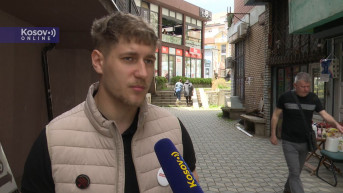
Aleksandar Sljuka, an associate of the non-governmental organization "New Social Initiative," stated that due to the changed circumstances on the ground, the further process of the Belgrade–Pristina dialogue should include the Serbian community to explain what a sustainable solution would be for them to remain in Kosovo.
"It would be most appropriate to ask the Serbian community in Kosovo what a sustainable solution is for them. We have seen that the entire Brussels dialogue process was conducted at a high level, where negotiations took place between representatives of Belgrade and Pristina, and where the Serbian community on the ground was largely neglected. Now, the topic of a sustainable solution is, we could say, a very complex issue," Sljuka told Kosovo Online.
Commenting on the statement of the EU Ambassador in Pristina, Aivo Orav, that the EU "wants to see a sustainable solution for the Serbian community in Kosovo," Sljuka assumes that this would most likely involve the formation of the Community of Serb-majority Municipalities (CSM), along with some additional concessions, such as the status of the Serbian Orthodox Church.
"However, the situation has changed significantly in recent years. The dialogue no longer has the same momentum; circumstances have changed greatly compared to the year when the Community was initially agreed upon. Especially when speaking about the north of Kosovo, many negative developments have occurred. We have seen numerous negative decisions made by the government in Pristina. Somehow, the Serbian community has come to realize that it is vulnerable, both in terms of security and in terms of access to everyday services," Sljuka explained.
This, he said, is evident from the closure of numerous institutions.
Therefore, he believes that the Serbian community in Kosovo now views a sustainable solution primarily through stronger guarantees than those offered through the Community of Serb-majority Municipalities.
"I believe that it would have to include clear, let’s call it, autonomy, particularly concerning the security sector, the police. We know that something similar was envisaged under the Brussels Agreement, but I believe that now the guarantees would have to be much firmer. On the other hand, access to everyday services, documents... People are currently most concerned about the closure of healthcare and educational institutions," Sljuka explained.
This, he emphasized, would also require clear guarantees."Guarantees that the Serbian community would be able to live and exercise its autonomy within the Kosovo system, where that system would not be able, at any moment, to abolish or usurp that autonomy in the way previous governments have attempted. I think we must enter new negotiations to define what a sustainable solution means and what would guarantee the survival of the Serbian community, especially since we see that with each passing day, it is becoming smaller and smaller," Sljuka specified.
Asked why the European Union, after 12 years of negotiations, has still not managed to implement a sustainable solution for the Serbian community, Sljuka offered several explanations.
"Some would say the EU is not interested, but I would say it lacks the strength to do so. At the beginning, when both sides wanted to negotiate and when both sides saw some benefit from the process, the EU could achieve results through the so-called 'carrot and stick' policy. But after the Brussels Agreement, the 'carrot' was used much more. Serbia began accession negotiations with the EU, and Kosovo, in the following years, signed the Stabilization and Association Agreement. So, there were concrete rewards that the EU could offer to the parties in exchange for their engagement in the Brussels dialogue. Over the years, such incentives became less and less present, and the parties no longer saw any incentive to engage decisively," Sljuka believes.
He sees another problem in the EU's inability to assert itself as a strong actor that, besides using the "carrot" policy, would also apply the "stick" and sanction actors who fail to respect agreements.
"We saw them attempt this in 2023. Those measures are still in place against Kosovo, but we also saw that the measures were not sufficient to significantly change Pristina's policies. The EU has capacities, but we must take into account that it is composed of numerous actors with different interests. Coordinating all of that is very difficult," the analyst said.
Regarding the EU-sponsored negotiations between Belgrade and Pristina, he also pointed out an additional problem — that five EU member states do not recognize Kosovo.
"The EU does not have a coherent, clear voice among its members to be able to act more actively. I believe that is the main problem," Sljuka concluded.

0 comments