
Sorensen: Kosovo Government should provide residence permits for employees and students for an initial period of 12 months

Peter Sorensen, the EU Envoy for the dialogue between Kosovo and Serbia, said at a press conference in Pristina today that the European Union considers it a key priority for the Kosovo Government to provide residence permits for employees and students affected by the Law on Foreigners for an initial period of 12 months, in order to prevent any disruption of health and education services.
EU Ambassador Aivo Orav said they had just held a meeting with Albin Kurti and expressed hope that all issues would be resolved as soon as possible so that the process of EU integration could move forward.
“At the meeting, we focused on the implementation of the Law on Foreigners, which will begin tomorrow. We had intensive discussions with the Kosovo Government, and today an agreement was reached on the implementation of the Law on Foreigners with several additional measures, especially regarding the registration of Serbian residents in Kosovo,” Orav said.
Sorensen said the EU welcomes Kosovo’s overall commitment to the rule of law and the government’s December decision to postpone the full implementation of the Law on Foreigners and the Law on Vehicles, which enabled a comprehensive and accessible information campaign for those affected.
“The EU has followed the efforts made to inform the public, as well as the preparatory steps taken by Kosovo institutions, and positively assesses the efforts made to ensure the orderly implementation of both laws. The information campaign is ongoing, and the necessary information continues to be provided at border crossings and at the airport, in accordance with the Law on the Use of Languages. The European Union takes note of the Kosovo Government’s plans to integrate into the Kosovo framework the health and education institutions supported by Serbia, fully in line with previous agreements reached in the dialogue,” Sorensen said.
He also stressed that the process should be implemented in close cooperation with the EU Special Representative for the dialogue.
“We take note of Prime Minister Kurti’s commitment to implementing the above-mentioned laws while at the same time ensuring the uninterrupted provision of these services within Kosovo’s legal system. Any process affecting these institutions requires time, should be inclusive, and must be confirmed within all relevant agreements reached in the EU-facilitated dialogue. The EU insists on structured consultations throughout the process with representatives of the Kosovo Serb community to ensure their consent,” he said.
He further stressed that in this context, the EU considers it a key priority for the Kosovo Government to provide residence permits for the employees and students concerned for an initial period of 12 months, in order to prevent any interruption of health and education services.
“To ensure the uninterrupted provision of services, the EU asks Kosovo to allow the use of identity cards issued by Serbia before March 15, 2026, for those living in Kosovo as a means of identification for administrative processes. At the same time, the Kosovo Government should register in the Central Civil Status Register of Kosovo persons who meet the conditions under Kosovo law, in accordance with their civil status facts,” Sorensen said.
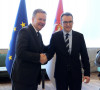
Kosovo Prime Minister Albin Kurti stated today that the process of implementing the Law on Foreigners and the Law on Vehicles will be carried out in close coordination with the EU Special Envoy for the Belgrade–Pristina dialogue, Peter Sorensen, as well as with representatives of local Serbs.
Kurti, speaking at a press conference after the morning meeting with Sorensen, said that no citizen should fear the implementation of the Law on Foreigners.
“The ultimate goal of this incorporation process is not to reduce any rights but to strengthen them. Accordingly, no citizen of Kosovo has the slightest reason to fear this process but should instead welcome the benefits it brings. The entire process will be carried out in close coordination with the EU Special Representative for the dialogue, but also in constant coordination with local Serbs. It is important for us that during the legalization process citizens of the Serbian community trust both the benefits of this process and the obligations arising from the Brussels agreements and Kosovo’s legal framework,” Kurti said.
He added that the government will ensure that there are no obstacles in the provision of basic services in education and healthcare.
“While ensuring that there are no obstacles in the provision of basic services in education and healthcare, the Government will begin the process of incorporating the education and healthcare systems into the legal framework of our country. The Government will receive lists from local leaders of academic and healthcare staff engaged in providing these services, and these lists will serve as the basis for issuing temporary residence permits for foreign nationals who apply to the Ministry of Internal Affairs,” Kurti said.
Kurti also added that Serbs in Kosovo who still do not have Kosovo documents will be allowed three months to use Serbian identity cards and apply for Kosovo documents.
“A new three-month window will also be opened for Serbian citizens. During this period, applicants will be allowed to use identity cards issued by illegal structures. The Kosovo Ministry of Internal Affairs will provide the necessary instructions enabling registration within the central system of the Republic of Kosovo,” Kurti said.


0 comments