
Szijjarto: Hungary opposes Kosovo's membership in the Council of Europe and the Srebrenica Resolution
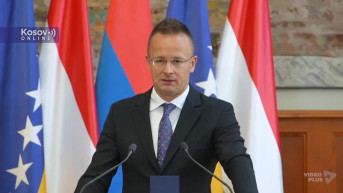
Hungarian Foreign Minister Péter Szijjártó stated today, following a meeting with Serbian Foreign Minister Marko Djuric, that Budapest is a strong ally of Belgrade and aims to bring Serbia closer to EU membership during its presidency of the Council of the EU. He emphasized that Hungary's stance is clear and that pressure on the country is futile - it is against Kosovo's membership in the Council of Europe until the successful conclusion of the Belgrade-Pristina dialogue, and it is also against the resolution on Srebrenica.
Hungarian Foreign Minister Péter Szijjártó emphasized that Hungary is preparing to take over the EU presidency, which Serbian Foreign Minister Marko Djuric welcomed.
"During our presidency, we aim to bring Serbia closer to EU membership. We are determined to open the third cluster of Serbia's accession negotiations. We consider it unacceptable and humiliating that the EU has kept Serbia in uncertainty for 15 years, with no new chapters opened in almost three years. Serbia has shown great enthusiasm, and we believe the EU needs Serbia's membership more than Serbia needs the EU. We call on EU members to end this hypocritical behavior and to clearly state why they have been blocking Serbia's progress towards EU membership," emphasized Szijjártó.
He also spoke about Hungary's stance on the upcoming UN General Assembly vote on the Srebrenica resolution.
"Next Thursday, the UN General Assembly will vote on the tragedy that occurred in Srebrenica, where there is an attempt to demonize the entire Serbian nation. Hungary will vote against it. Similarly, if the issue of Kosovo's membership in the Council of Europe arises, we will also vote against it. We have a principled stance that Kosovo can apply for membership only after the successful conclusion of the dialogue between Belgrade and Pristina," Szijjártó said.
Regarding Kosovo and Srebrenica, he stated that Hungary's position is clear, and international pressure is ineffective.
"The more pressure we face, the more determined we are in our stance. Some forget this and think pressure is effective, but it's futile. If there's an attempt to force us into actions against our national interests, it's pointless. We are firmly committed to the idea that Kosovo should apply for international organization membership only after the successful conclusion of the Belgrade-Pristina dialogue. Experience shows that any application for membership causes tensions that set the dialogue back by years," Szijjártó emphasized.
On the Srebrenica issue, he noted that no one denies the tragedy of the events there, but he does not want the UN to adopt a decision that demonizes an entire nation.
"This is a simplistic and unacceptable decision, and regardless of the pressures we face, we will vote as we have decided," stated the Hungarian Foreign Minister.
Szijjártó also highlighted the significance of Serbian Foreign Minister Marko Djuric choosing Budapest for his first official visit, underscoring the excellent relations achieved between the two countries over the past years. He added that the alliance, friendship, and cooperation between Hungary and Serbia are invaluable to Budapest.
"If anyone thinks this is an exaggeration, I will say that of all neighboring countries, Serbia provides the most rights to the Hungarian national community in Vojvodina. This includes the policies of the ruling party and in the executive branch. Hungary's energy security is in Serbia's hands because our gas supply comes through Serbia. So far this year, we have received two and a half billion cubic meters of Serbian gas. We have always been able to count on Serbia for stability and fulfilling contractual obligations," Szijjártó emphasized.
He added that the two countries expect excellent cooperation in the future.
"We will build an oil pipeline connecting the two countries, construct a state-of-the-art border crossing near Reske, and by the end of next year, we aim to complete both railway lines between Budapest and Belgrade, ensuring Serbia's energy security," Szijjártó stated.
In response to a journalist's question about the long-awaited visit of NATO's Secretary General to Budapest, Szijjártó said they would welcome him with great pleasure, and discussions have indicated he would visit at the beginning of summer.
"In the current situation, with a war in our neighborhood and migrant attacks, and the world in a state of flux, it is wise for NATO's Secretary General to negotiate individually with Alliance members. We expect him with great respect," concluded Szijjártó.



0 comments