
Vladisavljev: The Berlin Process and the Open Balkan are complementary initiatives, not competitive
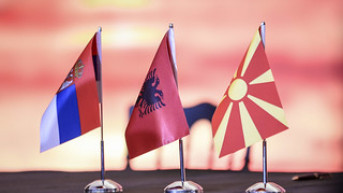
The Berlin Process and the Open Balkan should not be seen as competitive initiatives because they are complementary and have the same goal of promoting regional cooperation and connectivity among Western Balkan countries. This can only be beneficial. Whichever of them is applied, or if they are applied together, we can only benefit from these initiatives, Stefan Vladisavljev, program coordinator at the BFPE foundation says for Kosovo Online.
Tirana will host the Berlin Process Summit tomorrow, and considering recent statements by Albanian Prime Minister Edi Rama that the Open Balkan (OB) "has accomplished its mission to advance the Berlin Process", the question arises about the fate of the Open Balkan, in which Serbia, Albania, and North Macedonia are involved, and whether the Berlin Process will overshadow it. Vladisavljev says that Tirana has not withdrawn from the Open Balkan, at least according to clarifications heard from Edi Rama.
"At this moment, the Open Balkan is dormant. There are no obstacles to utilizing all the mechanisms it offers in a very short period of time if the need arises," our interlocutor said.
As he points out, different initiatives that facilitate regional cooperation are not necessarily competitors with each other.
"The fact is that within the framework of the Berlin Process as a pre-phase of European integration, cooperation at the regional level was enhanced around a decade ago. However, within that process, some insurmountable obstacles were also encountered. Since the Berlin Process (BP) concerns all six actors from the Western Balkans, one of these obstacles was that decisions were made by consensus. So, to implement something within the BP, all six actors must agree on it and make a joint decision. Given some bilateral tensions in the region, there was simply no agreement on all the decisions that were important for regional cooperation, creating the need for those states that want to move forward and can agree to move forward to find a way to do so. This is how the Open Balkan was created. It emerged as a response to the inefficiency of the Berlin Process and the impossibility of achieving all the benefits of regional cooperation through that consensus decision-making in which everyone had to agree for anything to be done," Vladisavljev says.
He believes that the Open Balkan is useful, especially because it can be "switched on and off" when needed.
"The Open Balkan is useful as an initiative because it can be switched on and off when you need it. Within the Open Balkan, you can reach an agreement, and move forward with your level of cooperation among three, four, or five actors from the Western Balkans. But when the Berlin Process is active, the Open Balkan is not necessary. So, I would say that these are not competing initiatives; I would say they are complementary, and each of these initiatives has its own advantages and disadvantages. But definitely, the Berlin Process has a form of institutionalization through some form of assistance from EU member states, while the Open Balkan is more of an ad hoc initiative owned by regional states that is used as needed, and its future depends on how much the Western Balkan states want to enhance their regional cooperation without major obstacles," Vladisavljev says.
As he assesses, currently, the need for the Open Balkan is less than it was some time ago, considering that Albania, which is hosting the Berlin Process Summit and is a member of the Open Balkan, is interested in the proper functioning of the Berlin Process.
"However, it can happen that some things agreed within the Berlin Process are simply not implemented because, for them to be implemented, Belgrade, Pristina, Sarajevo, and Podgorica all have to agree. Then we come back to a situation where representatives of Tirana, Belgrade, and Skopje meet and say, 'Well, maybe we can't do all this together; let's have our three states take a step forward within the Open Balkan initiative and sign some agreements or implement some decisions again'. Because that is the great advantage of the Open Balkan. When you want to do something and want to do it quickly and efficiently, the Open Balkan gives you that opportunity precisely because of this 'ownership' in the hands of the regional states, not some third-party countries or organizations," Vladisavljev explains.
Speaking about the reach of both initiatives, Vladisavljev highlights that the biggest achievement of both processes is a higher level of regional cooperation.
"At the time when the Berlin Process was established, we didn't have clear indications of when, or if, the Western Balkans would become a part of the EU. With the outbreak of Russian aggression in Ukraine, we got a new boost to the enlargement process, but it is still unclear which countries will become a part of the EU, how, and when. Therefore, it is necessary to promote regional cooperation in the field of the economy and in other areas of the social-political development of our region. The advantage of the Berlin Process is that all actors from the Western Balkans, all six economies, are included in it, and the fact is that if something is successfully agreed upon within the Berlin Process, it is applied across the entire region. Something that would be most popular across the population is the issue of roaming. When you travel to Montenegro, Albania, or North Macedonia, you can use your mobile phones without roaming charges, at least for a certain period. On the other hand, efficiency is associated with the Open Balkan. So, you don't need to have six members; there have been three until now. If they agree on something, they can implement it very quickly because there is both the political will and the economic benefit to implement those decisions," Vladisavljev says.



0 comments