
Vucic: Great expectations from the Tivat Summit; Costa: EU committed to Serbia’s European perspective
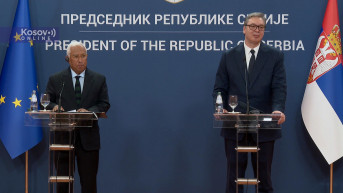
President of Serbia Aleksandar Vucic expressed gratitude to European Council President Antonio Costa for his visit and the open exchange of ideas and plans for the future, noting that this is of exceptional importance for a country on the European path. He also stressed that he has high expectations from the EU–Western Balkans Summit in Tivat. The President of the European Council, Antonio Costa, stated that he is in Belgrade to reaffirm the Union’s continuous commitment to Serbia’s European perspective.
“We spoke at length last night and this morning. For us, as a country on the European path that shares political and value-based positions with the EU, this is of exceptional importance,” Vucic said at a joint press conference with Costa.
Vucic emphasized that he has high expectations from the European Union–Western Balkans Summit in Tivat and hopes there will also be announcements related to the EU accession methodology.
“I am grateful to Antonio Costa because he has always been open to dialogue and willing to hear our side. I hope he at least partly understands Serbia’s position and our frustration over the fact that we have not opened a single chapter or cluster, primarily due to the conflict in Ukraine. Better times are surely coming,” the Serbian President said.
He stated that trade exchange amounts to as much as 58 billion euros and that the vast majority of imports and exports go to the EU. He added that exports are also growing and that Serbia accounts for 57.1 percent of the entire Western Balkans’ exports to the EU.
“This progress would not have been possible without European investments and free trade with Europe,” Vucic said, noting that EU member states are the largest investors.
Vucic added that it is important for Serbia to align with the rules the Union has prescribed for candidate countries.
He said they discussed various issues that have not yet received satisfactory answers, including the judiciary, REM, electoral laws, and ODIHR recommendations.
“As for the Venice Commission and the set of judicial laws, we will fully meet the requirements. As for REM, I have no idea how to solve that. Giving someone a majority in a body like that simply does not exist anywhere in the world. But I have learned a lot from Costa and understood that one must seek compromises every day, even when they seem impossible,” Vucic said.
He also noted that it is particularly important for Serbia to succeed together with Europe in the fight against organized crime and corruption.
I am going to Montenegro, it is important that I represent Serbia
Vucic announced that, despite warnings from the Security Information Agency due to security risks, he will attend the summit in Tivat.
“I received a written document from the BIA, I read it. I did not discuss it with Costa. I am going to Montenegro because it is very important that I represent Serbia. I will speak about other matters in Montenegro, to say directly where Serbia is portrayed as a small Russia,” Vucic said.
Regarding American investments in Serbia, he said that talks with the Americans are complementary to talks with Europeans.
“Will there be different views between the EU and the US? There is no doubt about that, but that is a question for them, not for us,” he added.
He also said that he handed Costa a written note concerning the steel plant, requesting that the issue be resolved through closer contact with the relevant European commissioners. In addition, he said that Serbian Prime Minister Djuro Macut raised the issue of transport operators at the delegation meeting.
“Serbia will remain on the European path,” Vucic stressed, adding that this was also the case when signing agreements with Chinese friends.
Costa: EU committed to Serbia’s European perspective
The President of the European Council, Antonio Costa, stated that he is in Belgrade to reaffirm the Union’s continuous commitment to Serbia’s European perspective.
“In times of geopolitical instability and uncertainty, enlargement represents an investment in peace, stability, security, and prosperity on our continent, for the benefit of all citizens of Europe and Serbia,” Costa said.
He noted that enlargement is based on trust, but that the path is clear.
“We must focus on three main priorities. First, fostering good neighbourly relations and regional cooperation, which are key to prosperity. Dialogue and the implementation of the Ohrid Agreement are crucial in this regard,” Costa said.
Second, he mentioned alignment with EU policies, especially foreign and security policy.
“These are not only principles we adhere to, but they form the foundation of our partnership with Serbia,” he underlined.
He also mentioned the implementation of reforms as necessary for progress on the EU path.
“We encourage you to continue working on reforms in the area of the rule of law and media freedom, where it is necessary to ensure a favourable environment and establish a new REM Council in a transparent manner, as well as reform the electoral law before the next elections in line with OSCE/ODIHR recommendations,” Costa said.
He welcomed the adoption of four laws, adding that it is also important to address other recommendations related to voter pressure.
“These reforms are not easy and must include the opposition and civil society. But they are worth every effort because they bring you closer to your goal, which is accession to the European Union. And we in the EU are here to support you in those efforts and bring Serbia closer to membership,” Costa said.
He underlined that the EU remains Serbia’s most significant partner in trade, investment, and strengthening democratic institutions.
“We want to do more, but the pace of progress depends on Serbia. The EU door remains open, but the time for decisive action is now. By working together, we will achieve our goal of ensuring that Serbia becomes a full member of the EU,” Costa said.
Responding to journalists’ questions, Costa recalled that on his second day in office, which he assumed in December 2024, he first met President Vucic and other Western Balkan leaders, and that from the beginning of his mandate the Western Balkans has been a key priority.
He noted that the enlargement process is not easy but is demanding and challenging for both the Union and candidate countries, as they must implement numerous reforms, transpose the EU legal order, reform institutions and economic structures, and align with foreign policy.
“This is a demanding process. It is not a matter of candidates on one side and the EU on the other. We have a common interest. We must work closely and honestly, solve problems, and deliver results. The accession process is merit-based and all countries must meet the criteria,” Costa said.
He stressed that the Union does not blackmail anyone or create obstacles.
“For us, enlargement to the Western Balkans is the most important geopolitical investment,” Costa reiterated.
Regarding the Tivat Summit, he said it is important to assess “where we stand and what we can do better.”
“Tomorrow European and regional leaders will discuss what we can do to move forward better and faster. If we want to strengthen mutual trust, we cannot create a sense of frustration on either side. It is necessary that everyone believes enlargement can become a reality in the coming years,” Costa underlined.
Regarding security risks in Montenegro, he said he is fully confident that the Montenegrin authorities, as hosts, will ensure the safety of the event and all leaders.
Asked about the importance of good neighbourly relations, he said it is a great advantage for all citizens to increase regional integration and that good neighbourly relations are key to EU membership.
“It is challenging to maintain unity among 27 countries, and it will be even more challenging among 33,” Costa added.
He noted that every bilateral issue should remain outside the EU.
“The history of the EU is a history of success because all members previously resolved their own problems and issues with neighbours. The EU is a peace project that grew out of the ashes of the Second World War. European integration is the best way to resolve such issues. I know that conflicts in this region are more recent than in other parts of Europe. But this is now an opportunity. We cannot work by looking backwards, we must turn our gaze to a shared future and security. It is necessary to have excellent relations among all six Western Balkan countries. I am confident that the accession process will be an excellent opportunity to overcome the past and focus on the future. I speak of overcoming, not forgetting,” Costa added.
At the beginning of his address, the President of the European Council expressed condolences over the death of a member of the Serbian Armed Forces serving in UN peacekeeping forces in Lebanon, who, as he said, lost his life while performing his duty in the service of peace.
Vucic hosted Costa at the Palace of Serbia, and after a one-on-one meeting, a meeting between the two delegations followed.
“An excellent and substantive conversation with Costa about the future of relations between Serbia and the European Union, the continuation of our European path, and key challenges facing Serbia, the Western Balkans region, and Europe as a whole,” Vucic wrote on Instagram after the one-on-one meeting with the President of the European Council.
He expressed gratitude to Costa for his personal engagement and willingness to listen to Serbia’s views, as well as for his support for the European perspective of the region.
“I am convinced that only through sincere dialogue, mutual respect, and joint work can we build a more stable, secure, and prosperous future for all citizens,” Vucic added.


0 comments