
Vucic: I believe in the possibility of cooperation and trade agreements

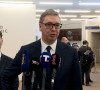
President of Serbia Aleksandar Vucic said today, commenting on the U.S. threat to impose a 200 percent tariff on French champagne and wines, that he believes in the possibility of cooperation and trade agreements.
Speaking in Davos, Vucic said he did not know what to say about the threat and that it would be better not to comment on it.
“This is certainly not good news for France. I believe in cooperation, trade deals, and free trade agreements. That is why we are signing as many agreements as possible with different countries around the world,” he explained.
Vucic said that a major visit to China is expected in May or June and that there is much work ahead.
He warned that there is a serious risk if an additional ten percent in tariffs remains in place and a further 25 percent is introduced should the Greenland issue remain unresolved, as this would affect Serbian companies producing automotive components.
“These companies employ around 90,000 people, and we cannot be exempt from that chain,” he said.
“They may be sparring among themselves, but the spillover effect exists for our country,” Vucic added.
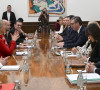
He noted that in Davos he met with the French energy company IDF, with which a memorandum has been signed on the development of nuclear energy in Serbia and a comprehensive approach to ensuring sufficient electricity supplies in the future, as Serbia plans to establish additional data centers.
Vucic announced that the President of Azerbaijan, Ilham Aliyev, will soon visit Serbia and expressed confidence that a gas supply agreement for a gas-fired power plant in southern Serbia will be signed.
“I believe we will sign an agreement on the gas power plant. We will add 500 MW to our system, which is a major step, as it does not depend on sunshine or wind, but solely on gas supply. With Azerbaijan, we are signing a contract for gas deliveries via the Bulgarian interconnector. This will be a gas power plant in the vicinity of Nis—a new economic driver in southern Serbia that will significantly reduce tensions regarding future electricity supply,” he explained.
Strengthening the Serbian Armed Forces to Protect Sovereignty and Ensure Peace and Security
Commenting on Serbia’s position in the latest Global Firepower Index, which ranked Serbia 63rd and Croatia 74th out of 145 countries, Vucic said that Croatia has a strong military whose capabilities are often underestimated, but that the Serbian Armed Forces are also strong and will continue to be strengthened.
“The Croatian Armed Forces deserve a better ranking, as do ours, because not everything we have was taken into account either. Croatia has a strong army, and no serious and responsible person should underestimate it. We underestimated it 30 years ago. Today, if nothing else, we are not foolish—although it is foolish to have to learn from one’s own mistakes. Still, better late than never,” Vucic said.
He stressed that the Serbian Armed Forces will be further strengthened to ensure peace and security for citizens and to deter potential aggressors.
“We must strengthen the military, and we are doing so. The Armed Forces will be better positioned—among the top 50 globally—which is extraordinary for a country of our size. We will invest heavily in armament and equipment, strengthening the military through substantial investments to protect our sovereignty, safeguard the survival, security, and safety of our citizens, and deter any potential aggressor,” President Vucic said.
OFAC Response to NIS Request Expected by Friday
Vucic said he expects a response from Office of Foreign Assets Control (OFAC) by Friday regarding the request submitted by Naftna industrija Srbije (NIS) for an extension of its operating license.
“Today, tomorrow, or the day after tomorrow,” he specified.
He expressed confidence that the documentation submitted by NIS would be sufficient, noting that everything requested had been provided.
“They said that the key elements of the contract needed to be submitted, and they are there. There are no secrets. We fully complied with everything they asked of us. I see no obstacle to the operating license being extended until the final conclusion of the contract,” Vucic said.
Responding to criticism of the adopted solution, Vucic asked what the alternative would have been.
“What option was there? To enter into a conflict with Russia, to undermine a traditional friendship maintained for centuries despite ups and downs, or four years without imposing sanctions? To seize their assets? What was the alternative, other than criticism?” Vucic asked, recalling that there were no problems in the country even though no crude oil entered Serbia for 100 days.
He added that Serbia had done everything within its power—ensuring full stability despite sanctions, respecting the wishes of the Russian owners, and increasing its ownership stake in the company.
0 comments