
Fotiou: Cyprus does not change its position on non-recognition of Kosovo; Serbia a key EU partner in the region
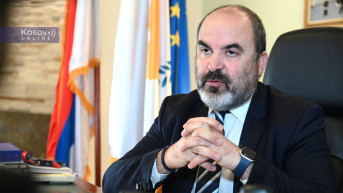
Cyprus’s position on Kosovo is clear and consistent – we have not recognized Kosovo’s independence because we are committed to international law and the Charter of the United Nations, and that position will not change, said the Ambassador of Cyprus to Serbia, Andreas Fotiou.
Fotiou, whose country assumed the Presidency of the Council of the European Union on 1 January, also stressed that Cyprus sincerely supports Serbia’s European perspective and believes that its future lies in the EU, noting that Serbia is a key partner for the EU and a key actor in the Western Balkans region.
“We would be more than happy if, during our Presidency of the Council of the EU, we were able to hold an intergovernmental conference,” the Cypriot ambassador said in an interview with Kosovo Online.
When it comes to the EU-facilitated dialogue between Belgrade and Pristina, Fotiou said that Cyprus, as the presiding country, will enable discussions in the Council of the EU whenever necessary and will appeal to all parties involved to engage constructively and implement everything agreed so far, while supporting the efforts of the EU Special Envoy, Peter Sørensen.
Cyprus is assuming the EU Presidency at a time of major geopolitical developments. How important and relevant are the priorities that Nicosia has set upon taking over the Presidency?
Cyprus is assuming the Presidency for the second time since joining the European Union. We have taken over the Presidency at a time of global challenges and change. However, since this is our second Presidency, we feel more confident and bear greater responsibility to act more effectively and to address the challenges ahead.
This is a time of profound geopolitical, economic, and security challenges for Europe. The Presidency will be guided by a strong sense of responsibility and the need to deliver tangible results to citizens. The motto we have chosen for our Presidency is “An Autonomous EU, Open to the World.” This sends the right message that the EU will become stronger, capable of standing its ground and proving itself on the global stage through strength and a focus on defending and protecting the interests of EU citizens. We will work on strengthening the EU’s strategic autonomy, enhancing economic resilience and competitiveness, advancing security, and promoting an active EU foreign policy.
At the same time, we attach great importance to enlargement policy. We see it as the only way to extend European values and principles across the entire continent. Naturally, the Western Balkans are a central part of these priorities. We view this as a strategic investment in European stability, security, and prosperity. The Cypriot Presidency will act as an honest broker, working closely with Member States and institutions to strengthen unity, dialogue, and consensus-building. Many wonder how 27 Member States can reach common decisions. Our strength lies precisely in that diversity, in the fact that despite our differences, we ultimately always manage to agree on a common position—often by consensus. That is the task of the Presidency: to act as a mediator in order to advance the implementation of the agenda.
To what extent do the war in Ukraine, the U.S. intervention in Venezuela, and U.S. demands regarding Greenland complicate the position of countries such as Cyprus and Serbia, which face challenges related to respect for their territorial integrity and sovereignty?
We are facing many challenges at the global level. The Presidency has the specific task of mediating discussions and facilitating decision-making. The presiding country will not impose solutions. Everything will always be in line with agreements and decisions of the Council of the EU. When it comes to issues of such importance as the situation in Venezuela or matters related to Greenland, the Presidency will always seek to preserve stability. Our priority is to protect our transatlantic relations. We will seek dialogue and mutual understanding. We will take our partner’s views seriously, but we also expect our partner to take our interests and positions seriously. For a country like mine, which is divided, we are always guided by international law. Our approach is based on international law and the UN Charter, and we will seek solutions and discussions within the framework of the United Nations.
Based on your experience, is it possible to join the EU with unresolved issues, or, as Brussels insists, is membership impossible until such issues are resolved?
Last December, Denmark, which held the EU Presidency in the second half of last year, attempted to reach agreement among Member States on conclusions regarding enlargement. In the end, this was not possible. The Presidency adopted its own conclusions. These include a specific reference to this issue and reflect the long-standing approach of the European Commission, which encourages partners to resolve their bilateral open issues and disputes in accordance with international law and succession agreements. Experience has shown that there is no automatic answer to this question, but many lessons have been learned. Unresolved issues make the accession process more difficult and politically sensitive. I can say this as a Cypriot as well. My country applied for membership as a divided state and was admitted as such, even though we aspired to resolve that issue. To date, we have not been able to resolve the Cyprus problem. However, the lesson is that there is always a need to resolve open issues, always in accordance with international law. Ultimately, a candidate acceding to the EU must be in a position to function as a normal Member State and to participate effectively in the EU’s decision-making mechanisms.
Would peace and stability benefit from the entire Western Balkans being admitted to the EU?
Cyprus has consistently emphasized its support for the EU membership of the Western Balkans. We have continuously supported the European perspective of the region. However, the accession process is an intergovernmental process, merit-based in nature. Each candidate country is assessed on its own merits, within different negotiation frameworks. This creates a situation in which Member States assess candidates based on performance and merits. This does not mean that the entire region will progress simultaneously at the same pace. We support the European perspective of the region, but in reality each country is assessed on the basis of its own merits. Candidates have different European paths depending on their performance. The more they deliver, the faster the process advances.
To what extent has EU membership helped Cyprus preserve stability and peace?
Accession to the European Union has placed Cyprus within a strong political and legal framework. The EU is the largest peace project in the history of the world. It is a privilege to be part of this Union, which offers institutional stability and economic resilience—particularly important for small countries in a very fragile region like ours. Accession has fostered a sense of security among citizens and predictability, strengthened democratic institutions, and reinforced the rule of law. We applied for membership taking into account our political issue, the fact that the country is divided. The greatest benefit of 22 years of membership has been the sense of security among citizens. Belonging to a large family of nations provides a stronger sense of security, especially given that we are only a few kilometers away from Turkey, which continues to occupy 36 percent of Cypriot territory.
EU membership has internationalized the Cyprus problem. The body of EU law and agreements applies to Cyprus and sets standards requiring that any solution to the Cyprus problem be in line with European law. Ultimately, Cypriot citizens cannot be treated as second-class citizens compared to others in the EU. The real added value is that all key EU elements—such as respect for international law and agreements—are now part of any future solution. This ensures that a solution must be compatible with European rules.
We must be honest: membership has not helped us reach an agreement as quickly as we would have liked, but it has significantly helped the negotiation process by introducing a European dimension. Ultimately, a solution will depend on the political will of those involved in the negotiations. We are fully committed to the framework of international law and the UN. The EU has supported the process and is ready to help, as we have requested. We call on all those involved in this issue to engage more with the EU, as we believe this will be crucial in achieving a solution that can be easily implemented on the ground—namely, the application of European law.
What is Cyprus’s position on Kosovo?
Cyprus’s position on Kosovo has been clear and consistent. We have not recognized the unilaterally declared independence of Kosovo because we are committed to international law, the UN Charter, and the need to respect the sovereignty and territorial integrity of Serbia. This position is well known and has not changed; it has been consistently and credibly maintained and will not change.
We support the European perspective of the Western Balkans region and believe that the EU has a stabilizing effect in the region. Engagement, dialogue, and, above all, efforts to align with European standards and policies are key to lasting stability and peace in the region. Cyprus, as the presiding country, will act as an honest broker in the Council of the EU, where we will support dialogue, regional stability, and remain committed to our principles and position regarding international law. We believe that the peace process will advance through the engagement of the parties. We have a Special Envoy for the dialogue whom we fully support.
To what extent can Cyprus, as EU President, influence the EU-facilitated dialogue between Belgrade and Pristina?
The Presidency will not replace or seek to overshadow the EU High Representative or the role of the Special Envoy for the dialogue, Peter Sørensen, whom we fully support. As President, we will facilitate discussions in the Council of the EU when necessary and appeal to all parties involved to engage constructively and implement everything agreed so far in the dialogue. Protecting and promoting the welfare of citizens will also be a priority. As President, we fully support the efforts of Special Envoy Peter Sørensen on this issue.
How can Cyprus help accelerate Serbia’s path toward the EU over the next six months?
Cyprus has always been a sincere supporter of Serbia’s European perspective. We have supported this process from the very beginning of accession negotiations. We believe that Serbia’s future lies in the EU. Serbia is a key partner for the EU and, of course, a key actor in the Western Balkans region. We recognize the efforts Serbia has made in recent years on its reform path. Much has been achieved, and we encourage reforms to continue, particularly in the areas of the rule of law, the judiciary, media freedoms, and alignment with the EU’s foreign policy. There has been significant progress in recent years, including in the economy. We want to encourage our Serbian friends to make an additional effort to implement further reforms in the accession process, and we are confident and optimistic that this will enable progress.
We would be more than happy if, during our Presidency of the Council of the EU, we were able to hold an intergovernmental conference. This can take place only if there are clear, tangible results on the ground.
During our Presidency, we will work to keep enlargement high on the agenda. We will ensure that the accession process is conducted fairly, on the basis of merit, and in line with established criteria. We believe that a credible enlargement process benefits first and foremost the candidates and their citizens, as well as the EU itself. I would like to send a message to our Serbian friends that we are always open, and that the Cypriot Presidency looks forward to registering tangible progress on the ground that would enable EU Member States to give their consent to the opening of new chapters.


0 comments