
Vucic: The lack of reaction could cause irreparable harm to the survival of the Serbs in Kosovo
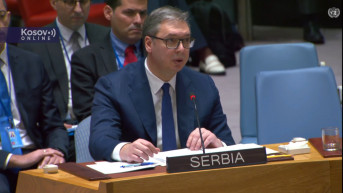
President of Serbia Aleksandar Vucic emphasized today, at the emergency special session of the UN Security Council convened at the request of Serbia, that current events could cause irreparable harm to the survival of the Serbs in Kosovo.
Vucic, in his address, emphasized the importance and necessity of holding an emergency session of the UN Security Council due to the current situation in Kosovo, which was contrary to the UN Charter and relevant Security Council resolutions.
"The interim institutions have created unbearable living conditions for the Serbs and are now carrying out systematic attacks on the Serbian population. The absence of an adequate response could cause irreparable harm to the survival of the Serbs. Serbia requested this emergency meeting because current events could cause irreparable damage. The reason we requested the session is the move by the Central Bank of Kosovo to ban the dinar from February 1st," he explained.
He added that with this decision, Pristina continued its attacks on the Serbs and other non-Albanian populations in Kosovo, as their survival was largely dependent directly on dinar funds coming from the Serbian budget.
"The data showing that the Republic of Serbia pays 60,946 salaries and pensions in Kosovo and Metohija from this budget, provides 2,430 scholarships for students, and finances public kitchens that meet the basic needs of around 2,000 of the most socially vulnerable citizens, show that this measure is primarily an attack on the Serbian population and makes the situation in Kosovo and Metohija difficult. These figures alone clearly demonstrate that a huge number of inhabitants in Kosovo and Metohija directly or indirectly depend on dinar income from the budget of the Republic of Serbia. Consequently, it is obvious that the ban on dinar payment transactions, or the abolition of the dinar as a means of payment, directly deprives a huge number of residents of basic personal means of living," Vucic said.
He also highlighted that 1,794 Serbian and non-Albanian agricultural households in Kosovo directly depended on dinar subsidies from the Republic of Serbia, while the survival of 922 business entities owned by Serbs in Kosovo, which were directly dependent on dinar payment transactions, was no longer operationally sustainable and possible.
"To sum up, by deciding to ban dinar payment transactions, Pristina directly prevents the functioning of all social, healthcare, educational, social, cultural, and other institutions that enable the Serbs to provide basic necessities for themselves and their families, educate themselves, receive medical treatment, buy medicine, and do everything else that is considered a normal life with a minimum of human dignity," Vucic said.
According to him, these institutions represent the basis for the formation of the Community of Serb-majority Municipalities, whose competencies and structure are clearly defined by the agreement signed in 2015, which precisely defines that Serbia has the right to finance the CSM.
Vucic emphasized that the decision of the CBK had been made within, as he said, the rule of law in Kosovo and in that sense pointed out two examples of how the rule of law was respected in Kosovo.
The first example is the disregard for the decision of the so-called Constitutional Court of Kosovo regarding the return of land to the Decani Monastery.
For eight years, they have refused to return the land to the Decani Monastery, the President of Serbia said, adding that it must be borne in mind that Decani was under the protection of UNESCO, KFOR, and that monks of the Serbian Orthodox Church lived there.
"In the context of the rule of law, I will give another example: the so-called judiciary that persecutes the Serbs and Serb returnees through false accusations of war crimes has decided that Azem Kurtaj, who shot a boy and his cousin on January 6, be acquitted, and he was not even charged with attempted murder of the child, but for disturbing public order," Vucic said.
He emphasized that since Albin Kurti had come to power in Pristina, the number of ethnically motivated attacks on the Serbs had increased, with the number increasing by 300 percent in the period from 2021 compared to the nine years before that.
He pointed out that the incidents were dramatic and highlighted that Dragisa Galjak and four other Serbs had been attacked with firearms.
"Since Kurti came to power in 2021 in Kosovo and Metohija, a total of 669 ethnically motivated attacks have been recorded, which is an increase of 300 percent. Kurti is leading the persecution of the Serbs, including incidents such as dramatic cases of police beatings and harassment of the Serbs, and the brutal shooting of Dragisa Galjak and four other Serbs," Vucic emphasized.
He says that the regime in Pristina is creating unbearable conditions for the Serbs, and the decision on the dinar, which is said to be within the framework of respecting the rule of law, is another in a series of mechanisms for creating intolerable conditions for the Serbs and their persecution.
He also noted that the euro had been adopted in Kosovo illegally, through a unilateral decision.
In that regard, he pointed out that the dinar was legal and as such could not be banned.
"Since Kosovo is a part of Serbia's territory under UN Security Council Resolution 1244, the dinar is legal," President Vucic said.
He emphasized that the decision on the euro as the currency was the prerogative of the European Central Bank and stated that it was clear that Kosovo had unilaterally used that currency and was only treated as the official currency by the population.
"This was done without any legal basis solely to create unbearable conditions for the Serbs and their persecution. This is just one in a series of planned, systematic measures that target the Serbian population with the aim of making conditions intolerable for the Serbs and their persecution," he emphasized.
According to him, the difficult situation in Kosovo and Metohija has significantly worsened since the elections in April last year.
He recalled that those elections had been held after the Serbs had left the institutions, after which attacks on the Serbian population continued.
Stating that the Serbs boycotted those elections justifiably, Vucic says that less than three percent participated in them.
"The elections were held in undemocratic conditions, illegitimate mayors were elected who took over municipal buildings with the help of armed forces. After that, symbols of Serbia were removed, symbols of so-called Kosovo were placed, and the Serbs working in public institutions were prohibited from coming to their workplaces. Peaceful protests by the Serbs followed, to which the Albanians responded and then 50 Serbs were injured on May 29 alone. There were also injuries to KFOR members, which is incomprehensible to us. Four Serbs were injured by firearms for which no one was prosecuted," Vucic emphasized.
He stated that after that, both Josep Borrell and Jens Stoltenberg, as well as countries that did not recognize Kosovo - Russia and China, and others, had directly accused Pristina of escalating tensions on the ground.
He states that at the meeting in Chisinau, he called for the signing of a petition for the dismissal of Albanian mayors and said that Serbs should not be pressured or humiliated and that the positions of those mayors make no sense because no one can be elected with three percent of the vote.
"Nobody wanted to listen and stop Kurti's crimes. Instead of demanding de-escalation from Pristina, we were asked to unconditionally participate in those elections that Albin Kurti didn't even intend to organize," Vucic said.
Vucic also recalled the requests to Serbia to reduce the number of Serbian Army members from the administrative border, even though their number had been smaller than in several previous cases, emphasizing that those requests had been accommodated, while Pristina, he noted ironically, had been sanctioned by being armed.
"When we asked which international document allows arming any armed force other than KFOR, we got the answer that those who did it were powerful, recognized Kosovo, didn't care about Resolution 1244, and could do whatever they wanted..." the President of Serbia pointed out.
He added that Serbia didn't mind when those arming illegal Albanian formations didn't speak about the territorial integrity of Ukraine, but it did bother when the territorial integrity of Serbia in Kosovo, guaranteed by the UN Charter and Resolution 1244, was not respected.
He stated that all efforts by Belgrade to find a solution with international partners had not borne fruit for de-escalation because, although the international community had identified Pristina as the culprit, it had not been seriously sanctioned.
He pointed out that terror against the Serbian community was intensifying, institutions were being closed, along with attacks on people, property, and the property of the Serbian Orthodox Church.
He cited data that in 2023 alone, 179 ethnically motivated attacks on Serbs had been recorded, with as many as 21 since the beginning of this year.
He emphasizes that it is institutional, physical, and structural violence, which includes armed formations raiding Serbian institutions and closing them, seizing money for salaries, and pensions, mistreating postal workers, healthcare workers... all, he repeats, illegally.
He warned that Pristina was increasingly openly using armed forces to repress the Serbs, adding that these formations were composed solely of Albanians, although their existence in Kosovo was contrary to Resolution 1244.
"Different armed forces have used disproportionate illegal force against Serbs 89 times since November 2022, including 39 incidents in the north. There have also been 38 incursions in the north, along with the illegal expropriation of private land belonging to the Serbs and the Serbian Orthodox Church. These armed forces carry out arbitrary arrests of the Serbs in these areas and other forms of violence - obstructing freedom of movement, stopping, mistreating, and humiliating, along with establishing illegal bases," Vucic said.
He recalled that according to Resolution 1244, armed forces in Kosovo must be demilitarized, meaning they should be banned and disbanded.
He emphasized that just last year, over 14 percent of the Serbs had left Kosovo.
"Tragically, Pristina is taking actions while the dialogue continues," Vucic underscored.
He also recalled that Pristina had committed, through the 2013 and 2015 Agreements, to form the Community of Serb-majority Municipalities, which it persistently refused to implement.
"Instead of creating conditions for survival, we witness planned, systematic measures that create unbearable living conditions and make the physical survival of the Serbs in Kosovo and Metohija impossible," Vucic stated.
The President of Serbia thanked the US and the EU, as well as traditional friends from the East, for their reaction.
"The seizure of funds intended for salaries and pensions, and the prosecution of people who legally transferred funds undoubtedly shows that statements are not enough to stop Pristina and discourage it from destabilizing the region. Demanding a delay in implementation is not the correct path because it encourages Pristina to continue with unilateral measures. The solution to this crisis and all others created by Pristina can only be a clear order to immediately stop these measures aimed at persecuting the Serbs and discouraging Pristina from doing so," he said.
Vucic recalled that after the attacks on the Serbian community, Serbia had requested the return of a sufficient number of Serbian forces to assist international forces in protecting the Serbian population.
He said that Serbia called on the Security Council and international organizations that could influence the resolution of the crisis to take urgent steps to stop further persecution of the Serbs and create conditions for the continuation of dialogue.
Serbia, he added, would implement all agreements and take all necessary steps in accordance with international documents.
He especially thanked those countries that respected the UN Charter and international principles.
Ziadeh: Unilateral actions cause concern, neither decisions of CBK nor actions of Kosovo Police contribute to de-escalation
The Head of UNMIK, Caroline Ziadeh, presenting the report, pointed out that unilateral actions lately had raised concerns in Kosovo, adding that neither the recent decision of the Central Bank of Kosovo to abolish the dinar nor the actions of the Kosovo Police in recent days contributed to the de-escalation of the situation sought by the international community.
Ziadeh reminded that almost a year ago, agreements had been reached in Brussels on February 27 and in Ohrid on March 18, establishing a path to negotiations and mutual engagement, but their implementation had been slow.
She noted that in the local elections in northern Kosovo last April, mayors had been elected with only 3-4 percent of the electorate, followed by clashes outside the assemblies of these municipalities, resulting in injuries to citizens and 93 KFOR members. She also pointed out the events in Banjska on September 24, where there had been fatalities, and stated that an investigation was ongoing but facing delays.
"Despite the positive momentum at the end of last year, the success regarding license plates, energy, customs documentation, the Serb participation in petitions for mayor dismissals, unilateral actions within the political dialogue cause great concern," Ziadeh warned, adding that, regardless of justifications, these actions in the absence of clear and public communication had only intensified an atmosphere of mistrust.
She emphasized that on December 27, 2023, the Central Bank of Kosovo had adopted regulations stipulating that as of February 1, the euro would be the sole currency for monetary transactions in Kosovo.
"Very little explanation has been provided about this, although since 1999, the dinar has been used as the de facto primary currency for transactions in predominantly Serbian areas. Dozens of people have been affected by this, as well as the economy, which depends on their purchasing power. This disrupts payments to individuals in institutions funded by Serbia in Kosovo, as well as pensions, and social benefits... Small and medium-sized enterprises, healthcare services, kindergartens... everything will be affected because they have long received funds from Serbia," Ziadeh noted.
She mentioned that the particularly short notice of the decision's entry into force, as well as the access to those affected by the decision, posed concerns for local communities and international partners.
Despite the additional month of transition provided by the Kosovo authorities, not all issues regarding dinar transactions have been resolved, as trucks carrying dinars have been prevented from entering - on February 1, a truck carrying four million dinars was stopped in Peja, and the money was confiscated.
Ziadeh also highlighted that according to the Brussels Agreement from 2013 and 2015, the formation of the Community of Serb-majority Municipalities in Kosovo was prescribed.
"Decisions like the one about the dinar must take into account the impact on the affected population. Such actions escalate tensions," she said.
She added that on January 26 and February 2, the Kosovo Police had launched actions against institutions used by the Serbian community in the municipalities of Dragash, Peja, and Istok, as well as the Health Center in Pristina, where employees had been detained for questioning and then released.
"Neither the Central Bank nor the actions of the Kosovo Police have contributed to de-escalation, as international interlocutors have requested. In all statements, I emphasize the importance of the rule of law, free from political influence, but I also reiterate that all actions must be anchored in the principles of human rights. I will continue to urge Belgrade and Pristina to engage in good-faith dialogue so that the most sensitive issues can be addressed. The only way forward is anchored in the principles of human rights and compromise," Ziadeh said.


0 comments