
Vucic: The military alliance of Tirana, Zagreb and Pristina poses a much greater threat to Serbia than it appears
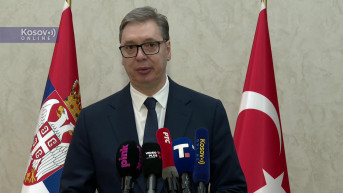
President of Serbia Aleksandar Vucic warned today from Ankara that the military alliance of Croatia, Albania and Kosovo represents a far greater danger to Serbia than it appears, as it is not intended for defensive, but rather offensive operations.
Asked to comment on a statement by the Croatian Minister of Defence that the “tripartite pact” poses no threat to anyone in the region, Vucic told journalists that this is not merely military cooperation as presented by the minister, but a military alliance.
He stated that military alliances are not formed to build ammunition factories or other equipment, as that constitutes military-technical cooperation.
“What we are talking about—especially when chiefs of general staff meet—they are not discussing procurement or weapons, but rather the strategy and tactics of military operations: how to conduct attacks, how to defend, what the possible offensive and defensive directions of movement are. When they say it is not a threat, the fact remains that it is a military alliance, and every military alliance is directed against someone,” Vucic explained.
He asked what Albania and Croatia need a military alliance for when they are already NATO members, noting that they included Pristina in order to make it clear to everyone that it is aimed against Serbia.
“It is a major threat to the citizens of Serbia and to the Serbian people as a whole—much greater than some may perceive. I have access to intelligence information, and I openly warn our citizens every day. I said this today to Erdoğan, and I say it to others as well. With great concern, I observe how this military alliance is gaining full momentum—from initial discussions about supporting the so-called ‘Shota’ combat vehicle in Pristina, with some purchasing and others equipping it, to joint military exercises and analyses of a supposed enemy,” he underlined.
Vucic stated that the alliance represents a much greater threat to Serbia than it appears, because it is designed not for defensive actions but for offensive operations in the event of developments in Eastern Europe.
He added that Serbian generals are fully aware of this danger.
“We will not attack anyone, nor will we form military alliances. But we are strengthening our capabilities at tremendous speed. We did not display everything at the parade, and in the meantime we have acquired additional assets. We will work intensively to ensure that we can deter any potential aggressor,” he emphasized.
Vucic pointed out that he has never received a rational answer to the question of why this military alliance was formed or for what purpose.
“When you ask our politicians, they say: ‘It doesn’t matter, the world will not allow it.’ Which world? The same world that took 14 percent of our territory and bombed us. Do you think this alliance was formed for no reason?” he asked.
He noted that the countries are integrating logistically, in intelligence and counter-intelligence matters, and—most importantly—are working on interoperability.
He told citizens they can remain calm—not because those countries lack serious intentions toward Serbia, but because Serbia is currently serious and strong enough to deter any potential aggression.
Today We Restored Serbia–Turkey Relations to the Path We Built Over the Years
Vucic also emphasized that today’s meeting with Turkish President Recep Tayyip Erdoğan has returned bilateral relations to the best path that had been built over many years, expressing confidence that Serbia–Turkey relations have a promising future.
“I have known Tayyip Erdoğan for a long time, and we have become sincere friends. We do not have to agree on everything, but we have never entered into personal conflicts. I believe that today we restored Serbia–Turkey relations to the best course that we had built in previous years,” Vucic told journalists, summarizing his one-day visit to Turkey.
He conveyed that they discussed all open political and economic issues and reiterated that he expects Erdoğan to visit Serbia in four months, hoping that they will then be able to jointly sign numerous agreements.
“We issued a joint declaration on peace and on a joint commitment to preserving peace and stability. I believe that Turkey and Serbia have good prospects and a positive future in bilateral relations,” Vucic said.
He expressed gratitude to his Turkish hosts for their hospitality, especially to the President of Turkey, who, he said, always wishes to show respect toward Serbia.
He added that by accepting the invitation to visit Serbia, Erdoğan demonstrated that he cares about good relations with Serbia, just as he (Vucic) cares about good relations with Turkey.
“We discussed many important issues in his office and reached several agreements—this is one of them. He will come to Serbia for two days. I believe there will also be other international guests, but we will discuss that later. I am confident that this will be an exceptionally important visit for Serbia,” Vucic stated.
In Munich, a Deeper Trench Between Europe and the United States Will Be Visible
From Ankara, Vucic will travel to Munich to attend the Munich Security Conference, where, as he announced, he has numerous meetings scheduled and will be able “to see, hear and conclude much about the future.”
“We will hear from Americans and Chinese, from Merz and Macron. I will meet with Chinese Foreign Minister Wang Yi, European Council President António Costa, Marta Kos and others,” Vucic said.
He assessed that the divide between Europe and the United States will become even clearer at the event, despite public affirmations of necessary and nostalgic transatlantic relations.
“The trench will be deeper, wider and larger than in Davos. Everything else will be secondary. Europe did not awaken because of Putin, but because of Trump—and whether it is too late, we shall see,” President Vucic concluded.

comments