
Vucic at the UN: Kosovo and Metohija is an inalienable part of Serbia; We expect all countries to respect our territorial integrity
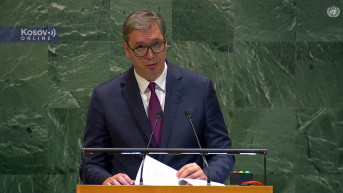
Addressing the United Nations General Assembly today, President of Serbia Aleksandar Vucic reaffirmed that Kosovo and Metohija is an inalienable part of Serbia, underscoring the expectation that all UN member states respect Serbia’s sovereignty and territorial integrity, while extending gratitude to the majority of countries that already do so. He called on the international community to take concrete measures to halt the violence against Serbs in Kosovo.
“Serbia will never forget its history, its people, and its sanctities. Kosovo and Metohija is an inseparable part of Serbia—the cornerstone of our identity, culture, and spiritual heritage. For us, it is not merely a piece of land, but the cradle of our spirituality and existence for centuries. We care, not only for moral and historical reasons, but also for profoundly human ones,” the President stated.
He highlighted the difficult circumstances under which Serbs in Kosovo live today, noting daily violations of their rights to life, free movement, education, healthcare, access to work, and property.
“They live in isolation. There are shortages of basic food and medicines; children grow up in uncertainty and fear. Their plight is not a local issue but one that engages the conscience of the entire international community and serves as a test of our readiness to stand with the vulnerable. If the violence endured by Serbs is tolerated, this will not bode well. We see ethnic violence against Serbs every day, of alarming proportions. They are being arrested, intimidated, deprived of property, and denied their linguistic, cultural, and educational rights. Their lives are made deliberately difficult, services denied, all with the aim of instilling fear and forcing them to abandon Kosovo and Metohija,” Vucic warned.
He urged the international community to take concrete steps to halt the violence and to safeguard the rights and security of all communities in Kosovo.
“Compassion alone is not enough—we need action,” he appealed.
President Vucic emphasized that, despite persistent and open violations of UN Security Council Resolution 1244, Serbia continues to believe in dialogue under the auspices of the European Union.
“Dialogue has no alternative—it is the only path to a just solution, in line with international law and with respect for mutual obligations. As in the past, Serbia will continue to fight for peace—patiently, methodically, and in good faith,” he affirmed.
He underscored Serbia’s firm commitment to upholding the core principles of the UN Charter:
“What we committed to eight decades ago applies equally to all—large and small, powerful and less powerful. With profound respect, Serbia continues to work tirelessly toward the implementation of international norms, despite facing double standards,” Vucic declared.
Reiterating that Serbia respects the territorial integrity and sovereignty of all UN member states, he stressed that Serbia expects the same in return:
“The majority already do so, and for this I am deeply grateful,” he said, noting that respect for the UN Charter is not a matter of choice, but a universal obligation.
“Territorial integrity is not a principle measured by power, but a principle that limits power. If applied selectively, it ceases to be a principle, creating not exceptions but dangerous precedents. Serbia knows all too well the price of such practices,” Vucic noted, recalling that Serbia had been the victim of NATO aggression 26 years ago, which opened a Pandora’s box, undermined international law, and placed the principle of territorial integrity into question.
He emphasized that Serbia respects global powers, but remains unwavering in its adherence to international law, convinced that its principles must be upheld consistently and without exception.
“Just as a drop of water shapes stone over time, so too can our persistence shape international law. Serbia will continue to stand for these principles, as only their respect can guarantee peace and stability,” the President affirmed.
He added that the UN is not a relic of the past but a compass for the future, noting that after 80 years it is time for reflection.
“Over the past eight decades, the UN has provided a framework for dialogue and solidarity among nations. Only through joint efforts can we build a future worthy of dignity and security,” Vucic stated.
He emphasized five core principles as pillars of Serbia’s foreign policy, the foremost being that the UN must not become an arena for the contest of great powers, but a round table where all members matter.
He reaffirmed Serbia’s readiness to cooperate with all partners on the basis of reciprocity, respect for sovereignty, and independence of decision-making, stressing:
“The UN Charter was written not for one moment in history, but to withstand the test of time. In an era of profound geopolitical changes, it remains the only framework that can hold us together.”
Vucic offered Belgrade as a venue for dialogue on global conflicts and reiterated that the peoples of the Balkans deserve to shape their future free from external interference.
“Thirty years after the wars, stability has become our greatest value. The peoples of the Balkans deserve the right to shape their future with mutual respect, cooperation, and without foreign meddling. Cooperation, dialogue, and trust are the key levers of international and regional relations,” he said, reaffirming Serbia’s commitment to stability in Bosnia and Herzegovina and the full implementation of the Dayton Peace Agreement.
The President stressed that Serbia remains a free, independent, and sovereign state making its own decisions, dedicated to peace, stability, and prosperity, including EU integration and strengthened relations with global partners.
“We believe that peace is the greatest value and the strongest foundation of development. Serbia will continue to invest its energy, knowledge, and resolve in building a more just and secure world for future generations,” Vucic concluded.
0 comments