
Vukadinovic: Pristina cultivates the legacy and cult of all quisling leaders from World War II
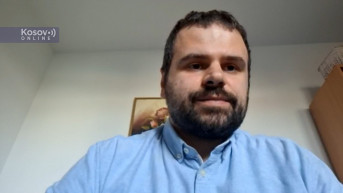
Historian Igor Vukadinovic told Kosovo Online that Pristina is nurturing the legacy and cult of Xhafer Deva and all other quisling leaders from World War II, adding that the West does not have a significant issue with the restoration of Deva’s house because it is "pragmatic and tends to use various extreme totalitarian ideas and ideologies to advance its interests."
Vukadinovic pointed out that Kosovo has streets named after Xhafer Deva in Pristina and other cities, as well as streets named after Mustafa Kruja, who was the Prime Minister of "Greater Albania."
"All of these figures were collaborators with the occupiers during World War II, and they now have a positive image and role in today's Kosovo society," Vukadinovic stated, commenting on the completion of the restoration of Xhafer Deva's house in South Mitrovica.
Vukadinovic added that Xhafer Deva was a direct collaborator with the Germans in Kosovska Mitrovica, participating in the Holocaust and crimes against Serbs. He explained that Deva was the main support for the occupiers in Kosovska Mitrovica until 1943, and after Italy's capitulation, he became one of the most important figures in all of Albania. He also served as the Minister of Interior of Greater Albania in 1943 and 1944, making "his role now absolutely clear."
"When it comes to Western opposition, it's obvious that some EU statements should not be taken too seriously—no one really does. The Western agenda does not have a significant problem with this move or others like it. After all, if the West truly had an issue with the fascist legacy and the crimes of Xhafer Deva, he wouldn't have lived in the United States for decades under American protection," Vukadinovic emphasized.
The historian Igor Vukadinovic recalls that, after the war, Xhafer Deva lived for some time in Turkey, Italy, and various other countries, before moving to the United States in 1956, where he cooperated with the American intelligence service.
"There is a report from the Albanian Ministry of Foreign Affairs from 1968, which states that the Americans encouraged Xhafer Deva to form the Third League of Prizren, an organization of extreme Albanian emigrants. The same reports mention that German intelligence services supported the League of Prizren, working toward the secession of Kosovo from Yugoslavia and the establishment of a second Albanian state in the Balkans. It is quite clear that he enjoyed the support and protection of the Americans during his lifetime, so the current stance is not surprising at all," Vukadinovic explains.
He adds an interesting fact: in 1977, Dragisa Kasikovic, a Serbian writer and fierce critic of the totalitarian regime in Yugoslavia and its methods, was brutally murdered.
"In a joint operation by the Yugoslav communist service and American services, he was killed in a brutal manner, while that same year, Xhafer Deva was living peacefully and calmly in America. So, they have no problem with Xhafer Deva, but they do have a problem with Dragisa Kasikovic, and with the remnants of the Serbian intellectual elite that opposed what was happening in Yugoslavia," Vukadinovic states.
He adds that people often have a naive, almost childish view of certain things, believing that European values are something that the European Union blindly follows.
"In practice, the European Union and its leading countries have no issue supporting neo-Nazis in Ukraine, with whose help they seized power in Kyiv in 2014, nor supporting the Islamic State in Syria, nor fiercely defending Stalin’s and Lenin’s borders and creations on the territory of the former Russia, nor just as passionately defending Broz’s legacy and creations on the territory of Yugoslavia. It is clear that the West is absolutely pragmatic in this sense and likes to use various extreme totalitarian ideas and ideologies to achieve its goals," the historian observes.
He emphasizes that Serbian media's focus on Xhafer Deva and the restoration of his house is problematic to him, "while at the same time, the media stands against the idea of Serbia finally abandoning the cult of Josip Broz."
"The current borders of the so-called self-proclaimed Republic of Kosovo were not determined by Xhafer Deva, but by Josip Broz. In my opinion, that is the much bigger problem. We still have, in our own country, the totalitarian and anti-Serbian legacy of Josip Broz," Vukadinovic argues.
In his view, symbolic gestures like the restoration of Xhafer Deva’s house are less significant than other moves that have been intensively undertaken in Kosovo over the past 10-12 years. However, he notes, "the public often reacts much more to these symbolic moments, like the Ibar Bridge."
Nevertheless, he reminds that in the past year, there has been a deterioration in the situation, with intimidation and arrests in the north, aimed at encouraging the departure of as many Serbs as possible.
"Those are the main problems now: the endangered security of people in northern Kosovo and the feeling of abandonment. In this context, Xhafer Deva is the least of their problems. They have many Xhafer Devas around them today, both in the West and in the region," the historian concludes.



0 comments