
Vuletic: European elections shifted Kosovo out of EU focus, key role could be taken by the US
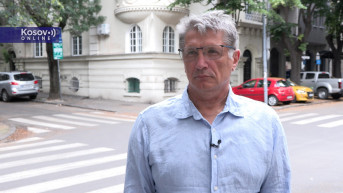
Sociologist Vladimir Vuletic assesses for Kosovo Online that after the European Parliament elections, there will be no significant shifts in policy, but internal problems of EU countries will push the Western Balkans to the back burner. He expects the same regarding Kosovo, not excluding the possibility that the key role will again be handed over to the United States.
“There is a lot of talk about Europe's shift to the right. There is no doubt that, regarding the European Parliament, there have not been any dramatic major shifts that would affect either personnel or generally European policies on key issues. Thus, there will be no change in the approach to the war in Ukraine, nor in the relations within the European Union, so when it comes to those key policies, there is no reason to expect any turnarounds,” Vuletic says.
He notes that the more significant shocks for Europe are within individual, primarily leading EU countries, and he believes they will lead to less interest in regional issues in the Balkans.
“They will primarily deal with their internal issues. We see that parliamentary elections have already been announced in France, the ruling coalition in Germany is significantly shaken, so we can expect less interest in the idea of expansion. On the other hand, when it comes to issues that concern us the most, primarily Kosovo, we might expect a decreased focus and the key role to be handed over to the United States again, as has been the case before,” Vuletic states.
Commenting on current geopolitical circumstances, he assesses that they do not change so quickly and that the West’s idea is “to fragment this area to the extent that it is easier to control.”
“This generally does not suit Serbia. Serbs are the largest ethnic group, they are territorially dispersed, but we see that this policy has already led to Serbs almost no longer being a significant political factor in Croatia. Montenegro and Serbia have separated, making the position of Serbs in Montenegro more difficult. Today, it is somewhat different and better than it was before, but let’s remember that this change is always possible. So, Western policy, not because they like or dislike someone more, ultimately they don't care, but primarily they are interested in having small, as small as possible states,” the renowned sociologist says.
He emphasizes that in this sense, the topic of not allowing the creation of a "Greater Albania" is also current today.
“As if it is some kind of consolation for Serbia, which considers Kosovo and Metohija as its inseparable part. In this sense, I fear that we cannot expect any significant benefits from changes,” he adds.
Potentially, what could affect this region, he assesses, would be Donald Trump’s victory in the US elections.
“Let’s remember that towards the end of his term, Mr. Grenell and he already had a certain plan for this region, for relations between Belgrade and Pristina. It was never formalized, but it is roughly known what that plan was based on, which is significantly different from what the current administration is trying to implement,” Vuletic says.
In this context, he believes, one should understand the idea, informally launched by American professor and analyst Edward Joseph, that the US could send a special envoy to the Balkans for the issue of recognizing Kosovo.
“Honestly, we have already had many envoys here, albeit not focused on just one issue, but on general stabilization, and I think this is more of an idea, that is, how should I say, a trial balloon. But if something like that happened, it would mean that the United States' primary interest is the recognition of Kosovo. I am not sure that in this election year it is exactly so. Even if it happens, there is too little time, only a few months, and the tasks before such an envoy would be enormous,” Vuletic concludes.


0 comments