
Attacks on Serbian holy sites in Kosovo – between physical destruction and historical revision
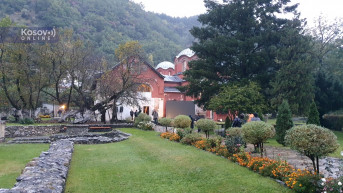
Art historian Jasmina Ciric assessed that the latest attacks on churches and religious buildings in Kosovo are new, but that the tactics being applied on the ground are old and well-known. Although some monuments are under UNESCO protection, the professor believes that the international public is not sufficiently informed about the situation on the ground, RTS reports.
In a series of incidents recorded in recent days in Kosovo, Serbian Orthodox churches in Dobrotin and Gornja Gusterica were broken into and damaged, prompting reactions from the Office for Kosovo and Metohija and the Ministry of Culture of Serbia.
The competent authorities warn of the continuation of a wave of attacks on Serbian spiritual and cultural heritage, while experts point out that, in addition to physical attacks, a struggle is also being waged over the interpretation and appropriation of history.
Jasmina Ciric, professor at the Faculty of Philology and Arts in Kragujevac, art historian and expert on Serbian medieval heritage, stated in an interview that the latest attacks on churches and religious buildings in Kosovo are new, but that the tactics applied on the ground are old and well known, RTS reports.
The professor emphasizes that this is not merely about criminal acts, but also about serious violations of the Law on the Protection of Cultural Property of the Republic of Serbia and international law. Every attack on endowments, whether medieval monuments or more recent buildings, represents an attack on the cultural and religious heritage of the Serbian Orthodox Church, she adds.
According to her, the method of attacks can be traced over a long historical period. She recalls that this year marks 45 years since the fire at the Patriarchate of Pec, set during the night between March 15 and 16, 1981, at a time of escalating crisis in Kosovo.
This was followed by the events of 1999, the adoption of Resolution 1244, and the later March pogrom of 2004, when numerous monuments were severely damaged or destroyed.
“In Resolution 1244 itself there is no specific article referring to the protection of cultural property,” Professor Ciric points out, adding that protection mechanisms were strengthened only after major destruction.
Material destruction and historical revision
According to the professor, physical attacks often go hand in hand with attempts at historical revision.
As an example, she cites the attempted takeover of the church in Rakinica near Podujevo, as well as the destruction of the remains of the Church of the Virgin of Hvosno, also known as “Little Studenica,” established as an eparchy by Saint Sava.
“When the material trace is destroyed, space is opened for changing the narrative,” she explains, emphasizing the importance of archival materials and documentation, such as the drawings of architect Milos Sekulic kept in Belgrade.
She particularly points to the “destruction” of frescoes in the Church of the Virgin of Ljevisa and in Gracanica during the 2004 pogrom, when donor portraits of King Milutin with clear inscriptions of his royal title were damaged. “When a donor fresco is set on fire, it is clear that this is an attempt to erase historical testimony,” she stresses.
“Albanization” and “Kosovarization” of heritage
Speaking about processes she calls the “Albanization” and “Kosovarization” of Serbian holy sites, Professor Ciric explains that this involves altering the historical narrative.
At certain universities in Pristina, she notes, there is a historiographical current of scholars who, with the support of part of the international academic community, seek to present Serbian medieval heritage as part of a different cultural context. As an example, she cites social media posts in which Gracanica is presented as an “Albanian basilica” allegedly restored by King Milutin.
“That is the Kosovarization – when exact scientific data are replaced by constructions that have no foundation in sources,” Ciric emphasizes.
The role of UNESCO
Although some monuments are under UNESCO protection, Professor Ciric believes that the international public is not sufficiently informed about the situation on the ground. The delegation of Serbia in international institutions, she notes, is making efforts, but better coordination is necessary.
As one of the key steps, she sees stronger cooperation between the Ministry of Foreign Affairs, the Ministry of Culture, religious institutions, and the academic community. She particularly emphasizes the importance of publishing scholarly works in world languages.


0 comments