
Bishop Sergije: Christmas is a message of love and sacrifice, Serbs of Kosovo and Metohija have been bearing witness for centuries
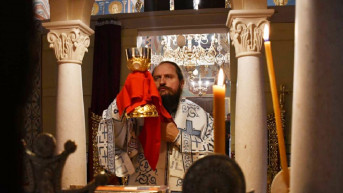
Christmas is a holiday that testifies to love above sacrifice and the sacrifice that affirms that same love. Within this act, where love is both the starting point and the destination, lies the unveiled mystery of Christ's Birth. From it, we draw the only possible message: we are created in love, we exist through love, and love, within us and among us, is the only path of our historical journey. Everything else leads astray and will not take us into the embrace of Christ the Lord. The Serbs of Kosovo and Metohija bear the best witness to this, Bishop Sergije of Bihac and Petrovac said in a Christmas interview with Kosovo Online.
Bishop Sergije emphasizes that Christmas, along with Easter, is the "cornerstone" of world history and that from these two holidays "everything Christians believe, hope for, and strive toward" originates.
"These are faith, hope, and love, which have their source in the person of the God-Man, Christ. If we have these three virtues that should adorn every Christian, then we will love God and our neighbors, and then the Lord will recognize us as His disciples. God does not demand the impossible from us, but rather that we do what we can, that we are and remain human. Therefore, we must remember every day that we will one day stand before the Face of the Lord, so we should behave as if that will happen tomorrow. Let us be human, let us be sincere Christians, and in doing so, we will gain the Kingdom of God," Bishop Sergije stressed.
Troubles – the centuries-long companion of the Serbs
Describing the current situation of the Serbian community in Kosovo, he highlights that "troubles have been the centuries-long companion of the Serbs on their historical path."
"For our people, life is not easy anywhere, and especially not in Kosovo and Metohija. This is not a recent development – troubles have been our companion on the historical path we tread. This makes us stronger than we would be if everything were ideal. Therefore, it is important not to complain about our fate but to do what we can within the given circumstances," the bishop said.
Quoting Saint Peter of Cetinje, "He who does as much as he can has done as much as he ought," Bishop Sergije emphasizes that Serbs in Kosovo, as well as in other parts of the former Yugoslavia, from Dalmatia, Lika, Slavonia to the western regions of Bosanska Krajina, understand this well.
Thus, he notes, they do not need messages of support because their lives and perseverance send those messages themselves.
"They do not need our message; their life and perseverance are the best message for all of us. The best messages consist not of words but of deeds they perform. Let us look up to them and be more thankful to God for what we have, and that is, above all, freedom in peace and peace in freedom," Bishop Sergije said.
When asked whether the situation for the Serbian community in Kosovo could deteriorate further, he observes that "it is hard to imagine things getting worse," but he also doesn’t expect any dramatic improvement in their living conditions.
"It is what it is, but they know best how to cope with all difficulties. War is the worst option, but we hope that those who make decisions will act with reason to prevent war. Still, we should not be naive to think that everything will unfold as we wish," the bishop said.
The strength of a crucified people
He states that the strength of Serbs in Kosovo lies in the fact that troubles make them stronger.
"Caution is needed, so life must proceed with that caution, and for the rest, we trust in God’s will. This is nothing new. Life has been like this for centuries. Those who endure will become stronger than anyone thought possible. This is the strength of our people in Kosovo and Metohija, our crucified, martyred people of whom we are rightfully proud," the bishop emphasized.
Commenting on the increasingly unilateral actions by Pristina authorities and the international community’s response, Bishop Sergije notes that this reflects the fact that Kosovo is no longer a focus of global politics, which is why "the suffering of the Serbian people is going unnoticed."
"New hotspots have emerged, geopolitically far more significant for the future of humanity. On one hand, this is good because Kosovo and Metohija are no longer the most important playground for global schemers. On the other hand, the suffering of the Serbian people is flying under the radar of European politics. The life of Kosovo-Metohija Serbs unfolds within this gap, so it is difficult to expect understanding and help from the West, as they have never truly provided it," the bishop warns.
He observes that attempts to appropriate the cultural and historical heritage of the Serbian Orthodox Church and the Serbian community "are not new," but he is confident that Europe knows the truth, making this an "ultimately futile battle for those seeking to rewrite the past."
"The attempts to seize our spiritual and cultural-historical heritage are not new, but they are unlikely to succeed because Europe and the world know the truth, even if it may not seem so today. It is difficult to deceive educated and informed people, so I believe this is a futile battle by those who want to rewrite our past, to claim our sacred sites, and to weave into their identity the heritage of those they persecute," Bishop Sergije of Bihac and Petrovac concluded.


0 comments