
Choir “Tsar Dusan” and vocal group “Mladost” preserve traditional Kosovo songs from oblivion
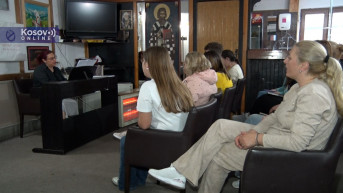
Traditional Kosovo songs are a precious part of the cultural heritage of the Serbian people. Through them, memories of important events have been preserved, the struggle for survival has been described, natural beauties have been celebrated, as well as great loves. Members of the choir “Tsar Dusan” from Strpce and the vocal group “Mladost” from Gotovusa strive to preserve the traditional songs of their region and present them to a wider audience through performances.
The choir “Tsar Dusan” from Strpce, in addition to spiritual and patriotic songs, has in recent years also cultivated traditional Kosovo songs in its repertoire.
Choir conductor Aleksandra Spasic points out that these songs depict the circumstances of life over many centuries.
“Kosovo and Metohija is a region extremely rich in musical heritage, and we can boast of its inexhaustible wealth. Every song has a purpose and a reason for being performed. We have songs connected to spinning gatherings, social gatherings, dances, work songs related to field labor, and wedding songs that remain relevant and popular even today. The people knew how to sing about everything that constituted life circumstances through time and centuries, and even today. It is a vast body of material. We have people engaged in researching, recording, and analyzing these songs. It is an honor and a pleasure for us to perform them,” Spasic said.
She also emphasized that the Sirinic region has a large number of songs that remain little known, and that eminent experts from Belgrade have been working for years on discovering the traditional songs of this area through kaval-playing and singing workshops accompanied by the kaval.
“There is a large number of songs, and I discover and learn about them every day because I live here. Through cooperation with colleagues from the Ethnomusicology Department in Belgrade, Sanja Rankovic and Mirjana Zakic, as well as Milos Nikolic, who leads the kaval workshops every autumn, I have learned that we have a very large number of songs that are currently neglected, and we are trying to bring them back into the repertoire by passing them on to younger generations, children who engage in singing, and they will carry them forward through their own knowledge and experience. It is interesting to me that this region has, in some way, been unfairly neglected when it comes to musical heritage. Although songs such as ‘Gusta mi magla padnala’, which are among the most popular and most frequently performed, are well known, we have a great number of songs that are very melodic, have interesting lyrics, and bear the stamp of the times in which people lived and worked. They speak of difficult periods and circumstances, both under Ottoman rule and during times of occupation. The people knew how to commemorate these experiences and leave them to future generations as a legacy that would remain a living, sung history,” Spasic said.
She also noted that Kosovo songs are highly requested at their performances and that choir members enjoy performing them.
“I am glad that the songs of Kosovo and Metohija are alive, because new times are coming and new types of music are now popular and heavily promoted. However, children, young people, and even the women in our city choir love performing them. Whenever we perform outside Kosovo and Metohija, in central Serbia, Bosnia and Herzegovina, audiences mostly request songs from Kosovo and Metohija, which makes me extremely happy. It was a challenge for me to include them in our repertoire. These songs will be arranged for choir performance in two and three voices, as much as our capabilities allow. They will not be performed in their original form, because Sirinić songs are traditionally sung in a single voice accompanied by the kaval, and that is what we preserve through our workshops. The choir, however, will perform them in a different way, and I hope audiences will enjoy it,” Spasic said.
The members of the vocal group “Mladost” from Gotovusa are true guardians of the traditional songs of the Sirinic region. Slavisa Dobrosavljevic emphasized that he is pleased they managed to save some songs from being forgotten.
“We started with the group rather late, about twenty years ago, and we should have begun earlier because we would have collected much more material. Many songs have already been forgotten. Nevertheless, we have preserved a great deal and rescued many from oblivion, but unfortunately we do not have younger members who could continue the work. I must first mention the song ‘Devojcice plavojcice’, which we performed at our first appearance, and then other songs followed, such as ‘Zaspalo mi kalince’, a traditional song, then ‘Ovce cuvam tri godine’, ‘Sto se beli Sar planina’, and ‘Oj kad ce prodjem Sar planinu’. The song ‘Zaspalo mi kalince’ is traditionally performed during the White Shrovetide holiday, and only in Gotovusa. Wherever we performed it, people showed great interest, and even historians from the Sirinic district became involved in researching it. They say it is a ritual song, with ‘kalina’ symbolizing the sun, and the song says, ‘Rise, rise, Kalina,’ which symbolizes the sun appearing only briefly during winter and being called to awaken in spring, when spring agricultural work begins,” Dobrosavljevic said.

0 comments