
A dictionary connected students from Pristina and Belgrade: Serbs and Albanians can be friends, they just don't know each other well enough
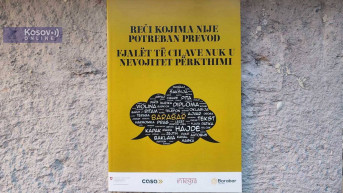
Based on the idea of the non-governmental organizations Center for Affirmative and Social Actions (CASA) and Integra, students in Pristina and Belgrade created a dictionary titled "Dictionary of the words that need no translation" which compiles words that are common in Serbian and Albanian. Their goal was to emphasize through words that Serbs and Albanians have much in common and that it is necessary to focus on what unites them rather than what separates them.
Eight people worked on the dictionary, including six students from the University of Pristina and Belgrade, among them Borivoje Lazic, and the author Nora Bezera and co-author Marija Orovic. Linguist Nora Bezera highlights that the first edition of the dictionary was done two years ago, and the second edition was presented on November 20.
"We had several goals through this project. The first goal was to bring together young people from the Serbian and Albanian communities in Kosovo, which we succeeded in. The second goal was not just the mere collection of words but to, through these common words, highlight our similarities and, in some way, facilitate communication among us", Bezera said.
She emphasizes that the Serbian and Albanian languages share a significant number of common words. According to her, most of them are inherited from the Turkish language, especially those used in culinary terms, while words from legal and technological terminology are mainly inherited from English, French, Italian, and other languages.
"However, in the second edition, we found some words that are of Albanian origin but are used in Serbian, or words of Serbian origin used in the Albanian language. For example, we have the word 'darovit' (talented). It is found in the Albanian dictionary, but it is actually the Serbian word 'darovati' (to give). Then we have the word 'gun' or 'gunj', a word that is first mentioned in Albania. In writings, it is considered to be of Illyrian origin, but it is also used in Serbian. It is a part of traditional clothing, perhaps an archaic word, but something that the Serbian language uses. There are many such words, for example, the word 'besa' is included. In Albanian, it is more of an institution than a word, a part of Albanian culture. However, Serbs also know very well what 'besa' is and use it, especially in Kosovo. Instead of saying 'I give you my word,' they say 'I give you my besa' for something they need to uphold, a promise", Bezera emphasizes.
Although reconciliation is a broad concept, Bezera emphasizes that working on this dictionary is certainly a small step towards it.
"I always like to quote Nelson Mandela, who said, 'If you talk to someone in a language he understands, it will reach his head, but if you talk to him in his native language, it will reach his heart'. Well, just that saying of his speaks volumes. Of course, it's regrettable that we communicate in the English language, which is culturally much more distant. Linguistically and culturally, we are much more similar, Serbs and Albanians, than English is to us. How will we overcome that? When we start socializing with each other and when we no longer live closed off in our communities", Bezera said.
Among those who worked on the dictionary was Suzana Maric from Novi Sad, who is studying Balkan studies at the Faculty of Philology. She is the only Serbian student at the University of Pristina.
"In general, all these ideas related to languages, culture, to intercultural dialogue are somehow the most interesting to me. I have attended various programs, and those related to languages, and therefore culture, have always been closest to me. So, the dictionary is interesting and very good because it has connected students from Albanology in Belgrade and students from Pristina in a very nice way, and they really collaborated very well. Those bright faces when we realize that we say the same word.... These are some small details that somehow make you happy. I have attended other training sessions and exchanges with different themes, but somehow, when it comes to culture or language, it connects young people much more. When they realize that they use the same words, only then do they understand that they have more similarities than differences when it comes to language. And through language, of course, you get to know culture", Maric said.
She decided to study Balkan studies at the University of Pristina because, as she claims, the Balkans has always interested her as a broader concept, including Balkan languages.
"I have always believed that we have more similarities than differences, perhaps because my parents and the rest of my family come from Bosnia, Croatia, and Montenegro, so it has always been connected for me. In Balkan studies at the University of Pristina, the Albanian language is my main subject, while for Albanian students, it is another language. But, besides that, we study the culture of other Balkan peoples and their languages. We will also have another Balkan language in the third and fourth year, we'll see whether it will be Bulgarian, Macedonian, or Greek, so it is, in a way, much more extensive, and I really liked it. Also, I wanted to learn the dialect, or Gheg, spoken in Pristina. I had many friends who graduated in Albanology in Belgrade and who said they understood nothing when they came here. It is a bit confusing because you learn one thing at the faculty, and then you go out on the street and hear something completely different. As for me, I can't speak fluently yet, but I can certainly understand very well", Maric said.
She emphasizes that she feels very comfortable in Pristina, and a larger number of high school students would choose to study at the University of Pristina, but there are administrative barriers.
"Perhaps someone would come for a master's, but the problem is diploma recognition. Also, there are young people who would enroll in Balkan studies, but there is an issue with the non-recognition of high school diplomas from the Serbian system in Kosovo. Of course, there are misunderstandings and fears, but a significant part is due to political moves that block certain things. So, for now, I am the only one. I mostly listen to myself, and my intuition. If I want to do something, I totally ignore what others tell me because somehow I know everything will be fine, as it is. I really haven't had any unpleasant incidents in almost two years of living in Pristina", she said.
The only thing she doesn't like, she adds with a smile, is that, as the only student of Serbian nationality in Pristina, she is often in the spotlight.
"I'm too much in the spotlight, that's the only thing I don't like. I think there are plenty of opportunities for young people here that they could take advantage of. This is something we shouldn't politically divide. There are certain areas where politics shouldn't go, and education is, in my opinion, one of them. There is really a lot to learn from a different perspective, and I find that very interesting. I would love for more young people from our community to be here", Maric emphasized.
Borivoje Lazic is a student of Albanology at the University of Belgrade. He says that one of their motives for creating the dictionary was to show that Serbs and Albanians have a lot in common and can be friends if they focus on what connects them rather than what separates them.
"We attended a workshop in Durres in May of this year. There were three of us from the University of Belgrade and three from the University of Pristina. We spent two days creating the second volume of the dictionary, and the first one came out earlier. It was very interesting for me because I didn't know that there were words that were the same in Serbian and Albanian. It was interesting to meet young people who are willing to work on this intercultural collaboration and work together on something to make the future, as well as the present, better", Lazic says for Kosovo Online.
He emphasizes that it was very interesting for him when he discovered that some words are completely the same and have the same meaning in both languages. Nymph, battery, tradition, whim, neighbor, legacy, ajvar, and epidemic, are just some of the 2,000 words with the same meaning in Serbian and Albanian.
"I found it interesting to discover the verb 'lafiti' (speak), which is not used much in standard Serbian but is used in the south. In Albanian, there is the same word, and I assume it comes from Turkish. It happened that we were talking about something, and then a colleague from Pristina pronounced a word in Albanian, and I would tell her that the same is said in Serbian. And then, literally, in the conversation, we came across even more words which neither she nor I knew were the same in Serbian and Albanian and had the same meaning", Borivoje says.
He adds that creating the dictionary for the young people he worked with was an opportunity to discover the connection between two nations that are geographically very close but, as he says, do not know each other well despite living side by side for centuries.
He says that the similarities are not evident at first glance and that to discover them, one needs to delve into the essence and "scratch beneath the surface".
"All this specifically meant to me to broaden my horizons but also to show the younger generation and our peers that Serbs and Albanians can be friends, that when they agree, they can create beautiful things, like this dictionary we made, which is for the benefit of all. The biggest problem for Serbs and Albanians is that they are geographically very close but don't know each other well. We don't know each other's languages. Serbs may only know some Albanian words in certain border territories. Albanians may know a bit more Serbian, but I think that's the main problem because we don't have enough mutual communication and don't have enough common ground. The average Serb living in central Serbia knows about Albanians only from the media, and those are mostly negative things. As we have seen, there are positive examples as well, and I would like our story to reach broader frames, for people to see that Serbs and Albanians can be friends, live together and that ethnic affiliation shouldn't matter because, in the end, we are all human beings", Lazic believes.
He says he is from Bujanovac and decided on Albanology as a life calling thanks to the music he listened to as a high school student.
"I fell in love with the language through music and decided to study it. The language sounded beautiful and interesting to me. I found out that there was a department in Belgrade, and I wanted to show that a Serb can speak Albanian, engage in Albanology, and have a good relationship with Albanians. I wanted to show that Serbs and Albanians can be friends and work together to improve our relations. A better future for us as two nations won't come out of the blue; we need to make an effort together to make that relationship better. I hope and believe that these relations can be better. We need to focus on the good things and leave behind what has separated us for years—politics, history—and just be humans", Lazic says.


comments