
The Eparchy of Raska and Prizren: Accusations against the Serbian Orthodox Church are spreading hatred, not the church's care for its sanctuaries
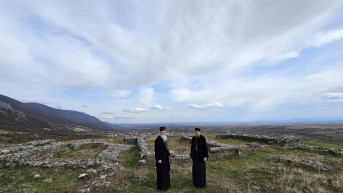
The Serbian Orthodox Church is not spreading hatred by caring for its sanctuaries, which are recognized in Kosovo's laws. Instead, it is those who accuse the church of this who are spreading ethnic and religious hatred, the Eparchy of Raska and Prizren emphasized in response to statements made by Alliance for the Future of Kosovo MP Beka Berisha. They further added that the damage to the fence around that location was a direct consequence of the hatred systematically spread against the Serbian Orthodox Church.
Berisha made accusations against the Serbian Orthodox Church following a visit by Bishop Teodosije and his associates to the archaeological site of the Monastery of the Mother of God in Hvosno in the Municipality of Istok on March 4, after which, as the Eparchy recalls, the site was attacked by unknown individuals who damaged the fence surrounding the complex.
Such accusations are rough and unfounded, the Eparchy stressed.
They also expressed ongoing concern for the Monastery of the Mother of God in Hvosno, as one of the significant historical sanctuaries of the Serbian Orthodox Church, which was included in special protected zones along with nearly 50 other SOC sites in Kosovo. The recent damage to this site indicates that church properties are still at risk and require protection, especially since there are no Serbs living in the area, and the location is not secured by police.
Regarding Bishop Teodosije's visit, they emphasize that it was organized with representatives of the EULEX Mission and in coordination with the Kosovo Police due to previous unlawful activities at that site.
"The complex of the Monastery of the Mother of God in Hvosno is registered under that name in the Law on Special Protected Zones adopted by the Kosovo Assembly, according to which, no activities or works can be carried out in the protected zones without the consent of the Serbian Orthodox Church and the Council for the Implementation of Protected Zones. This is clearly stated in the law, which unfortunately the Kosovo authorities often do not respect. Since Mr. Berisha obviously does not know the laws of Kosovo, although he is a member of the Assembly, he should be reminded that the law was enacted to protect the SOC facilities in Kosovo, which have been attacked and desecrated multiple times in previous years. That is why 45 locations were placed under the status of special protected zones, and those are locations of the Serbian Orthodox Church, as well as the entire village of Velika Hoca and the historical part of the city of Prizren, which includes several medieval Serbian Orthodox churches," the statement from the Eparchy reads.
They also recall that the history of the Monastery of the Mother of God in Hvosno has been researched several times both before and after World War II, and significant artifacts have been found, testifying to the complex history of that site - from an early Byzantine basilica from the 6th century to the 13th century when the facility was expanded and renovated, and the Monastery of the Mother of God in Hvosno became the seat of the Serbian Orthodox Eparchy in Hvosno in 1219.
From that period, valuable artifacts have been found, including the Rodop’s bell with a Serbian inscription, two antimension (liturgical cloths), as well as remains of a three-nave church, narthex, refectory, and towers. This valuable monument is extensively documented in medieval and contemporary literature because the center of this bishopric was an important Christian, cultural, and educational center in the region. At the end of the 17th and beginning of the 18th century, this structure was destroyed by the Ottoman authorities following an unsuccessful attempt to liberate the Balkans by the Austrian army.
Since then, the Monastery of the Mother of God in Hvosno has remained in ruins, but the Serbian faithful have often gathered and prayed to God at its ruins, a tradition that has continued to this day.
"Beke Berisha's accusations that our Church spreads hatred by taking care of its holy sites, which are designated as such in Kosovo's laws, actually represent expressions of ethnic and religious hatred themselves, but also indicators that the damage to the fence around this site is a direct consequence of the hatred systematically spread against the SOC and our spiritual and religious objects, more than 150 of which have been damaged or desecrated since the 1999 war by Albanian extremists," the Eparchy emphasizes.
Therefore, they appeal for the protection of this site and its proper designation in accordance with the name specified in the Law on Special Protected Zones.Top of Form
"Otherwise there is a possibility of further vandalism and historical revisionism being conducted by individuals from the Kosovo authorities, violating the basic principles of human and religious freedoms that exist in the democratic world," the Eparchy of Raska and Prizren warns.
Berisha, who is also the President of the Parliamentary Committee on Security and Defense, two days ago strongly condemned the visit of Bishop Teodosije to that location, stating that "the primary goal of the Serbian Orthodox Church was to spread many falsehoods and incite hatred in Kosovo."


0 comments