
Milicevic: Key problems facing the Serbian Community are political instability, economic conditions, and security
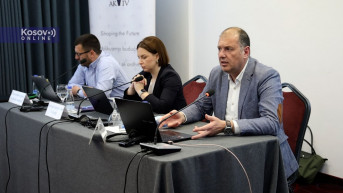
Miodrag Milicevic, Executive Director of the NGO AKTIV, presented in Pristina today the annual publication on the status, challenges, and outlook of the Serbian community in Kosovo. He stated that the research revealed a prevailing sense of pessimism among Kosovo Serbs, with the key issues being political instability, economic conditions, and security.
The study titled “Trend Analysis 2024: Attitudes of the Serbian Community in Kosovo”, published for the ninth consecutive year by NGO AKTIV, tracks shifts in public opinion among Kosovo Serbs, focusing on concerns such as freedom of speech, trust in politicians, and other critical matters. Milicevic emphasized that the research methodology remained unchanged.
One of the key findings, he said, is that as many as 91.2% of respondents from both the north and south of Kosovo believe that the situation is not moving in the right direction, and only one in ten thinks life for Serbs in Kosovo will improve in the next three years.
Milicevic highlighted political instability, economic hardship, and security issues as the central concerns.
“Trust in decision-makers is so low that 72.2% of respondents do not trust any political party. As for individuals, despite widespread distrust, many chose not to name names. Only 2.8% of respondents trust the Serbian List. One in three respondents from the north feels their safety is threatened, and 70.9% know someone who has left Kosovo. Only 25.8% believe the Community of Serb-majority Municipalities (CSM) will be established, while only 3.28% trust the media, and 67.6% did not participate in the census in northern Kosovo,” Milicevic reported.
He also noted that the study included a question on the impact of the Central Bank of Kosovo's ban on the dinar. The decision negatively affected 80% of people, while 8.7% were unaffected because they have no income in dinars.
Trust in institutions, Milicevic said, has remained unchanged.
“Only 2.49% trust the Government of Serbia, and 2.37% trust the Office for Kosovo and Metohija. These institutions enjoy the highest level of trust. There was also data on trust in KFOR, as well as a notable decline in trust in Russia — down to 44.7% in 2024, compared to over 69% in 2020. The Brussels Agreement has regained prominence as the only viable alternative, with a 10% increase in support compared to last year,” he added.
The research also addressed safety. Over the past five years, 18.1% of respondents reported feeling unsafe, 81.3% said they did not, and 66% said they knew someone who had left Kosovo in 2024.
Jovana Radosavljevic, Executive Director of the New Social Initiative, described the findings as devastating.
“The overall impression I got regarding the position of the Serbian community in Kosovo is one of deep disappointment — both politically and economically, as well as in terms of existential conditions. The results indicate a sharp decline in trust — in institutions, in the security situation, and in the opportunities this community can access in such a society. On one hand, we see institutional trust collapsing to alarming levels, and on the other, we have no political representatives who enjoy strong public support,” she explained.
She added that trust in both Kosovo and Serbian institutions, as well as in political representation, is extremely low, with the community feeling increasingly disconnected from these bodies.
Regarding the perception of isolation and insecurity, Radosavljevic emphasized that decisions made by the Kosovo government — which should have been part of the Belgrade-Pristina dialogue and concern both Kosovo and Serbian citizens living in Kosovo — have instead been moved into Kosovo’s internal political domain.
She also raised concerns about the Kosovo Police in the north, which many Serbs view as a threat rather than as a protective force — especially since Serbs withdrew from Kosovo’s institutions.
“The way the current government has handled the situation has only widened the trust gap between Kosovo Serbs and institutions. Life has been profoundly disrupted for Serbs in the north — and also in the south — as these measures weren’t limited to the north. The pressure and media spotlight were heavier in the north due to its symbolism, but the overall effect was not to improve lives but to complicate them further. Removing an institution without offering an alternative or a proper transition doesn’t solve anything,” she concluded.
Darko Dimitrijevic, Editor-in-Chief of Radio Gorazdevac, said the report offers clear indicators of where things are heading.
“I’ll be frank — even harsh — in assessing the causes and consequences. From the very start, the data is alarming: more than 90% believe things are not going in the right direction. Trust in decision-makers is low — only around 2% trust the Serbian List. In any normal society, such numbers would be a clear sign to politicians to take action. Unfortunately, we live in a highly populist environment, whether it’s the Serbian List, the Kosovo government, or the government in Belgrade — they all operate using similar methods,” Dimitrijevic said.
He noted that citizens feel extremely unsafe and that, although trust in the EU is increasing — especially south of the Ibar — a more decisive stance from the international community is needed regarding the rights and legal protections of Serbs.
“Despite all this extreme pessimism, we’re seeing a slight increase in trust toward Serbian-language media in Kosovo. Sadly, journalists face numerous challenges as they try to report the truth factually and objectively, but people are starting to recognize their efforts. Still, I’m not encouraged — we’ve had a few recent incidents in Gorazdevac. What bothers me is that people don’t trust the police enough to report incidents to them first; they come to us instead. That’s wrong, but it shows just how little trust they have in the police.
We also have a serious problem with the multiethnic composition of Kosovo institutions. In many of them, language rights are blatantly disregarded. The image presented doesn’t reflect real multiethnicity,” Dimitrijevic concluded.
The first survey was conducted in 2016 in four municipalities in northern Kosovo, and in 2019 it was expanded to include all municipalities and areas with a majority Serbian population across Kosovo.

0 comments