
Never to Forget: Memorial service marks 25th Anniversary of the murder of 14 Serbian harvesters
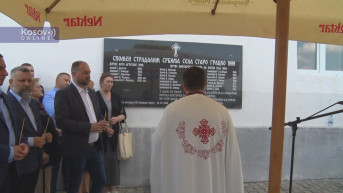
A memorial service, with candle lighting and wreath laying at the monument in Old Gracko, was held to mark the 25th anniversary of the murder of 14 Serbian harvesters. The families of the victims express that after a quarter of a century, they have lost faith in earthly justice and hope that the perpetrators will answer before God.
The memorial service was attended by the victims' family members, residents of Old Gracko, representatives from the Office for Kosovo and Metohija, as well as political representatives of Serbs from Kosovo.
Momirka Cankovic, a resident of Old Gracko, highlighted that families have been reluctant to speak to the media about the tragedy over the past decade because, as she said, they have been bearing a heavy burden for 25 years.
"I don't want this to sound like I'm justifying them, but 25 years have passed since the murder of their husbands, the mothers have unfortunately already passed away, so they cannot speak about how they feel and how they live without their sons. Those women bore a heavy burden on July 23, 1999, left alone with very young children. They have carried that burden for 25 years and have managed to educate their children and guide them on the right path. To me, all of them are heroic mothers. They don't want to speak because they no longer expect justice, and none of us from Old Gracko expect it anymore. If we thought 25 years ago that something might be done considering the military presence at the time, 25 years later, when the picture has become much clearer worldwide, we truly do not expect justice," emphasized Cankovic.
She stated that the people who perished, whom she knew, were honest and good hosts.
"Expecting justice from a world ruled by lies and deceit, where something is invented and then they bomb in the name of democracy... you cannot expect justice from such a world. Neither the families nor we expect it. The families are silent, and their message is very clear—they are expecting another kind of justice, divine justice, and so do we. Perhaps some of us will live to see this worldly justice, but only if the state of the world changes. As things stand now, there will be no justice for the murdered Serbs," Cankovic said.
Father Dragisa Jerenic, who served the memorial service along with other priests of the Raska-Prizren Diocese, emphasized that innocent people died simply for honorably and honestly bearing the cross given to them.
"People who die while going to gather bread to feed their families cannot be criminals, only martyrs, and we in the church always pray to the martyrs to intercede for us before the Lord. The most honorable among us perished, for God rarely allows criminals to suffer justly. It is the best among us who suffer justly, those willing to bear their cross and even die for it. There are few such people, and you are all witnesses that the harvesters were such among us," the priest said.
Igor Popovic, Assistant Director of the Office for Kosovo and Metohija, reminded that 25 years after the crime, the perpetrators and organizers have not been found, arrested, or convicted, despite the commanders of KFOR, responsible for security, declaring they would turn over every stone in Kosovo to find the killers.
"Although a large number of executors and organizers must have been involved in this crime, whose actions must have left numerous reliable traces, members of the international community, KFOR, and UNMIK allegedly could not find a single perpetrator or organizer of this crime all these years. They say there is no evidence, and these are representatives of Western countries and members of the civil and military mission of the international community who had all the military and civil power, and technical and logistical capabilities in Kosovo and Metohija, an area where everything is known. In an area where the statements of KLA commanders from November 1999 are clearly available, boasting of ethnically cleansing the Lipljan municipality through killings, kidnappings, beatings, and expulsions, and recommending themselves for similar actions in other Serbian areas like Strpce, where there are still many Serbs," Popovic said.
He emphasized that the then-head of UNMIK, Bernard Kouchner, described the crime in Old Gracko as an act of "understandable Albanian revenge."
"Unfortunately, it is clear that we cannot expect the international community to punish this crime," he said, adding that it is up to the Serbs to seek earthly and divine justice.
"We must keep the memory of the murdered Serbs from Old Gracko alive, continually commemorate such events, and never allow this crime to be forgotten. We must constantly remind the international community and institutions in Pristina that the crime remains unresolved and unpunished," Popovic said, emphasizing that the Republic of Serbia and the Office for Kosovo and Metohija bear great responsibility to ensure that the sacrifice of the villagers of Old Gracko is not in vain.
Dalibor Jevtic, Mayor of Strpce and Vice President of the Serbian List, stated that the message of July 23, 1999, when those who went to the field were killed, was very clear—"that they are not welcome here and that someone wanted not just Old Gracko but the entire Kosovo and Metohija to be free of Serbs."
"This is not the only crime that remains unsolved and without justice, but it is our duty, not only through persistent questioning of who and why killed the 14 harvesters, to resist and not allow the ultimate goal of those who committed it to be achieved, which is for us to leave these areas, for us as a people not to be here anymore," Jevtic said.
He recalled that on July 22, 2018, as Deputy Prime Minister and Minister in the Kosovo government, he sent a letter to all international institutions and those responsible for justice in Kosovo, demanding the reopening of the investigation. However, there was no response.
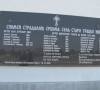
"A crime is not only when someone is killed; a crime has many faces. Crimes have occurred and are happening in different ways, with the same people trying to expel us. We haven't forgotten the breaking of the plaque. This new plaque, which has been placed with a clear message, shows that no matter how much they try to kill us, break our plaques and memorial stones, destroy us, or burn our homes, we do not give up on surviving in these areas," Jevtic said.
Marinko Djuric from the "Kosmet Victims" Association emphasized that the 14 harvesters from Old Gracko were killed before the eyes of the world's powerful simply because they were Serbs.
"The hosts sought help, but the KFOR authorities were deaf to the cries of the harvesters. The 'Kosmet Victims' Association tells the families of the murdered harvesters that we understand your pain and suffering and pray to God to give you the strength to endure these turbulent and difficult times, with faith in God that the hand of justice will reach the perpetrators," Djuric said.
On this day, in the village of Old Gracko, during the harvest, Milovan Jovanovic, Jovica and Rade Zivic, Andrija Odalovic, Novica, Slobodan, Mile, and Momir Janicijevic, Stanimir and Bosko DJekic, Sasa and Ljubisa Cvejic, Nikola Stojanovic, and Miodrag Tepsic were killed.
Their murder is considered one of the greatest crimes after the Kosovo conflict in 1999, for which no one has been held accountable.
Seven Albanians were under investigation. In October 2007, UNMIK arrested Mazlum Bitiqi from the village of Veliki Alas, near Old Gracko, on suspicion of participating in the murder of the Serbian harvesters. However, he was released two months later due to a lack of evidence.
The Special Prosecutor's Office in Pristina, together with EULEX, stopped the investigation in 2017 due to a lack of evidence.

0 comments