
Popovic: In Kosovo, the "brightest symbols" of the Serbian community are under attack
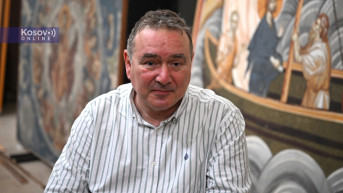
Museum advisor at the Fresco Museum in Belgrade, Bojan Popovic, assessed for Kosovo Online that in Kosovo, the "brightest symbols" of the Serbian community are consistently under attack, and the threat of demolishing the Church of Christ the Savior in the center of Pristina is just part of this narrative, which does not receive condemnation from the international community.
"It is clear that what suffers the most is what is most sacred to everyone, such as faith, places of worship, and cemeteries. This is the intimate part of every nation’s life. The question is how much injustice one can endure. Of course, within any solution that should follow, all these messages only prevent a resolution for any person living in that area, that is for sure," Popovic said for Kosovo Online.
He adds that the same situation applies to other Serbian sacred sites or cultural monuments.
"There is a constant tendency to present them in any way, just not as Serbian," emphasized this art historian.
He views the constant attacks on the property of the Serbian Orthodox Church as a "deliberate intention" supported from abroad.
"Clearly, there is an intention that is supported from abroad. This does not receive enough condemnation from the world. It receives condemnation from some countries, but not from those that support an independent Kosovo. It should be said that this really has no justification, and the other side should consider what will happen in 50 or 100 years. We will still be neighbors then," Popovic noted.
He reminds that the West has a clear stance on respecting private property.
"This only happens in Cyprus, where someone usurps property, and it cannot be reached for decades, all under the guise of 'peace,'" Popovic emphasizes.
He believes that Albanians suffer the most from the consequences of such a policy and specifies that this is the result of the fact that the standards from Martti Ahtisaari's plan for the protection of the Serbian Orthodox Church's property in Kosovo have not been met.
"You have an economic frenzy in which the largest number of Albanians may be the ones who suffer the most from the terror of such a group of people and such an ideology. Imagine what it means – and we all know this, all the Balkan nations – when you have to endure some harsh ideology of a government. Imagine how Albanians in Kosovo feel when they have to endure their own government, which is entirely supported by such an ideology. You remember the triumph when they managed to return a measly 15 hectares of forest to Decani. This is truly a great comedy that can take place," Popovic stated.
He appeals to Albanians to rebel against such ideas.
"I would ask Albanians to rebel against this, because it is a terrible anti-human injustice," Popovic said.
He emphasizes that there have been frequent examples in history where sacred objects of other nations and religions were destroyed during wars, but that in modern history in this part of the world, there have only been two recorded cases: in Nazi Germany and in the Independent State of Croatia, where church monuments of another nation were removed even during peacetime.
"Albanians are, by nature, a hospitable people. It is a great shame that in Pristina, which they know little about – and certainly don’t know about the famous inscription on the walls of Pristina regarding how Vuk Brankovic decorated the city – they don’t know their own foundations and beginnings, yet they are building one of the largest Catholic churches in the Balkans, and at the same time, they would exclude a place of worship from the urbanism of that city, not of another nation, but of another nation that lives there. This is simply unacceptable. It is similar to how unacceptable this was during World War II in Croatia," Popovic points out.
He illustrates the denial of Serbian architecture and religious heritage with an example from Prizren.
"In the evening, when you go out in Prizren and look toward the fortress as the highest point, you can see that it is illuminated, but right below it, you can see the Church of the Holy Savior only in the dark," Popovic explains.
0 comments