
Raska-Prizren Diocese: It is essential to clearly distinguish commercial tourism from religious pilgrimages
The Raska-Prizren Diocese stated that religious pilgrimages must be distinguished from commercial tourism activities, following reports that the Kosovo Police had been distributing leaflets informing organized groups that, as of August 1, foreign tour guides without a Kosovo-issued license must be accompanied by a locally licensed tour guide while staying in Kosovo.
"The Raska-Prizren Diocese has received information from pilgrimage groups returning from visits to our holy sites in Kosovo and Metohija that the Kosovo Police distributed leaflets containing a notice from the Ministry of Culture and Tourism regarding the implementation of the Law on Tourism, which enters into force on August 1, 2026. The notice states that persons professionally engaged in providing tour guide services and leading organized groups for tourism purposes must possess the appropriate license, while organized groups accompanied by a foreign tour guide without a Kosovo-issued license must, during their stay, be accompanied by a local tour guide licensed in Kosovo, with fines announced for non-compliance with these rules," the Diocese said in a statement.
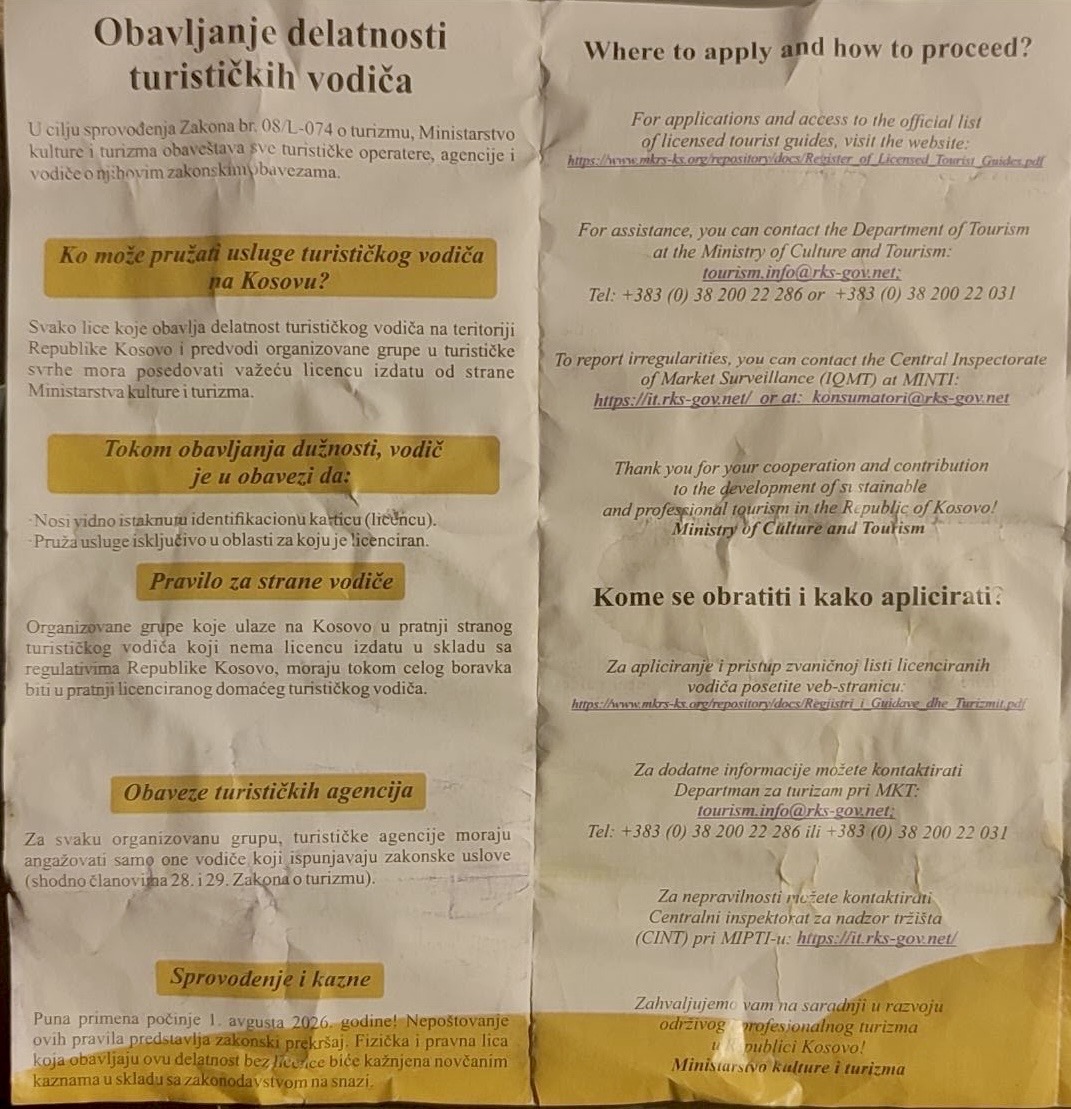
The Diocese added that, at the same time, some media outlets had expressed concern that organized pilgrimage groups of Serbian Orthodox Church faithful would, in the future, be unable to visit Serbian Orthodox monasteries without complying with the above-mentioned requirements concerning tour guides licensed by Pristina.
"Given that these reports have understandably caused concern among the faithful, it is essential to clearly distinguish commercial tourism from religious pilgrimages as one of the fundamental expressions of the freedom of religion. The monasteries of the Serbian Orthodox Church in Kosovo and Metohija are, above all, living holy sites—places of worship, prayer, and monastic life. The overwhelming majority of visitors do not come to these shrines as tourists but as pilgrims wishing to participate in religious services, venerate holy relics, seek spiritual guidance, and visit monasteries as part of their religious life," the Diocese stated.
According to the statement, the freedom of religion also directly encompasses the right of believers to freely visit their holy sites, participate in religious services, and organize pilgrimage journeys.
"The Constitution of Kosovo and the Law on Freedom of Religion contain specific guarantees for religious communities, including the Serbian Orthodox Church, protecting its status and explicitly guaranteeing free access for pilgrims and other visitors to religious sites. The Diocese does not question the right of the competent institutions, within the framework of the applicable legislation, to regulate the professional provision of tour guide services and commercial tourism activities. However, the regulation of commercial tourism services cannot be interpreted in a manner that equates religious pilgrimages, accompanied by pastoral care, participation in religious services, and the ordinary religious life of monasteries with the professional provision of tourism services," the statement reads.
The Diocese further emphasized that no interpretation of tourism regulations may diminish the Serbian Orthodox Church's right to independently regulate religious life within its monasteries, nor interfere with its authority over worship, pastoral ministry, spiritual instruction, or the presentation of its own spiritual, historical, and cultural heritage, in accordance with the Constitution of Kosovo, the Law on Freedom of Religion, and the rights guaranteed to the Serbian Orthodox Church under Annex V of the Comprehensive Proposal for the Kosovo Status Settlement (the Ahtisaari Plan).
"Based on the applicable legal provisions that are publicly available, the Diocese is not aware of any legal provision establishing a general rule requiring every organized pilgrimage group to have a licensed tour guide solely in order to gain access to a living monastery for prayer or participation in religious services. Claims suggesting the existence of such an obligation therefore require careful legal examination and should not be accepted as an undisputed fact. Given the urgency of the matter, and in order to avoid unnecessary misunderstandings and practical difficulties when pilgrimage groups travel to Kosovo and Metohija, the Diocese recommends that organized church pilgrimage groups, whenever possible, travel accompanied by a priest or a monastic member—a monk or a nun—who will serve as the group's spiritual and ecclesiastical leader. Their role should be pastoral and liturgical, not that of a professional tour guide. It is also advisable that groups carry an appropriate certificate issued by their parish, monastery, or the Diocese confirming the religious nature of the journey and the status of the person providing the group's spiritual leadership," the statement says.
According to the Diocese, this recommendation is a temporary practical measure intended to clearly establish the religious character of the pilgrimage and must not be interpreted as recognition that the presence of a member of the clergy or monastic community is a legal requirement for pilgrims to visit, nor as acceptance that religious pilgrimages may be equated with commercial tourism programs.
"The Diocese remains committed to constructive dialogue with the competent institutions and expects that any implementation of tourism regulations will be carried out with full respect for the constitutionally and legally guaranteed rights to freedom of religion, freedom of movement, free access of pilgrims to religious sites, the special rights enjoyed by the Serbian Orthodox Church in Kosovo and Metohija, and the autonomy of religious communities. Only such an approach can simultaneously ensure the lawful regulation of tourism activities and the unhindered exercise of fundamental human rights and freedoms," the statement concludes.

comments