
Raska–Prizren Diocese: No Decision Has Changed the Canonical Seat of the Diocese
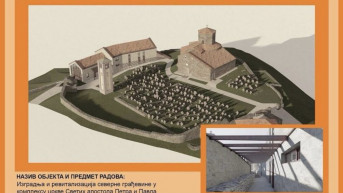
The spiritual, canonical, and historical seat of the Raska–Prizren Diocese is located in Prizren and at the Monastery of Gracanica, where the diocesan offices are based, and this remains unchanged. No decision — whether synodal or administrative — has altered the canonical seat of the Diocese, nor has any procedure for its relocation been initiated, the Diocese stated in response to public commentary in the media and on social networks concerning works within the complex of the Church of the Holy Apostles Peter and Paul in Novi Pazar.
The Holy Assembly of Bishops of the Serbian Orthodox Church, headed by the Patriarch, decided on 18 May 2017 that, in addition to its historical and spiritual seat in Prizren (Gracanica), the Diocese may also have an administrative seat with official premises in Novi Pazar.
This decision, the statement emphasizes, was adopted in accordance with the Constitution of the Serbian Orthodox Church and represents a supplement to the existing structure, not its modification. The decision was implemented in line with the regulations of the Republic of Serbia and registered in the Register of Churches and Religious Communities maintained by the Ministry of Justice. The registration of an administrative seat in Novi Pazar did not alter the status or identity of the Diocese, nor did it affect its canonical seat in Prizren.
The Diocese underlines that the establishment of an administrative center in Novi Pazar is neither political nor personal in nature.
The Raska–Prizren Diocese encompasses both the Raska region and Kosovo and Metohija. Given the geographic scope and complexity of this territory, adequate administrative conditions are necessary for pastoral and organizational activities, in accordance with the legal system of the Republic of Serbia.
It is particularly stressed that the construction of the Diocesan Center near the Church of the Holy Apostles Peter and Paul aims to dedicate greater attention to the Raska region at a time when preserving spiritual, cultural, and national identity is of essential importance for the Serbian people in that area.
The intention of the bishop, the statement notes, is not to withdraw from Kosovo and Metohija, but rather the opposite — to strengthen the presence of the Church in all parts of the Diocese, including the historic Raska region, regarded as a foundation of Serbian spiritual heritage. Given the extremely difficult circumstances in Kosovo and Metohija, the Diocese’s continued activity in the Raska region is described as crucial for the survival of the Church, the faithful, and the sacred sites in Kosovo and Metohija, since both parts form an interconnected and organic whole.
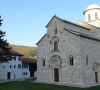
The Church of St. Peter (Petrova crkva) in Old Ras historically served as the seat of Raska bishops and metropolitans. Ensuring that this shrine receives appropriate institutional attention in contemporary times through the construction of a diocesan center is presented as an act of historical responsibility rather than arbitrary decision-making.
Regarding the project for revitalization and construction of a residential building (konak) within the Church complex, the Diocese notes that the initiative dates back to the mid-1990s, when an initial conceptual plan for the site’s arrangement was drafted and reviewed by the Republic Commission for Medieval Heritage.
In 2009, the project was submitted to the International Council on Monuments and Sites (ICOMOS), the advisory body to UNESCO, which issued a positive opinion regarding restoration within the existing dimensions. ICOMOS explicitly stated that any increase in height, capacity, or volume would be unacceptable.
The revised conceptual design from 2022 retained the previously approved dimensions entirely — neither floor area nor height has been increased. ICOMOS does not prohibit a change in function within existing parameters but strictly forbids expansion, a condition that has been fully respected, according to the Diocese.
The project underwent all legally prescribed procedures: issuance of location conditions, technical protection requirements, expert review by the Ministry of Construction’s Revision Commission, and ultimately received a building permit on 12 September 2024. All works are being carried out under the professional supervision of the Republic Institute for the Protection of Cultural Monuments.
The Diocese further states that claims that the status of the UNESCO World Heritage site “Stari Ras and Sopocani” is being endangered are unfounded. UNESCO does not grant direct approvals for individual projects, and the advisory body ICOMOS set limitations that have been fully observed. Competent professional institutions have determined that works conducted in accordance with the approved design do not pose a risk to the site’s status.
Archaeological research was conducted between 2011 and 2022. Discovered remains are neither endangered nor incorporated into the new structure; they will be protected, covered, and made accessible to the public. The project applies the principle of clear differentiation between old and new elements, in line with contemporary conservation standards, thereby preserving authenticity and avoiding historical reconstruction without scientific basis.
The Diocese concludes that allegations of “uncontrolled construction,” “overshadowing the church,” “building over a necropolis,” or “endangering world heritage” are not supported by official positions or documentation of the competent institutions.
In all relevant matters, the Raska–Prizren Diocese states that it has acted strictly in accordance with decisions of the Holy Assembly of the Serbian Orthodox Church, applicable legal regulations, and expert guidelines for cultural heritage protection.
“The intention of the bishop and the Diocese is neither political nor personal, but pastoral and historically responsible: to dedicate greater attention to the Raska region in a time of numerous challenges, for the sake of the survival of our people, the preservation of spiritual heritage, and the dignified presence of the Church in all parts of the Diocese,” the statement concludes.

0 comments