
Srbljak on the crime in Gorazdevac: I still relive that August 13, the injustice hurts even more
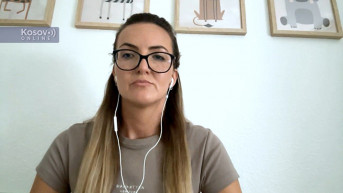
One of the children who survived the crime in Gorazdevac in 2003, Dragana Srbljak, says that even today, 21 years later, she continues to relive that August 13th, and that the hardest thing for her is the fact that in Kosovo it has become a rule that the perpetrators of crimes against Serbs are never found or held accountable.
"On that fateful August 13th, 2003, at the Bistrica River, a monstrous crime occurred when two unknown attackers opened fire on children while they were swimming in the river. Unfortunately, my godbrother, Pantelija Dakic, who was 12 years old at the time, and my first neighbor, Ivan Jovovic, who was 19 years old, were killed. Four of us were injured," Srbljak recounts that day in a conversation with Kosovo Online.
She arrived at the river a few minutes before the massacre took place.
"I was running toward the river as if someone was calling me. The shooting happened literally within three minutes of my arrival. The sound was so loud that it deafened me and left me frozen. I didn’t notice that the children were scattering and running past me. My sister, who was heading home, wanted to come back to help me, but her now-husband gave me first aid and carried me to the first vehicle that came by," she recalls the moment when one of the fired bullets hit her leg.
She received first aid at the local clinic, and then her father, due to the heavy bleeding, decided to transfer her to a hospital operated by the Italian KFOR contingent.
"But that day the military was changing shifts, so they blocked our way and redirected us to an Albanian hospital. The terror continued there. Unfortunately, they placed a cast on my open wound. The leg was bleeding everywhere, but they gave me discharge paper so I could go home. My mother, who is a medical worker, took over responsibility immediately when she saw what had happened, saying she would take me and Djordje Ugrenovic from the hospital. She drove us to Kosovska Mitrovica," Srbljak says.
She adds that during the journey, both she and Djordje lost a lot of blood, and the doctors at the North Mitrovica Clinical Hospital Center said they were only ten minutes away from death.
"My surgery lasted two and a half hours. I stayed in the hospital for about ten days. The wound was treated there," Dragana recalls.
A direct consequence of the injury is 80 percent damage to her ankle joint.
Another consequence is the invisible wound on her soul that time cannot heal. Through the shooting of Stefan Stojanovic from Gotovusa in the Strpce Municipality on Christmas Eve last year, she relived August 13th once again.
"What is hardest for me, or rather what was hardest during my growing up, was when I realized what actually happened to my friends and all of us who were injured back then. The moment when I, from the perspective of an adult, looked at the same event was last year on Christmas Eve when they shot Stefan Stojanovic, who was the same age as I was back then. That event shook me deeply. I saw him as me on that day. His cries and sorrow, I went through all that with him that day, and in some way, it illuminated my trauma and the stress that occurred at the Bistrica River," this young woman admits.
She doubts that those responsible for the massacre in Gorazdevac will ever be held accountable.
She also says that she constantly asks herself why crimes against Serbs in Kosovo are not treated the way every crime should be treated.
"Somehow, it has become a rule that the perpetrators of these crimes are not found. The very fact that my parents live there and all the people who continue to survive there, despite knowing that the killers walk in the same place where they do, brings me additional stress and sorrow," Dragana admits.
She also questions where the representatives of international missions in Gorazdevac were on that day, those who were responsible for their safety.
"The then head of UNMIK stated that every stone would be turned to find the killers, but in 2010 the investigation was halted. We received letters from EULEX stating that no evidence was found. International missions were present at Bistrica during the event. They were responsible for our safety, for protecting human life in Kosovo and Metohija, and they knew that we were not safe at that river. I wonder where they were that day, why no one protected us," Srbljak asks, 21 years later.

0 comments