
Survivors from Gorazdevac: The bodily wounds have healed, but the pain in the soul never did
Twenty years ago, a day in Gorazdevac was normal for Serbian children until at one point a burst of shots marked and changed their lives for all of them, and unfortunately, stopped some of them. They went out to seek refreshment from the August heat in the river Bistrica, in whose water they bathed every day, just as they also hung out on its banks. Even today, unknown perpetrators changed the lives of all Serbs in Goraždevac in an instant, seriously injuring four children and killing two.
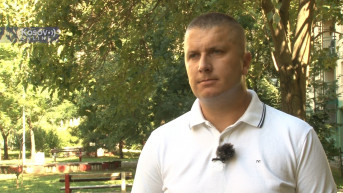
"I feel absolutely the same today as I did that day - the pain does not stop. The bodily wounds have healed, but the pain in the soul never did," Bogdan Bukumiric, who was treated for six months for severe injuries sustained in that heinous feast, tells Kosovo Online.
Bukumiric, who was 15 years old in 2003, shared his memories that, as he himself says, never leave him, and in the conversation, he first mentioned his fallen comrades Pantelija Dakic, who was 12, and Ivan Jovovic, who was 19.
"An incredible thing, in such a small area, none of us who lived in that village, who attended school, ever dreamed that it was possible to experience such a tragedy and trauma," he says.
He says that on that day, like every other day, they went to the river to cool off and notes that it was the only place where they could do so, considering that there was no swimming pool in Gorazdevac.
"Everyone passed by my house because it was the closest to the river and that day my friends invited me to go, I resisted, I also asked my father, who seemed to have a premonition - he told me, “Don’t go, wait a little longer, the water is cold', but after that he allowed me and I went. I entered the water, the water was very cold, so I quickly got out and stood with my friends who had already made a fire to roast corn," Bukumiric says, vividly remembering each detail.
He adds that he was standing next to Panta, whose life was stopped only after 10, to 15 minutes.
"After 10, to 15 minutes, the burst of fire started. During the first moments, we didn't know what was happening, and then three bullets hit me from the left side, which threw me 20 to 30 centimeters, and it crossed my mind that I wanted to see a monster, the villain who shot. I turned sharply towards them in the hope of seeing a figure, so that if I happened to survive - to remember. However, two bullets hit me above the chest and I could no longer stand on my feet. As I fell, a bullet hit me in the head, and the eighth bullet grazed the ankle of my left leg," he said.
In Gorazdevac, from 1999 until then, the Serbs had already learned to recognize where the sound of gunfire was coming from, so they all went to the river in the hope that nothing happened to their children.
But the fight for the wounded children continued even after the perpetrators finished their bloody feast and fled.
"They put me in a car and transferred me to the KFOR base in Gorazdevac, but they didn't have a doctor there to provide first aid, so they transferred me to the village clinic where they bandaged and alleviated my injuries. In the meantime, the locals and my family were asking KFOR to transfer me to the hospital in Pec, to their base, but they got the answer that it couldn't be done for security reasons," Bogdan says.
His memories go back to the fact that his brother and his neighbors drove to that base in a car with Serbian license plates, and their car stopped right next to the green market in Pec.
"The neighbor was sitting in the back seat next to me and he was encouraging me all the time that everything would be fine. When our car stopped, they attacked us, they wanted to pull us out of the car; they demolished the car; they hit the neighbor who was driving with fists, and stones, and the neighbor who was next to me protected me from everything and from blows. That's where my memory ends," he said.
He continues the story according to what he was told and says that two KFOR vehicles came by, not sure if it was by accident or on purpose.
He was transferred to one vehicle, while his neighbors and brother were transferred to another.
From there they were transferred to the hospital in Pec, not to the KFOR base, and he was placed in the room where the murdered Pantelija lay.
"Pantelija's father held both his and mine hands. In the hospital, they were having fun, and playing loud music; there were also other wounded. After that, the doctor and KFOR came to provide first aid, which the father of the deceased Panta did not allow because he believed that they would inject something into our bodies so that it would kill us. After some time, the doctor from Gorazdevac who was with us noticed that I was showing signs of life and insisted from KFOR that they transfer me to the northern part of Kosovska Mitrovica. They again excused themselves that they had to ask the command in Pec, and the command in Pec must ask the command from Pristina and so on," Bukumiric says.
They delayed the decision to transfer him for three hours, after which they allowed him and Marko Bogicevic to be transported by helicopter.
First, they headed towards Mitrovica, but then they headed towards Prizren, where they left Marko Bogicevic at the German KFOR base.
Bogdan was transferred to the southern part of Mitrovica in the French part of KFOR.
Doctor Milena Cvetkovic from the Clinical Hospital Center Kosovska Mitrovica found out where he was and on her own responsibility drove the ambulance towards the hospital of the French base.
She insisted on being present while they operated on his spleen, and then she asked what would happen to the wound on his head.
"They told her that they had called a neurosurgeon from Pristina, she didn't know which doctor they called, whether theirs was French or Albanian, she panicked and insisted that they transfer me to the northern part of Mitrovica. At first, they didn't approve, but after a lot of persuasions, they allowed it. I was transferred to the northern part of Mitrovica, and for the first time the helicopter of the Auto-Moto Association was supposed to land, but they did not allow them to fly over the administrative crossing, so the doctor transferred me in an ambulance to Raska, from where I was transferred by helicopter to the Military Medical Academy," Bukumiric said.
As he states, even today, when he remembers the whole situation, he feels absolutely the same as he did the first day.
"The monster, the villain who shot those innocent children, walks free, maybe we see him every day, maybe he looks at me and laughs, I don't know. Every day I expect, every second I expect someone to call me and say 'Bogdan, monster, villain, or whatever, he was arrested'. It would make things a little bit easier for me," he says.
The investigation into that crime was officially suspended in 2010, and Bukumiric says that he lived through a terrible period then and that when he read and watched it, he could not believe that the investigation in such a small area had not come to an end.
"All the evidence was found, and we are the evidence that bears witness to all of this, and it is incredible that in such a small area, the villain who shot the children could not be found. Why did the international community not do anything about the fact that not only the crime in Gorazdevac but none of the others - neither in Staro Gracko nor the Nis Ekspres bus..., have been resolved? Are they there to do something about it, I think I deserve to know who did it and answer for their crimes, for my two dead comrades for my wounds," Bukumiric said.
He has a message primarily for the international community, which is to reopen the investigation, emphasizing that there is evidence because they stated in the report that 78 shell casings had been found.
However, he doubts that all the evidence that was found exists at all today.
"Covering up a crime is a very serious crime. We the victims and our families deserve to know who it was, and I would only ask him one question - why the children, why us," he said.
Twenty years later, Bogdan Bukumiric lives in Belgrade, and has accomplished himself as a family man, and his strength for life, as he states with the first smile on his face since the beginning of the conversation, is given by his two daughters.
For the last 20 years, Bistrica River in Pec, for Bogdan Bukumiric is no longer an oasis where he spent his childhood with his friends and sought refreshment from the summer heat, since August 13, 2003, Bistrica has been a river of blood for him.
The murder of Serbian children on the Bistrica River is considered one of the four biggest crimes against the Serbs since 1999 and the arrival of the international mission in Kosovo.

comments