
Konjufca: Report biased and one-sided, UNMIK unnecessary
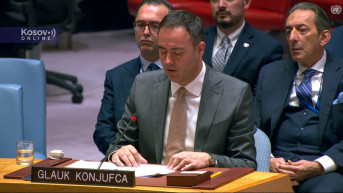
Kosovo's Foreign Minister Glauk Konjufca said at a UN Security Council meeting last evening that UNMIK's report on the situation in Kosovo was biased and one-sided, and that the Kosovo government was committed to creating a safe environment and opportunities for progress for everyone.
“No one will be left without basic necessities and security,” Konjufca said, announcing the further integration of Kosovo Serbs as equal citizens of Kosovo.
According to him, UNMIK's report was based on “Serbian propaganda”, while the incidents listed in the document were “unfoundedly described as interethnic”.
“There is no evidence that Albanians are responsible for interethnic incidents... Such incidents exist only in Serbian reports,” Konjufca said, calling on the UN Secretary-General to reconsider support for UNMIK reports.
Konjufca also said that UNMIK had “long since overstayed its welcome”, adding that it was unnecessary and that it was time for it to be abolished.
He accused Serbia of having “killed 12,000 unarmed, innocent Albanians”.
“Minister Djuric did not say a single word about those 12,000 Albanians who were killed. I call that a denial of justice. He denies it because his state committed all those massacres,” Konjufca said.
Konjufca called on Serbia to take responsibility for the attack in Banjska on 24 September 2023 and, as he put it, to end its hostile policy towards Kosovo.
He reiterated the claim that the official authorities in Belgrade had supported the attack in Banjska, mentioning Milan Radoicic, whom he identified as the organiser of the attack and who, he said, had recently appeared at a political rally held by Aleksandar Vucic.
“These are not isolated provocations; they expose a hostile doctrine, territorial expansionism and impunity for armed aggression,” Konjufca said.
Kosovo's chief diplomat also called on the international community to condemn such actions and demand accountability for the attack in Banjska.
He also mentioned a statement by Serbian Minister Snezana Paunovic and welcomed the European Union's response to that statement. He criticised the honours paid at the funeral of General Ratko Mladic, as well as a statement by Serbian Deputy Prime Minister Ivica Dacic, “who claimed that the Serbian flag would fly over Prizren sooner or later”.
According to Konjufca, these statements show “that Belgrade's territorial ambitions towards Kosovo are not just a thing of the past”.
Referring to the verdict of the Kosovo Specialist Chambers sentencing four former Kosovo Liberation Army leaders to a total of 81 years in prison for war crimes, Konjufca said Kosovo would work to “correct the injustice through the appeals process”.
“The verdict has provoked a strong negative reaction in Kosovo. As a people that was a victim, Kosovo cooperated with the Hague Tribunal, other courts and UN bodies in prosecuting and punishing all war crimes, regardless of ethnicity. We did the same in the case of the Specialist Chambers. It was clearly emphasised there that the KLA's war itself was not on trial, and that the ruling was not intended to diminish the significance of the liberation war, nor the proclamation of an independent state, which represents the most important element of stability in the region,” Konjufca said.
Nevertheless, he said, Kosovo was expressing serious concern over the very severe sentences.
“We believe that the verdicts contain errors in terms of both substance and facts, and we expect them to be corrected by the Court of Appeals,” Konjufca said.
Konjufca also called on Serbia to “stop obstructing Kosovo's membership in international organisations”.
He reiterated claims that the rights of Albanians in Presevo, Bujanovac, and Medvedja were being violated.
“Serbia must stop systematically obstructing Kosovo's membership in international organisations and accept mutual recognition as the basis for interstate relations. The sovereignty of the Republic of Kosovo is not up for negotiation. Serbia's destructive role has been reduced to sabotage and cross-border espionage operations, incitement to war and discrimination against Albanians in the ‘Presevo Valley’. This should also be a matter of concern for the Council,” Konjufca said.
He said that Albanians accounted for 71 per cent of the total population in that region, according to Serbia's 2022 census, but that their institutional representation remained limited.
Konjufca drew a parallel with Kosovo, noting that 20 of the 120 seats in the Assembly were reserved for non-majority communities, including ten seats for the Serb community.
He said the reduction in KFOR forces in northern Kosovo was an indication of an improved security situation.
“Now that all institutions have been constituted, the Kosovo government will continue with its ambitious agenda of socio-economic prosperity, justice and security. We have dismantled illegal structures operating from Serbia that obstruct ethnic integration and undermine our democratic institutions. The dismantling of illegal structures provides security for every community. No citizen has been, or will be, left without services. As a result of the improved security situation in the northern municipalities, KFOR forces have optimised their deployment, allowing our authorities to deepen integration and communicate directly with Kosovo Serbs as equal citizens of our state,” Konjufca said.

0 comments