
Visoki Decani Monastery: Suspended works within the Special Protective Zone went beyond routine road maintenance

Visoki Decani Monastery announced that, following the formal intervention of the monastery and the Raska-Prizren Diocese, as well as the swift engagement of international representatives, the intensive road works recently carried out within the legally established Special Protective Zone of Visoki Decani Monastery have been suspended. The monastery emphasized that the 2020 arrangement reached by the Implementation and Monitoring Council (IMC) remains the foundation for a lawful and lasting solution.
The monastery expressed its gratitude to everyone who recognized the seriousness of the situation and helped prevent further unilateral activities until the full legal and technical circumstances surrounding the works are clarified.
"On July 29, the Abbot of Visoki Decani, Father Sava Janjic, sent a formal letter to the Mayor of Decani, Mr. Bashkim Ramosaj, requesting the immediate suspension of the works and full compliance with Law No. 03/L-039 on Special Protective Zones. The monastery had not been informed or consulted in advance and had received no project documentation, legal authorization, technical explanation, or information regarding the scope or purpose of the works," the monastery said in a statement posted on the social media platform X.
The statement added that the mayor subsequently described the activities as ordinary road maintenance, stated that no paving was planned, and announced that the works would be halted.
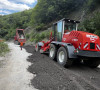
"The monastery appreciates the mayor's prompt response and the subsequent suspension of the works. However, the explanation provided does not correspond to the nature and scale of the activities documented on the ground. Heavy trucks delivered substantial quantities of crushed stone aggregate, while heavy construction machinery spread, leveled, and graded the material along a significant and evidently continuous section of the road. In terms of their scale, continuity, and technical characteristics, these activities clearly exceeded the repair of isolated potholes or other minor routine maintenance," the statement emphasized.
The monastery further noted that Visoki Decani has consistently cooperated with the municipality on genuinely necessary minor repairs to local roads whenever such activities were announced in advance and coordinated with both the monastery and KFOR.
"Our concern is therefore not directed against ordinary road maintenance or the legitimate needs of the local population. Rather, it concerns substantial infrastructure works carried out within a legally protected area without prior notification, consultation, agreement, or consideration by the competent joint mechanism established by law. The legal distinction is clear. The construction or development of an international transit road through the rural Special Protective Zone of Visoki Decani is prohibited under Article 5 of the Law on Special Protective Zones. Such a project cannot be approved by the municipality, even if the monastery were to consent, nor can it be carried out through unilateral actions on the ground," the statement reads.
The monastery added that, at the same time, road construction, maintenance, and major repairs within the Special Protective Zone constitute restricted activities under Article 6 of the Law.
"They require prior coordination and agreement with the Serbian Orthodox Church. If such agreement cannot be reached, the matter must be referred to the Implementation and Monitoring Council (IMC) for consideration. None of these procedures was followed before the latest works commenced. It is also important to recall that the issue of the Decani–Plav transit road was not left unresolved. A lawful and carefully balanced compromise was reached at the meeting of the Implementation and Monitoring Council on November 9, 2020," the monastery stated.
It explained that the meeting brought together the Head of the European Union Office and EU Special Representative, the Head of the OSCE Mission in Kosovo, the two Kosovo ministers responsible for culture and spatial planning, Decani Mayor Bashkim Ramosaj, and representatives of the Serbian Orthodox Church, including the Abbot of Visoki Decani, Father Sava.
"The agreement was based on a proposal facilitated by the then Italian Ambassador to Kosovo, Nicola Orlando, and the former KFOR Commander, Major General Michele Risi. The plan, accepted by all participants, envisaged the construction of the international Decani–Plav bypass outside the boundaries of the Special Protective Zone. The bypass was intended to become the principal route to Plav in Montenegro, diverting international and heavy traffic away from the protected area. The agreement was also supported by the European External Action Service (EEAS) as an important step forward," the monastery said.
According to the statement, the existing road through the Special Protective Zone, together with other roads in the valley, was intended to remain part of the local road network, serving primarily local residents, light vehicles, agricultural activities, and access to the surrounding mountainous area.
"The agreement did not allow for the gradual transformation of the local road through the Zone into an international transit route. It also envisaged specific traffic-control measures near the monastery, including speed-control devices and retractable bollards designed to prevent heavy vehicles from passing immediately alongside the monastery walls. These measures were agreed upon to protect the peaceful life of the monastic community, the integrity of the Special Protective Zone, and the cultural and natural setting of the 14th-century monastery, which forms part of the UNESCO World Heritage property Medieval Monuments in Kosovo," the monastery noted.
The statement stressed that the 2020 agreement was based on a synchronized implementation process.
Construction of the international bypass outside the Zone and the limited rehabilitation of local roads within it were intended to proceed simultaneously and in clearly defined phases.
"KFOR was explicitly tasked with monitoring progress and reporting to the IMC before any subsequent phase could be approved. The agreement therefore did not constitute a general authorization for unilateral works but rather an institutional framework designed to ensure that all road development remained in full compliance with the Law on Special Protective Zones. Unfortunately, the 2020 agreement has yet to be implemented. The international bypass outside the Special Protective Zone has not been constructed, the agreed traffic-control measures have not been installed, and the Implementation and Monitoring Council has not met regularly to supervise the agreed process. Under these circumstances, unilateral works on the existing road within the Zone risk undermining both the law and the compromise unanimously accepted in 2020," the statement said.
The monastery concluded by reaffirming its commitment to dialogue, peaceful cooperation, and the legitimate development needs of all people living in the Decani area.
"The monastery does not oppose improved transport links, economic development, or necessary maintenance of local infrastructure. However, all such activities must be carried out transparently, lawfully, and in full respect of the special protection regime established for one of the region's most important religious and cultural sites. Visoki Decani Monastery therefore remains open to constructive discussions with the Municipality of Decani, the competent Kosovo institutions, KFOR, and international representatives. Such discussions must be conducted on the basis of the Law on Special Protective Zones and the decision of the Implementation and Monitoring Council of November 9, 2020, which already provides a lawful, balanced, and mutually accepted solution for the international bypass, local roads, and the protection of Visoki Decani Monastery," the statement concluded.

comments