
Thaci, Veseli, Krasniqi and Selimi sentenced to a combined 81 years in prison for the torture of 303 people and the murder of 96 people
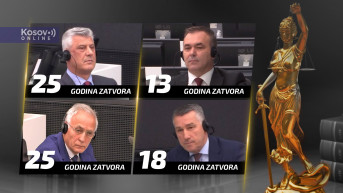
The Kosovo Specialist Chambers in The Hague handed down first-instance verdicts against four KLA leaders, Hashim Thaci, Kadri Veseli, Jakup Krasniqi and Rexhep Selimi. Thaci was sentenced to 25 years in prison, Veseli was sentenced to 18 years, Krasniqi was also found guilty and sentenced to 25 years, while Selimi was sentenced to 13 years. The Panel found that all four were criminally responsible for the war crimes of arbitrary arrest and deprivation of liberty of 385 persons, cruel treatment of 49 persons, torture of 303 persons, and the murder of 96 persons, according to the summary of the judgment.
When handing down the sentence to Hashim Thaci, Judge Smith said the following:
“Mr Thaci, in the name of the people of Kosovo, after considering all the evidence, pursuant to Articles 43 and 44 of the Law, the Panel finds you guilty under Count 3 of unlawful deprivation of liberty of at least 385 persons, under Count 5 of cruel treatment as a war crime against at least 49 persons, under Count 7 of torture as a war crime against at least 303 persons, and of murder as a war crime against 96 persons. The Panel acquits you of several charges of war crimes because there was insufficient evidence – persecution, imprisonment and other inhumane acts, torture, murder and crimes against humanity under Counts 1, 2, 6, 8 and 10. Mr Thaci, having been found guilty, a sentence has been determined for each charge. A sentence of 15 years’ imprisonment for the war crime of unlawful arrest and deprivation of liberty, a sentence of four years’ imprisonment for the war crime of cruel treatment – Count 5, a sentence of 20 years’ imprisonment for the war crime of torture – Count 7, and a sentence of 23 years’ imprisonment for the war crime of murder – Count 9. The single sentence of imprisonment is 25 years, and the time you have spent in detention shall be credited.”
As for Jakup Krasniqi, the Panel found him guilty under Count 3 – for unlawful arrest and deprivation of liberty as a war crime against at least 385 persons, under Count 5 of cruel treatment as a war crime against at least 49 persons, under Count 7 of torture as a war crime against at least 303 persons, and of murder as a war crime under Count 9, committed against 96 persons.
“The Panel acquits you of several charges of war crimes because there was insufficient evidence or because the Panel established that the particular event did not fall within the jurisdiction of this Court – persecution, imprisonment and other inhumane acts, torture, murder and enforced disappearances as crimes against humanity under Counts 1, 2, 4, 6, 8 and 10.”
When handing down the sentence to Jakup Krasniqi, a sentence was determined for each charge.
“A: A sentence of 15 years’ imprisonment for the war crime of unlawful arrest and deprivation of liberty, a sentence of four years’ imprisonment for the war crime of cruel treatment – Count 5, a sentence of 20 years’ imprisonment for the war crime of torture – Count 7, and a sentence of 23 years’ imprisonment for the war crime of murder – Count 9. The single sentence of imprisonment is 25 years, and the time you have spent in detention shall be credited.”
As for Kadri Veseli, it was stated that he was found guilty under Count 3 – for unlawful or arbitrary arrest and deprivation of liberty as a war crime against at least 385 persons, under B, Count 5, for cruel treatment as a war crime against at least 49 persons, under C, Count 7, for torture as a war crime against at least 303 persons, and under D, Count 9, for murder as a war crime committed against 96 persons.
“The Panel acquits you of several charges of war crimes because there was insufficient evidence or because the Panel established that the particular event did not fall within the jurisdiction of this Court – persecution, imprisonment and other inhumane acts, torture, murder and enforced disappearances as crimes against humanity under Counts 1, 2, 4, 6, 8 and 10. Mr Veseli, having been found guilty, a sentence has been determined for each charge. A: A sentence of 10 years’ imprisonment for the war crime of unlawful arrest and deprivation of liberty, a sentence of three years’ imprisonment for the war crime of cruel treatment – Count 5, a sentence of 13 years’ imprisonment for the war crime of torture – Count 7, and a sentence of 16 years’ imprisonment for the war crime of murder – Count 9. The single sentence of imprisonment is 18 years, and the time you have spent in detention shall be credited,” Judge Smith stated.
Finally, Rexhep Selimi was sentenced to 13 years in prison.
“Pursuant to Articles 43 and 44 of the Law, the Panel finds you guilty under A, Count 3 – for unlawful or arbitrary arrest and deprivation of liberty as a war crime against at least 385 persons, under B, Count 5, for cruel treatment as a war crime against at least 49 persons, under C, Count 7, for torture as a war crime against at least 303 persons, and under D, Count 9, for murder as a war crime committed against 96 persons. The Panel acquits you of several charges of war crimes because there was insufficient evidence or because the Panel established that the particular event did not fall within the jurisdiction of this Court – persecution, imprisonment and other inhumane acts, torture, murder and enforced disappearances as crimes against humanity under Counts 1, 2, 4, 6, 8 and 10. Mr Selimi, having been found guilty, a sentence has been determined for each charge. A: A sentence of six years’ imprisonment for the war crime of unlawful arrest and deprivation of liberty, a sentence of two years’ imprisonment for the war crime of cruel treatment – Count 5, a sentence of eight years’ imprisonment for the war crime of torture – Count 7, and a sentence of 11 years’ imprisonment for the war crime of murder – Count 9. The single sentence of imprisonment is 13 years, and the time you have spent in detention shall be credited,” Judge Smith concluded.
In explaining the verdict, Judge Smith said that, regarding the gravity of the crimes, the Panel was of the view that the acts were of great gravity and scale.
“They were committed in 14 municipalities in Kosovo and at two locations in northern Albania. All of the crimes were serious – cruel treatment and torture constitute serious attacks against the victim, while murder is one of the most serious crimes. Some individuals were detained together with other members of their families. In Malisevo, a baby was detained together with its mother for 10 days, and a 14-year-old boy was also detained. One elderly man was beaten so severely that his face was crushed. The acts had lasting consequences for the victims. For these reasons, it was concluded that the crimes were very serious. The Panel assesses the nature and degree of the accused’s participation, but I will not repeat that now.”
Hashim Thaci – The aggravating circumstance is that Thaci abused his position. It was concluded that he used his leadership position in order to achieve the punishable aspects of the common objective. The mitigating circumstances are his contribution to the establishment of the Specialist Chambers, the fact that he resigned as prime minister, and that he voluntarily surrendered to the Court.
Kadri Veseli – He abused his position, which constitutes an aggravating circumstance. As for the mitigating circumstances, he is married and has school-age children. He behaved exemplary throughout the proceedings. He voluntarily surrendered.
Rexhep Selimi – The aggravating circumstance is that he abused his position and authority. The mitigating circumstances are that he has a wife and children and says that he is very close to them. He cooperated with the Specialist Prosecutor’s Office. He voluntarily surrendered and cooperated during the search of his home.
Jakup Krasniqi – The aggravating circumstance is that he abused his position because he used his office to achieve the punishable aspects of the common objective. The mitigating circumstances are his advanced age and exemplary conduct throughout the proceedings.
Reading out the Panel’s decision, Judge Smith said that although the accused’s responsibility was personal, none of them could have achieved what was done on their own.
“Together, they agreed on the objective, established a system, set up detention facilities and formed units. They assigned roles to themselves and others. Together, they appointed other individuals to important positions, together they issued statements, attacked enemies, and created a policy of impunity for crimes. As simple as the plan was, it was also devastating. It consisted of establishing detention facilities, arrests, deprivation of liberty and killings. That plan was implemented throughout the conflict,” Judge Smith said.
Mr Thaci participated in the commission of crimes and supported them in numerous ways, Judge Smith said.
“By issuing statements and conducting the Special War, he demonstrated that he allowed crimes to be committed against opponents. He personally participated in the crimes of arrest, deprivation of liberty and interrogation of 13 members of the Assembly in Cirez and Banjica, as well as in the arrest, deprivation of liberty and killing of Behajdin Allaqi. He was also aware of the arrest of several other individuals. With regard to Allaqi, the Panel concluded that in 1993 Allaqi had a serious conflict with Thaci because he was accused of bringing Shaban Shala, allegedly a Serbian spy, into the organization to which they belonged. The Panel concluded that before he disappeared, Allaqi had been under surveillance by the KLA intelligence service,” Smith said, continuing:
“Hashim Thaci and Kadri Veseli asked to be informed about Allaqi’s movements. On June 11, 1998, Allaqi left his home and went to the KLA headquarters in Glogovac. Thaci and Veseli arrived there. They took Allaqi away with his hands cuffed. Allaqi was never seen again, and the Panel was convinced that he had been killed. In order to conceal this, they did several things: They wrote a report stating that Allaqi had died in combat as a martyr. Kadri Veseli, together with Thaci, attempted to bribe Allaqi’s family, which they refused.”
Thaci and Veseli abused Shaban Shala, Judge Smith continued.
“The Panel concluded that Thaci was aware of a large number of crimes committed against opponents, but took no measures to punish the perpetrators. He actively participated in crimes and promoted individuals involved in the acts. He disseminated information about the crimes and made false statements that the KLA adhered to international humanitarian law. With regard to Veseli, the Panel concluded that he contributed to achieving the common objective. He was head of the intelligence directorate, whose purpose was to obtain information about collaborators and monitor those individuals. Mr Veseli was a key element in achieving the common objective. Together with the other accused, he appointed loyal individuals to key positions. In addition, the Panel concluded that Veseli participated in the crimes. He was personally involved in carrying out the General Staff’s Special War, identifying opponents, as well as in the commission of the crimes of arrest, deprivation of liberty, and killing of Allaqi, and in the arrest, deprivation of liberty, transfer, and release of another KLA detainee. He was aware of acts committed against opponents, but despite this, he did not prevent them. Instead, he actively participated in and encouraged the acts. The so-called security information on the basis of which a large number of people were arrested and killed consisted largely of rumors. There was no evidence that the victims were spies,” the judge read.
As for Selimi, the Panel concluded that he made a significant contribution to achieving the objective.
“He was a member of the KLA General Staff and served as chief inspector. He had less authority than the other accused, but played a key role in forming KLA units. In itself, this is not punishable, but the Panel concluded that Selimi regularly received reports about suspects and collaborators. Selimi was aware that KLA units were deliberately persecuting suspects. Before the war, he participated in attacks against collaborators, and it can therefore be concluded that he was aware that this was KLA policy. Mr Selimi encouraged the commission of crimes and participated in them. He participated in the arrest and detention of 13 members of the Assembly in Cirez. He participated in the General Staff’s Special War and did not prevent the acts. The Panel concludes that Selimi was aware of a large number of crimes – abuse and murder. He took no measures to prevent these acts or punish the perpetrators. When he became minister of public order, he promoted several individuals who had participated in crimes. As chief inspector, he failed to ensure that the KLA complied with international humanitarian law.”
At the beginning of the reading of the verdict, Judge Charles Smith stated that the proceedings concerned the indictment, not the legitimacy of the KLA.
“Hashim Thaci is the first accused in this case. From March 1998 to September 1999, Thaci was head of the KLA Information Directorate and commander-in-chief of the KLA. Kadri Veseli, the second accused in this case, is a citizen of Kosovo. Mr Veseli is one of the founders of the KLA and its General Staff. He was a member of the KLA Directorate for Political Affairs and head of the KLA intelligence service. He was also head of Kosovo’s intelligence service, known as ShIK. Rexhep Selimi, the third accused, is a citizen of Kosovo, born in the municipality of Srbica in Kosovo. The Prosecution alleges that Selimi was a member of the KLA General Staff and head of the KLA operations sector. Jakup Krasniqi, the fourth accused, is a citizen of Kosovo. The Prosecution claims that he was a member of the KLA General Staff and a member of the KLA Directorate for Political Affairs, the KLA’s chief spokesperson and spokesperson for the provisional government of Kosovo,” Judge Smith said.
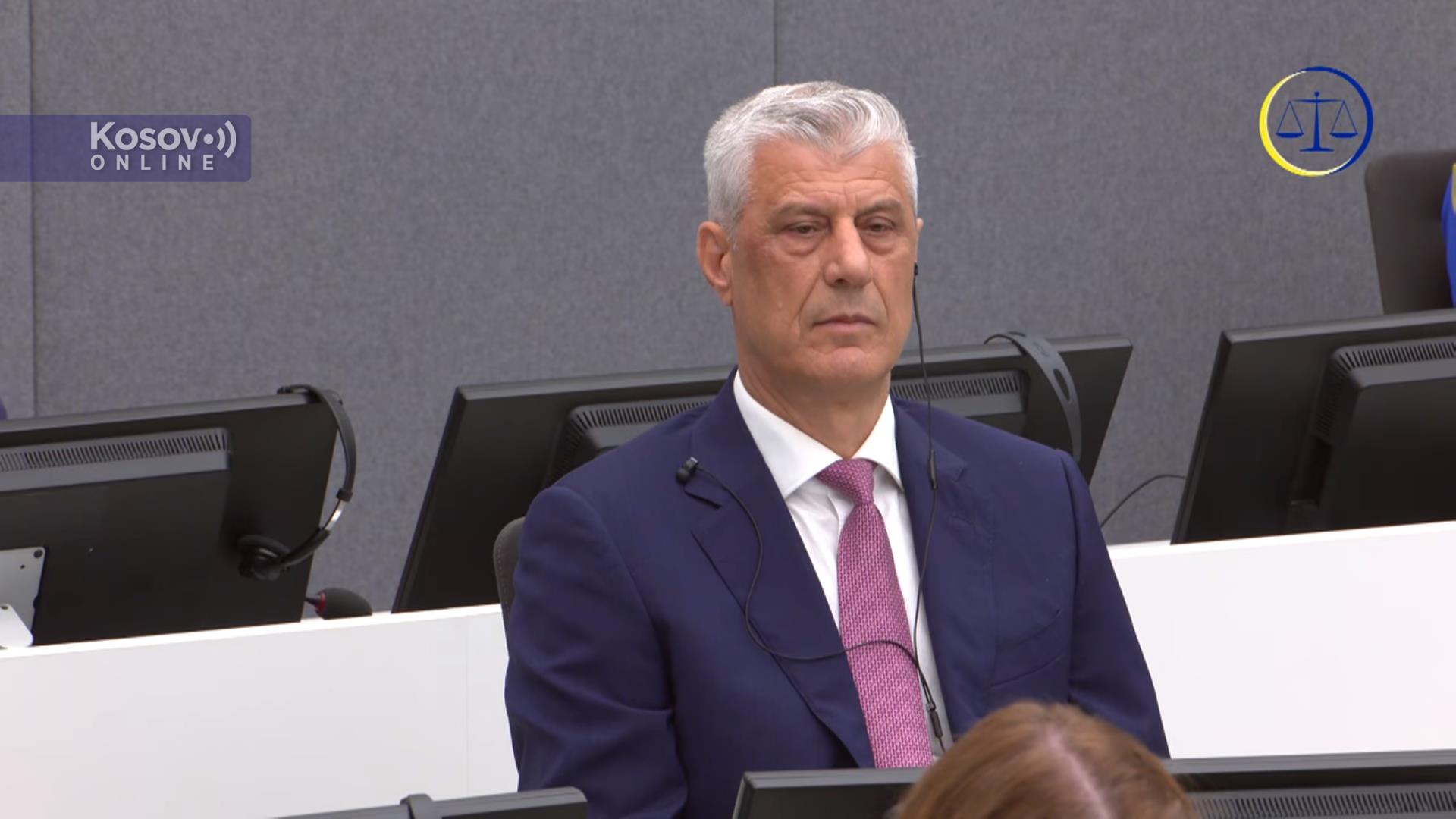
Judge Smith further stated that the Prosecution charges all of the accused under six counts of the indictment for crimes against humanity – specifically persecution, imprisonment, other inhumane acts, torture, murder and enforced disappearance of persons.
“The Prosecution alleges that all of the acts charged against the accused formed part of a systematic attack and a broader attack. The Prosecution contends that the accused were aware of that attack. The Prosecution also charges the accused under four counts of the indictment for war crimes: unlawful or arbitrary arrest or deprivation of liberty, cruel treatment, torture and murder. According to the Prosecution, all of the acts were committed in the context of the conflict between the KLA and the forces of the Federal Republic of Yugoslavia. The Prosecution alleges that the acts were committed at KLA bases or headquarters. The accused were aware that the victims were persons who were not actively participating in the hostilities. The accused bear individual criminal responsibility. All four accused pleaded not guilty to all counts of the indictment.”
The judge further stated that the trial was conducted in the context of ongoing witness intimidation.
“Several witnesses retracted their statements, lied to the Panel, or repeated rehearsed statements. Some witnesses were afraid out of concern for their own safety. The fact that the Panel is able to render a verdict is a testament to their courage and determination. Because of witness intimidation, protective measures were implemented to safeguard individuals.”
On crimes against humanity
“The Panel was not satisfied that the victims constituted a civilian population and therefore did not conclude that the Prosecution had proven the crimes of persecution, torture, other inhumane acts, murder and enforced disappearance as crimes against humanity. The Panel found that, no later than the end of March 1998 and until 20 June 1999, a non-international armed conflict existed in Kosovo between the KLA and the Federal Republic of Yugoslavia. The conflict was fought in Kosovo, but the rules of international humanitarian law also applied to certain parts of northern Albania. The victims were persons protected under international humanitarian law. All four accused were aware of the circumstances of the conflict and of the victims’ protected status. The Panel finds that the events in question that occurred after the end of the armed conflict, when the rules of international humanitarian law no longer applied, cannot be characterized as war crimes,” Judge Smith said.
The judge further stated that, in this regard, the Panel recalls that persons deprived of their liberty are, in principle, protected under international humanitarian law until the end of the conflict.
“I will begin with Count 3. The Panel found that members of the KLA arbitrarily deprived at least 385 persons of their liberty and held them in numerous detention facilities under KLA control in 14 municipalities in Kosovo and at two locations in northern Albania. KLA members, as well as military police personnel, arrested the victims and took them to these facilities. Many were arrested in their homes or on roads and taken to detention sites. They were beaten, had their personal belongings taken away, and were intimidated, all on allegations that they were Serbian spies, traitors, or similar accusations. While in detention, the victims were not allowed to leave the facilities and were kept under guard. Many were held in chains with their hands tied, while others were held at gunpoint. One witness testified that he was taken to a barn where people were chained like animals. There was no reasonable suspicion that would have made the deprivation of liberty necessary. In some cases, the detainees were women and children. There was no evidence that the victims had engaged in any dangerous activities. They were detained on the basis of rumors that they were Serbian collaborators because of alleged spying or contacts with the Serbian police or military. There is no evidence that they were in fact spies or traitors,” Judge Smith explained, continuing:
“The Panel found that KLA members, even when personal disputes were the reason for an arrest, detained individuals for prolonged periods of time. In some cases, they killed the victims. During their detention, prisoners were not afforded the basic guarantees to which they were entitled under international humanitarian law. Except in a very small number of cases, detainees were not formally informed that they were being detained or of the reasons for their detention. They were left entirely at the mercy of their captors. They were denied regular legal process, which demonstrates that between April 1998 and June 1999 KLA members intentionally detained individuals in 14 municipalities in Kosovo. For these reasons, the Panel concluded that the war crime of unlawful imprisonment and deprivation of liberty charged in the indictment was committed against at least 385 persons.”
On the torture of detainees
“Based on the evidence as a whole, the Panel concluded that 348 persons were subjected to cruel treatment, of whom 303 were subjected to torture. KLA members maintained inhumane conditions of detention. Detainees were held in various types of facilities, such as former schools, barns, and abandoned buildings. Many detainees had to sleep on concrete floors covered with human and animal excrement. They were given very little food and were not allowed to wash. They were bound with chains or handcuffs, with their hands and feet restrained. Many KLA members physically abused detainees, regularly kicking and beating them and striking them with rifle butts, metal rods, and electrical cables. Some were hung by their legs and beaten while suspended. Many were beaten until they could no longer stand. Some detainees died as a result of severe beatings. One detainee begged for a bullet while he was being beaten, but a KLA member told him that there was no bullet for him,” Judge Smith said.
Reading the reasoning of the verdict, he further stated that the detainees were subjected to psychological torture, and that two detainees were beaten so severely in front of the others that all the other detainees began to cry.
“One detainee who had committed suicide was left for the others to watch. In many facilities, victims were threatened with being killed, or were told that other individuals held with them had been executed. Detainees watched as their relatives or family members were beaten. One witness described how a relative was killed in front of them: ‘It would have been easier for me if they had killed me,’ the witness said. Many detainees suffered serious injuries, including broken legs and ribs, and continue to suffer pain to this day and are unable to walk normally. Many had their teeth knocked out or were left with permanent scars. Many described lasting consequences of their suffering and continue to suffer from depression and other problems. The Panel concluded that KLA members intended to inflict severe physical and mental suffering on the detainees.”
Judge Smith then turned to the count of the indictment concerning murder as a war crime.
“The Panel concluded that between 1998 and June 20, 1999, KLA members intentionally committed acts and omissions that caused the deaths of 96 persons who were not actively participating in hostilities. Specifically, at various locations under KLA control, victims were killed with firearms, while others died as a result of severe beatings. The bodies of the victims were found in conditions indicating that their personal dignity had been violated. One witness testified that a family learned about the death of their family member through the media. The victim’s body had been left by the side of the road, with a broken arm, bruises and cuts. The bodies of some victims were never found. In light of the circumstances and the injuries inflicted on them, the only conclusion is that at least some KLA members intended to kill certain individuals. The Panel therefore concludes that KLA members intentionally committed acts that caused the deaths of at least 96 persons in 12 municipalities in Kosovo, and it has therefore been proven that the war crime of murder was committed,” Smith stated.
Judge Smith emphasized that members of other forces and persons associated with them were targeted:
- Individuals who were alleged to be connected to the Serbian authorities, as well as members of national minorities, such as Roma and Serbs. The main targets were the killing and attacking of ethnic Albanians suspected of collaboration and ethnic Serbs designated as enemies.
- The targeted attacks against Albanians and Serbs for the same reasons.
- Wartime statements and declarations containing threats.
- Waging the Special War against opponents.
- Repeating those messages in statements by Thaci and Selimi.
- Using the military police, while the intelligence services were used to monitor collaborators.
- Establishing detention facilities. Searching for individuals based on lists of suspected persons.
- The existence of a clear pattern in the crimes committed at the facilities.
- Allowing, accepting and encouraging the commission of crimes, and the existence of a policy of impunity for crimes committed against opponents.
Summary of the Judgment
The Trial Panel today delivered its judgment in the case against Hashim Thaci, Kadri Veseli, Rexhep Selimi and Jakup Krasniqi. The Panel found all four criminally responsible for the war crimes of arbitrary arrest and deprivation of liberty of 385 persons, cruel treatment of 49 persons, torture of 303 persons, and the murder of 96 persons.
The Trial Panel acquitted the accused of the charges of crimes against humanity, concluding that the Specialist Prosecutor had not established beyond a reasonable doubt that there was a widespread or systematic attack directed against the civilian population. The accused were also acquitted of charges relating to a number of war-crime incidents.
The Trial Panel sentenced Hashim Thaci to 25 years in prison, Kadri Veseli to 18 years, Rexhep Selimi to 13 years, and Jakup Krasniqi to 25 years in prison, with the time they have spent in detention credited toward their sentences.
The judges concluded that, during the conflict in Kosovo, Thaci, Veseli, Selimi and Krasniqi made a significant contribution to a common criminal purpose of persecuting persons regarded as opponents of the Kosovo Liberation Army and its political and military objectives. These included Kosovo Albanians from other political or military forces, such as the LDK and FARK, persons allegedly linked to the authorities of the FRY, namely Serbia, and members of national minorities, including a number of Roma and Serbs.
Targeted attacks against these opponents included killing, arrest and deprivation of liberty without due judicial process, physical and psychological abuse, as well as other forms of mistreatment, intimidation and harassment.
With only a few exceptions, the Trial Panel concluded that there was no evidence that any of the victims had engaged in criminal activity, actively participated in hostilities, or represented a legitimate security threat to the Kosovo Liberation Army. The overwhelming majority of the victims were innocent civilians who found themselves in the path of the pursuit of the common criminal purpose, under which they were accused, most often falsely and largely without basis, of being collaborators and spies. A large number of victims stated that the suffering they endured had left them with lasting psychological and physical consequences.
In determining the sentences, the Trial Panel thoroughly considered the relevant facts, the gravity of the crimes, the nature and degree of each accused's participation, as well as mitigating and aggravating circumstances. The Panel also took into account the fact that some victims were in particularly vulnerable situations, for example, because of their age or because they were forced to witness the abuse or killing of members of their families.


0 comments