
Concerns and skepticism in the region ahead of The Hague judgment: What comes after September 16?
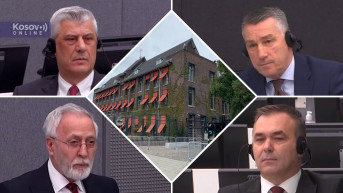
Seven days remain until the judgment is delivered against four former KLA leaders at the Specialist Chambers in The Hague, and it is unlikely that everyone in the region will welcome the decision. According to Kosovo Online’s interlocutors, some will say that justice has been served, while others will say that it has not. Although an appeal will be possible, protests and incidents cannot be ruled out. There are also assessments that violence against Serbs in Kosovo will continue regardless of the outcome—either as an act of retaliation or, in the event of an acquittal, out of a sense of triumphalism, with such a verdict interpreted as meaning that crimes against Serbs are permissible.
Written by: Dusica Radeka Djordjevic
A mural depicting the four former KLA leaders—Hashim Thaci, Kadri Veseli, Jakup Krasniqi and Rexhep Selimi—who are awaiting judgment on charges of war crimes and crimes against humanity, is being painted in Pristina today. KLA flags have been flying in the central square for several days, while a “countdown clock” installation in Pristina, as well as in several municipalities, is counting down to the delivery of the judgment scheduled for September 16.
Six years after they were detained in The Hague, tensions in the region have been further heightened by former KLA commander Nasim Haradinaj’s statement that the situation could escalate if the Specialist Chambers convict the four former KLA leaders.
“If such a decision is made, everything will burn. The situation will escalate very badly and this place will burn, Macedonia will burn, all of Albania will burn,” he said.
Responding to such statements, Kosovo Specialist Chambers spokesperson Michael Doyle said today that the mandate of the Kosovo Specialist Chambers was to ensure fair, impartial and secure trials, and that judgments were delivered by a panel of independent judges on the basis of the law and careful consideration of all evidence presented at trial concerning the individual responsibility of the accused.
The Albanian diaspora will follow the judges’ decision from close proximity.
The “Freedom Has a Name” initiative has announced a gathering in The Hague beginning at 10 p.m. on September 15 and continuing until 10 a.m. on September 16, when the judgment is expected to be delivered, with the stated aim of showing support for the former KLA leaders.
Before the gathering in The Hague, a “Freedom March” will be held in Pristina this weekend. All Albanian political parties have been invited, and participants will demand the acquittal of the four former KLA members.
Serbian President Aleksandar Vucic expressed concern about the gathering last week.
“I am very concerned because the Albanians have scheduled a major ‘Freedom March,’ if that is what they have called it, for September 12, expecting Hashim Thaci, Kadri Veseli and the others to be released. They are threatening violence and putting pressure on the court if that does not happen,” Vucic said.
What can the region expect after September 16, and, in the event of a conviction, could the anger of those dissatisfied with the verdict be directed against Serbs, as Milovan Drecun, Chairman of the Serbian Parliament’s Committee on Defense and Internal Affairs, believes?
Regardless of whether the judgment is a conviction or an acquittal, historian Stefan Radojkovic believes that violence against Serbs in Kosovo will continue, with only the motivation differing.
“If there is a conviction, it will be an expression of revenge and retribution, while an acquittal will produce triumphalism. In that case, it will demonstrate that crimes can go unpunished, particularly crimes against other ethnic groups. It should be recalled that Thaci and his associates are being tried here for crimes against Serbs, Roma and other Albanians who were political opponents of the KLA. An acquittal would be interpreted as meaning that crimes committed against Serbs and Roma are more or less permissible and that, even now, there would be no major consequences if disturbances, incidents or attacks occurred in predominantly Serbian areas,” Radojkovic told Kosovo Online.
He assessed that everyone in the region was probably awaiting the judgment with skepticism, albeit for different reasons. Serbia and the Serbian people, he said, did not have positive experiences with international courts, although this was a hybrid court.
“We do not expect justice to be served. On the other hand, Pristina and Tirana fear that justice will not be served in the way they understand it—in other words, that it will be shown that the KLA was far from being a heroic, valiant, liberation and democratic organization, but rather a structure composed of terrorists, separatists and mafia figures—in other words, criminal structures primarily in northern Albania and in Kosovo and Metohija,” Radojkovic said.
“Reason must prevail”
Political analyst from Skopje Sotir Kostov assessed that, following the September 16 judgment of the Specialist Chambers in The Hague against the former KLA leaders, some would say that justice had been served and others that it had not, but stressed that the debate should take place through civilized discourse and without inflammatory statements.
If protests occur over the judgment, he said, they should be directed toward the court in The Hague. Protests were always permissible provided they were peaceful, well organized and had a clear objective, and the same should apply on this occasion if there were those dissatisfied with the outcome.
“Protests should be directed toward the court in The Hague, either in The Hague itself or toward some representation of The Hague in the Balkans. This is a Specialist Court established to address everything that was done outside the international rules of the United Nations and all other conventions governing war, peace, the treatment of prisoners, inhumane treatment and so forth. To whom do we want to address our dissatisfaction? Why should we protest in Skopje, Pristina or Tirana? There is no reason. But I believe protests are legitimate and permitted under all constitutions and laws. If they are peaceful and well organized, I will view them sympathetically. If they provoke actions that are improper, I will condemn them and will not accept them,” Kostov told Kosovo Online.
He also stressed that the outcome should not be prejudged and that everyone should wait to see how the competent court would rule.
“Afterward, there are ordinary and extraordinary legal remedies. International courts do not adjudicate quickly; they proceed slowly. They follow procedures. If someone’s rights have been violated, there is a right of appeal. We need to use reason and wait for the judgment. If it is a conviction, those who do not accept it can speak against it. Others will support it. If it is an acquittal, we will have the same situation. We should not make inflammatory statements because that only drives us further apart. The time of wars is over,” Kostov said.
He said that he hoped the truth would be established and that everyone would receive the judgment they deserved based on what they had done during the war.
“If someone committed wrongdoing, killings, God forbid genocide, or crimes against humanity, they should be held accountable. But if there is no evidence, those who are facing proceedings should be acquitted,” he added.
Commenting on Nasim Haradinaj’s statement about a possible escalation in North Macedonia if the Specialist Chambers convict the former KLA leaders, Kostov recalled Article 5 of the NATO founding treaty, under which an attack on Macedonia would constitute an attack on NATO.
“Issues among Albanians are internal matters”
Editor-in-Chief of TV Syri in Tirana Bledian Koka told Kosovo Online that the charges against the former KLA leaders had been brought on the basis of “unjust claims and positions of former European Parliament member Dick Marty, and time has shown that these were fabricated claims directly sponsored by Russia.”
“The fog surrounding these accusations has lifted. Even after all this smoke and these false claims, I certainly believe that the international court will deliver a fair decision recognizing the merits of the former commanders of the Kosovo Liberation Army. Whatever the court decides, it will not tarnish the KLA’s war. We will listen carefully, particularly to the testimony of former NATO commanders from that period, who had direct links and communication with former KLA commanders. They gave their testimony and confirmed that the war was one of self-defense,” Koka said.
Given that the defendants in The Hague are also charged in connection with the killings of Albanians who opposed them, Koka said that internal issues among Albanians covered by the charges in The Hague remained internal matters for Kosovo.
“It would be like asking Serbia to resolve its internal political conflicts before an international court. That makes no sense from either a logical or legal standpoint. I would therefore like to separate these conflicts. I would like to distinguish allegations concerning internal conflicts in Kosovo or elsewhere from issues concerning the establishment of the truth about the positions and actions of former commanders of the Kosovo Liberation Army or former commanders of the Yugoslav Army,” the TV Syri Editor-in-Chief said.
Amer Alija, a lawyer with the Humanitarian Law Center Kosovo, pointed out that it would be unprofessional to comment on whether evidence existed in the proceedings because observers, the media and everyone outside the proceedings had only limited access to both the evidence and the court hearings.
He said that every court judgment should be respected and that parties dissatisfied with the decision would certainly have the right to appeal.
“As far as guilt and the judgment are concerned, it is unprofessional to comment on whether evidence exists or does not exist. It is the trial panel that analyzes all the evidence. It will determine whether there is sufficient evidence,” Alija told Kosovo Online.
He added that a large number of witnesses had been heard in the case and that approximately 50 percent of them had testified in closed sessions.
“I do not know what the judgment will be, but it could be either a conviction or an acquittal. It is also possible that someone could be partially acquitted. All of these are possibilities. However, given that a large number of sessions were closed and that we, as observers, do not have access to some of the evidence, I would not speculate about what the judgment will be,” Alija said.
Prosecution seeks 45-year prison sentences
Specialist Prosecutor Kimberly West asked the court on February 9 to find the former KLA leaders guilty on all ten counts of the indictment and sentence each of them to 45 years in prison.
She said that the testimony and evidence presented during the proceedings had established that the crimes had been committed and that the accused were responsible for them.
Thaci, Veseli, Krasniqi and Selimi are charged with crimes against humanity—persecution, imprisonment, other inhumane acts, torture, murder and enforced disappearance—as well as war crimes, including unlawful or arbitrary detention, cruel treatment, torture and murder.
They have been in detention in The Hague since November 2020, while their trial began in 2023. A total of 134 witnesses testified in court, including 125 called by the Prosecution, two by Victims’ Counsel and seven by the Defense. In addition, 164 witness statements were admitted in written form.



0 comments