
Scholz: The inviolability of borders is a fundamental principle of international law that applies to all
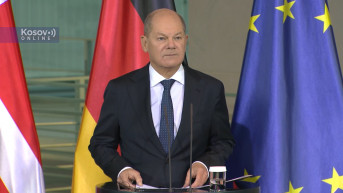
German Chancellor Olaf Scholz emphasized today that the inviolability of borders is a fundamental principle of international law, and this principle must apply to everyone.
"The inviolability of borders is a fundamental principle of international law. Russia violated this principle by attacking Ukraine, thereby also undermining the peace order in Europe. This principle must apply, and it must apply to all. I have already made this clear from this platform a few days ago. Borders must not be changed by force," Scholz stressed, adding in English, "to whom it may concern."
At a press conference with Danish Prime Minister Mette Frederiksen in Berlin, he noted that we live in challenging times, and in these times, a strong Europe and a strong NATO are important.
Scholz pointed to reports of damage to another undersea cable, which, he emphasized, demonstrates the threat posed by the Russian fleet in the background.
"With a NATO operation, we will improve the protection of the Baltic Sea and critical infrastructure on the seabed. One thing is clear: NATO remains the guarantor of our collective security. For this reason, many allies have significantly increased their defense spending in recent years. Finland and Sweden have joined the alliance. We agree that we must strengthen the European pillar of NATO and further increase the defense budget. Next week in Brussels, we will also discuss a more efficient European defense industry. We need rules that facilitate joint development and procurement of military equipment in the European Union," he explained.
He emphasized that Germany's stance on Russia's aggression against Ukraine remains the same.
"We will support Ukraine in defending its sovereignty and freedom, 'for as long as necessary.' We agree with our partners in Washington that this war must end, but it should not be a dictated peace. Putin must understand that he is sending his soldiers into a senseless battle. Because Ukraine will persist as a sovereign, united nation on its path to the European Union," Scholz conveyed.
Frederiksen said that Europe faces an uncertain reality that makes it even more urgent for it to be united and for countries to closely cooperate.
"We are witnessing Russia's hybrid attacks in Europe, in the Baltic Sea, its aggressive war against Ukraine on the European continent, and now the cooperation of Russia, Iran, and North Korea. We must do more in Europe. We need a stronger, more decisive Europe, capable of defending itself and promoting European interests. Now it is up to Europe to define the future of our continent, and I believe we must take more responsibility for our own security and for strengthening our defense industry. We must increase our support for Ukraine, we must counter the influence of China and Russia, and we must invest in developing technologies, our economies, and our security," she highlighted.
Frederiksen emphasized that Europe is based on the fundamental idea that cooperation, not confrontation, will lead to peace, prosperity, and a better existence, and this thought must be respected.
0 comments