
Edi Rama's role in the region: Great defender of the KLA and ardent promoter of the "Open Balkans"
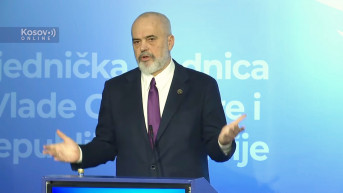
There is almost no statement or move by Albanian Prime Minister Edi Rama that does not attract attention in the region, partly because his statements are often contradictory, so the Prime Minister of Albania is at the same time one of the biggest defenders of the KLA and an ardent promoter of the "Open Balkans" initiative. The interlocutors of Kosovo Online say that Rama is "in a sandwich" between two ambitions, i.e. at the same time, he expresses national consciousness and awareness of the need for economic progress.
Specific not only because he graduated from the Academy of Arts and was a member of the Albanian basketball team, Rama does not hesitate to express his sometimes controversial views.
Thus, on the eve of the trial of former KLA leaders before the Special Court in The Hague, Rama reminded on Twitter that Joseph Biden called Hashim Thaci "George Washington from Kosovo" during his senatorial mandate, and on the day of the trial, he announced that Albania was in the Parliamentary Assembly of the Council of Europe collected signatures to challenge Dick Marty's 2011 resolution on organ trafficking and the "Yellow House".
Rama does not hide his attachment to the KLA, "with a lump in his throat because of injustice", he congratulated Thaci on his birthday two weeks ago, and at the same time he is one of the biggest advocates of the "Open Balkans" initiative, which promotes regional cooperation and economic development of the region.
At the same time, he says that "Open Balkans" is the right way to resolve the impasse in relations between Belgrade and Pristina, he calls on all countries, including Serbia, to recognize the independence of Kosovo, but also that the EU’s expension to the Western Balkans cannot be imagined without Serbia.
Commenting on Edi Rama's role in the region, former Minister of Foreign Affairs of the FRY Vladislav Jovanovic assesses that Rama is "in a sandwich".
"These are two attractive ambitions - on the one hand, he expresses his national consciousness, feeling and will to stand in solidarity with his people throughout the Balkans, while on the other hand he has in mind that Albania cannot develop economically and progress if it is isolated from of other countries in the region. Rejecting national solidarity would put Rama in an unenviable political position and lose the support of the people who brought him to the position of the head of the government," says Jovanovic, emphasizing that in addition to political opportunity, the Albanian prime minister also has a personal sense of preserving national identity and justifying his actions KLA.
On the other hand, the Open Balkans is a noble idea that can only bring benefits to the countries in the region, the diplomat believes, and the leaders of the member countries, aware of the advantages of regional initiatives and economic cooperation, tolerate each other's views regarding national identity and political differences, especially with respwct to the independence of Kosovo.
"Edi Rama's views on the KLA reflect the contradictions of relations in the Balkans, especially in relation to the 'Open Balkans'. The idea of the 'Open Balkans' is noble and in the long-term interest of all those who want to cooperate in this still undefined part of Europe. On the other hand , the two countries participating in the initiative did something that was not friendly towards Serbia - they recognized Kosovo and established diplomatic relations with them," said Jovanovic.
The interest of the countries within the initiative is a longer-term cooperation that should provide the basis for overcoming some of the previous problems, adds Jovanovic and says that Serbia has gone over certain positions of the other two leaders in the hope that irregularities regarding Kosovo's independence will be corrected over time.
According to him, the biggest obstacle to improving cooperation between Serbia and Albania is that Albania was a direct participant on the side of the KLA during the fight in 1999, which, he says, essentially violated the position of the UN Preference on not attacking neighboring countries and not interfering in their internal affairs.
Jovanovic explains that it was overcome in a way, because more complex events such as NATO aggression took place, which made Albania's participation peaceful in relation to the magnitude of the harm that aggression caused to the inhabitants of Serbia and Kosovo.
"It is something that is not pleasant to our ears and eyes, but it must be tolerated in the expectation that the very development and benefits that all three countries will have from the advancement of the Open Balkans project will help to more easily overcome and solve the issue concerning the violation of territorial integrity and sovereignty of Serbia by the two countries by their recognition of Kosovo and Metohija. These are contradictions that exist and we cannot translate them, but they must not prevent us from expanding cooperation with our neighbors and helping to overcome this problem in the future in a positive and just way in accordance with the UN Charter and our Constitution," says Jovanovic.
With the words "everything is possible in the Balkans, the Balkans are a unique contradiction", the diplomat explains that Prime Minister Rama is at the same time a defender of the KLA and a promoter of economic unity and cooperation with Serbia in the framework of the Open Balkans.
As he says, Rama is under some kind of national obligation to show solidarity with other Albanians in the neighborhood, so the absence of that solidarity would threaten his political position in Albania itself.
However, in addition, Jovanovic adds, the Albanian prime minister also has personal national feelings and aspirations that, as in this case, sometimes rise above the political opportunity of him as an official political figure.
"We are not in a position nor should we guess what is more important in his statement about the KLA, whether he was carried away by national sentiment or a political opportunity to protect himself from objections that he is not sufficiently nationally in solidarity with the Albanian nation. These are things that are at the level of assumptions. The interest that Albania has in cooperation with other neighboring countries could in the future be a healthier path for the eventual revision of the current position of both Albania and North Macedonia in relation to the issue of Kosovo and Metohija," said Jovanovic.
When asked how the national consciousness of Edi Rama affects the "Open Balkans" and cooperation with Serbia, the former head of diplomacy assesses that the national consciousness of the Albanian prime minister is a "weight".
"It is a weight on that project that somehow keeps it in check, now the question is whether that project should be abandoned suddenly or gradually because of this, or whether it should be strengthened as a perspective ally in the hope that the attitudes regarding Kosovo will be revised, along with the knowledge of the absolute impossibility that the so-called Kosovo can survive as an independent state, but maybe it can as a state within the state of Serbia," said Jovanovic.
One of Prime Minister Rama's guiding ideas, Jovanovic points out, is the creation of a "great Albania", but he also has a strong awareness that Albania cannot survive or progress economically if it is isolated from neighboring countries.
"Rama is obviously sandwiched between two attractive ambitions, one is to stand in solidarity with the idea of a greater Albanian state, but that idea is already a hundred years old and that does not mean that it cannot last as long and not be realized, and on the other hand life dictates to everyone, including Albania, to come to terms with the facts of life and its interests in and around the country and with the need to strengthen unity and joint cooperation with its neighbors," says Jovanovic.
It has been shown, he emphasizes, that large integration processes as well as small regional ones contribute to faster and more efficient individual development, strengthening of the economy and state preservation, and it can be concluded, he assesses, that such a way of thinking prevails among Rama as well.
Jovanovic also notes that Rama had the opportunity, he notes, to live through both situations and to see that isolated Albania, as well as isolated Serbia or any other Balkan country, do not have the same chances to develop faster and reach an enviable level of their own existence that others will appreciate. if they do not improve mutual relations with their neighbors and develop the most acceptable forms of mutual cooperation.
"This is now being attempted with the Open Balkans, and each country sees its own interest in it, which could only increase with the further development of cooperation, and then at one point it could prevail over the narrow national interest that at the moment fills all Albanians on Blkan. It is for them to think that they could forever separate Kosovo and Metohija from Serbia and annex it to themselves. Everyone has the right to a dream, it is still a dream and there are no realistic grounds for it to come true," concludes Jovanovic.
Albanian journalist Idro Seferi says that Rama builds his views on the KLA through the Albanian national issue, while he treats regional cooperation as the only way for the country to progress and "move on", but he also notes that in the matter of regional cooperation, Rama went one step ahead of the doubts as to whether Open Balkans is a good solution for everyone in the region.
"Regional cooperation costs him, because it is not seen as a good move in all countries. Of course, there is a bit of balancing involved, Rama has to be persistent in some issues concerning Albania and Kosovo, but on the other hand, he is still a man who tried that he goes one step further, and that quite far, even though the discussions about whether to be in the Open Balkans, especially in Kosovo, were negative. Rama did not hesitate to promote this cooperation with Serbia and other countries of the region at the highest level and stopped at side of it," Seferi said.
He assesses that Rama's support for the KLA is based on his previous support for the former president of Kosovo, Hashim Thaci, and on the fact that the two leaders used to have good relations. However, he adds that Edi Rama is not "alone" in the issue of dualism between regional cooperation and national issues, but this is also observed in other leaders on the Balkans.
"That's why regional cooperation does not function at full capacity. There are national issues that cause not-so-good relations between the capitals and states, and at the same time there is talk of deepening economic relations. When national differences are overcome, perhaps regional cooperation will be more successful than now",Seferi points out.
He believes that Edi Rama will certainly continue to work on the improvement of regional cooperation, because it is part of his policy, but also because Alania still benefited from being oriented towards the countries of the region.
He states that good neighborly relations have provided Albania with greater economic exchange, as well as the development of tourism and economy.
"I think it is in Rama’ interest that as many tourists as possible come to Albania and that the country progresses in every respect. All these other stories are topics that are important for his voters and for relations with Kosovo, but we need to see how some things can be overcome without hindering regional cooperation," Seferi concludes.
The director of the Center for Regionalism, Aleksandar Popov, notes that on the one hand Rama very often takes the role of the defender of war criminals and the KLA, while on the other hand he promotes economic unity and the relativization of borders in the region through the Open Balkans.
He believes that the political interests of authoritarian politics are hidden behind the roles of promoters of regional initiatives and that there are no mutual disputes between statesmen on this issue.
That is why he believes that behind the agreement on the Open Balkans between Serbian President Aleksandar Vucic and Prime Minister Rama there is hidden a tripartite solution for the Western Balkans, which was proposed in Brussels by Slovenian Prime Minister Janez Janša - "so that peace would reign in the Balkans, if a 'Greater Albania' were ‘Gretaer Serbia’ and ‘Greater Croatia’.
Popov concludes that it is possible that precisely because of the idea of a "great Albania", Rama talks about the economic unification of the region and the opening of borders, but does not renounce his views on the KLA.
He estimates that numerous issues of crimes and victims of both sides and political differences will be opened by the trial of KLA leaders in The Hague.


comments