
Why is Lajcak in Pristina once again postponing the talks on the CSM?
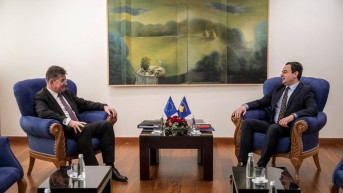
Amid the flood of messages from Washington, but also from European capitals, that it is high time to form the Community of Serb-majority Municipalities, yesterday's statement of the European Union Special Representative for Dialogue Miroslav Lajcak in Priština - that the CSM was not currently on the agenda of the dialogue, sounded, to put it mildly, surprising.
The Coordinator of the Working Group of the National Convention on the EU for Chapter 35, Dragisa Mijacic, tells Kosovo Online that Lajcak as a diplomat speaks in such a way that his language formulations can be interpreted ambiguously, while the former president of the Coordinating Center for Kosovo, Nebojsa Covic, commenting on Lajcak's statement leaves the possibility that it is "encouraging" Kurti as they "once encouraged Thaci, Haradinaj or Limaj", and what Lajcak is talking about examining new models for the CSM, Covic calls "reinventing the wheel”.
Mijacic assesses that Lajcak has the mandate to create the conditions for reaching an agreement on normalization based on the European plan, and as he says, that's why his communication goes in the direction of creating support or reducing public resistance in order to reach an agreement.
"As a diplomat, he speaks in such a way that his language formulations are clear, but can be interpreted ambiguously. For example, in last night's statement he emphasized that, at the moment, the formation of the CSM was not a subject of dialogue, but he did not add that the road map that will lead to the formation of the CSM is currently being negotiated because that part is not pleasing to the Pristina public," Mijacic says.
He points out that the Agreement on Normalization, which was recently adopted in Brussels, clearly emphasizes that the previous commitments must be implemented, including the formation of the CSM, and that the steps to achieve this are currently being negotiated.
"The formation of the CSM is the request of Germany and America for the beginning of Kosovo's negotiations for membership in the Council of Europe, so the Government of Kosovo will not be able to escape from this obligation. Another question is what form the CSM will take, whether it will meet the needs of the Serbs or not, which is much more important than whether such an institution will be formed," Mijacic notes.
Just one day before the statement of the European mediator that the CSM was not currently on the agenda of the dialogue, the American ambassador in Belgrade, Christopher Hill, said that it was important that the issues were resolved and that the CSM was finally formed after ten years.
Belgrade's position has been known for a long time - only when the CSM is agreed upon, can the dialogue proceed.
The former president of the Coordinating Center for Kosovo, Nebojsa Covic tells Kosovo Online that the fact that Lajcak says that the CSM is not currently on the agenda means that they are now concentrating more on the annex to the agreement, that is, what they call the road map.
"These annexes should contain specific timings, what will be done in the next 15 days, and what will be done in 150 days. But let's go back to the beginning of 2013 and the Brussels Agreement and what was signed in the implementation plan for the CSM. That plan has already been worked out. Let's go with that plan, why are 17 models being invented now? Don't let Lajcak reinvent the wheel now, because he is known for that. Let's simplify the matter: gentlemen, apply what was signed," Covic says.
He believes that the "encouraging" of Albin Kurti is also at work, as was done in the past to encourage Thaci, Haradinaj, and Limaj...
"At the same time, they were creating a concept that was not based on what was foreseen by Resolution 1244. Who can trust them anymore?" Covic asks.
As for the European models that could serve as a model for the formation of the CSM, which Lajcak mentioned yesterday in Pristina, Covic says that he sees it as: "a model for the Serbs is being sought", which, he believes, represents a fraudulent act.
"We are looking at models like those in Germany, France, Italy, or Belgium. There are about 17 different models that they will try to use and actually suggest paying attention to four things.
The first is that Germany, France, Italy, and Belgium are the founding countries of the EU; the second principle is that they are advanced democracies - so if something works with the founders of the EU and advanced democracies, it can also work elsewhere, the third is that those countries were once sworn enemies and the fourth is that these model regions have been the source of wars for centuries. Where is the deception? The implementation plans for the CSM were signed in one part in 2013 and in the other part in 2015. And that's where everything is worked out. This was signed by our side and the Pristina side, as well as the international community," Covic says.
As he adds, despite everything, Belgrade should participate in the talks, but also ask the question "when the signed agreements will be implemented".
"Or is the intention to impose something on us by force? Just so we know where we are," Covic concludes.


0 comments