
The agreement on membership in the Board of Peace has stirred unrest in the Assembly of Kosovo
The noticeable reserve shown earlier this year by Prime Minister and Albin Kurti, leader of Self-Determination, toward Kosovo’s membership in the Board of Peace was interpreted as his attempt to stay “in line” with European allies, but also as a consequence of deteriorating relations with Vjosa Osmani, who, as president, signed the charter of that initiative launched by Donald Trump. Now, when a Self-Determination MP in the Foreign Affairs Committee of the Kosovo Assembly has requested that one article of the agreement be clarified before deputies approve it, analysts say that move—given that international agreements cannot be altered—is actually a message both to the former president and to the U.S. administration.
Written by: Jelena Milenkovic
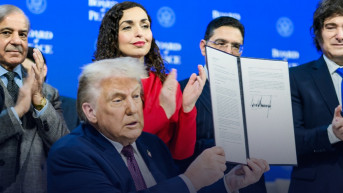
Kosovo’s accession to the initiative launched by U.S. President Donald Trump on the sidelines of the Davos Forum at the end of January was largely supported by politicians and the public in Kosovo. Most saw it as a privilege for Pristina and an important step in deepening partnership with the United States, although some were bothered that the charter of the Board of Peace was initialed by Vjosa Osmani, whose presidential term was nearing its end, interpreting it as a campaign move for re-election. For some, this was more troubling, which was reflected in the noticeable lack of strong support from the government and Prime Minister Albin Kurti.
Since January, many things have changed, and the Board of Peace has somewhat fallen into the background, partly due to the conflict in Iran, even for its initiator across the Atlantic. However, the draft law on ratifying the agreement has reached the Kosovo parliament—where it encountered an obstacle.
The Kosovo government recently easily adopted a decision to send members of the Kosovo Security Forces to the Gaza Strip as part of international stabilization forces, which aligns with the guiding idea of the Board of Peace. That decision was confirmed by MPs three days ago with 89 votes in favor, none against, and no abstentions.
However, the agreement on membership in the Board of Peace was blocked at the parliamentary committee level by Self-Determination MP Arbereshe Kryeziu-Hyseni, who stated that “one sentence in Article 2, paragraph 2 is problematic and needs improvement,” adding that the issue lies in wording and that it must be assessed whether the agreement complies with European Union laws and directives. A working group has therefore been formed to harmonize the draft law this week.
Is it just about wording?
The debate over Self-Determination’s stance on the agreement continued in parliament on Friday.
Democratic Party of Kosovo MP Enver Hoxhaj criticized the ruling party, stating that “states must be serious about what they say and agree abroad and implement it at home.”
Although, he said, the way Osmani supported the initiative in Davos without involving the Kosovo government was a legal violation, he was even more concerned that the parliamentary majority is attempting another violation by trying to alter the Board of Peace agreement.
“Foreign policy is not a platform for fulfilling wishes or a place where egos clash. It is a process in which states must be serious about what they say abroad and implement it at home… We cannot sign one thing abroad and maintain a completely different stance at home. Let us end this political circus,” said Hoxhaj, a former foreign minister.
Self-Determination MP Arbereshe Kryeziu-Hyseni maintained that the ruling majority is not against membership in the Board of Peace, but rather aims to align the agreement with Kosovo legislation.
“In principle, no one is against it, meaning all political entities represented in parliament. It was mutually agreed to form a working group, in which you, Mr. Hoxhaj, are proposed as a representative of opposition parties. I am glad, because I believe you will contribute professionally to properly drafting this law. So far, only Albania has ratified this agreement, and no one else, as the idea is to align the law with the jurisdictions of member states. There is no reason for concern, and even less for it to appear as though we oppose it. We are not against it, but we are interested in ensuring the draft law is harmonized and well regulated,” she said.
A message to Osmani and the U.S.
Historian Stefan Radojkovic says that the decision by the parliamentary committee, prompted by a Self-Determination MP, is effectively a message from Kurti’s government both to the former president—whom it has politically distanced itself from—and to the U.S. administration, which has suspended the opening of a strategic dialogue.
He recalled that Kurti and Osmani grew increasingly distant during her mandate, and that earlier this year it became clear that the parliamentary majority would not support her candidacy for another term.
“This is a direct message to her, but also to Donald Trump’s administration, which suspended the strategic dialogue between Pristina and Washington precisely because of the behavior of Kurti’s government toward the Serbian community and institutions meant to form the backbone of the Association of Serb Municipalities, as well as unilateral moves within his political campaign,” Radojkovic said.
He believes Kurti, who sees the international community as often pressuring Pristina over the status of the Serbian community, decided to show a degree of resistance toward much of the international community, especially Washington, including regarding the Board of Peace.
“It was probably assessed that the Board of Peace could serve as a substitute for the United Nations, and we know that Pristina wants to be recognized as an equal member and represented as a state in the UN,” he added.
International agreements cannot be changed
Whether it is a political message or insistence on legality, the fact remains that international agreements cannot be unilaterally altered.
“It is a mistake that members of the Foreign Affairs Committee did not understand what an international agreement is and thought they could change one of its articles. According to the Vienna Convention on the Law of Treaties, as well as Kosovo’s Constitution, such agreements cannot be changed. Also, the parliament is not a negotiating party to intervene,” explained former diplomat Silje Ukshini.
He added that parliament can approve an agreement or recommend negotiations, but in this case, the document is not subject to negotiation.
“They rejected it more out of ignorance, given that both government and opposition support Kosovo’s inclusion in the Board of Peace. It helps consolidate Kosovo’s image and international position, presenting it as a reputable international entity. The committee will reconsider, and after consultations with the Foreign Ministry or legal experts, it will be confirmed that the text will not be altered. The agreement can be ratified or rejected, but not changed,” Ukshini emphasized.
Career diplomat Albert Prenkaj also warned that signed agreements entail international responsibility, describing Kosovo’s attempt to draft a ratification law as “playing with fire.”
He noted that countries such as Italy, Germany, France, and the United Kingdom have not expressed readiness to join the initiative, while only Albania has ratified it. He suggested that Kosovo’s recent hesitation may be linked to European positions, aiming to strike a balance.
He questioned what kind of balance Kosovo—outside the UN framework—can achieve when it has an opportunity to participate in a platform like the Board of Peace, where chances for greater international attention and potential recognition are evident.
Similarly, international law professor Enver Hasani described the actions of Self-Determination MPs as immature.
“This is complete immaturity. MPs should consult the legal department of the Foreign Ministry if they do not understand the standards on when and how an agreement signed by a head of state, government, or foreign minister can be altered before ratification. Parliament can change domestic laws, but not Kosovo’s international obligations,” Hasani said.
Meanwhile, former president Vjosa Osmani has called on MPs to urgently and unanimously ratify the agreement on Kosovo’s membership in the Board of Peace.


0 comments