
Albanian language before the Constitutional Court of North Macedonia: equality or threat to sovereignty?
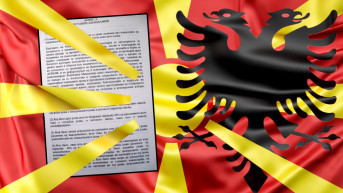
The Constitutional Court of North Macedonia will discuss on December 11 the Law on the Use of Languages, which stipulates that, in addition to Macedonian, the Albanian language can be used in all institutions and citizen procedures before all state authorities. Although the law is part of the implementation of the 2001 Ohrid Agreement, aimed at reducing ethnic tensions in the country, its application over more than two decades continues to provoke serious political and legal controversies. While some view it as a guarantee of equality and fairness, others describe it as a "linguistic Frankenstein" whose implementation could jeopardize sovereignty. However, interlocutors for Kosovo Online agree that the dispute is more political than a reflection of coexistence in North Macedonia.
Written by: Petar Rosic
The Law on the Use of the Albanian Language as an official language in North Macedonia was adopted only in 2018 after a lengthy political process and negotiations lasting a full 17 years. It allowed the Albanian language to be official in municipalities where Albanians constitute more than 20% of the population, as well as at the level of central authorities.
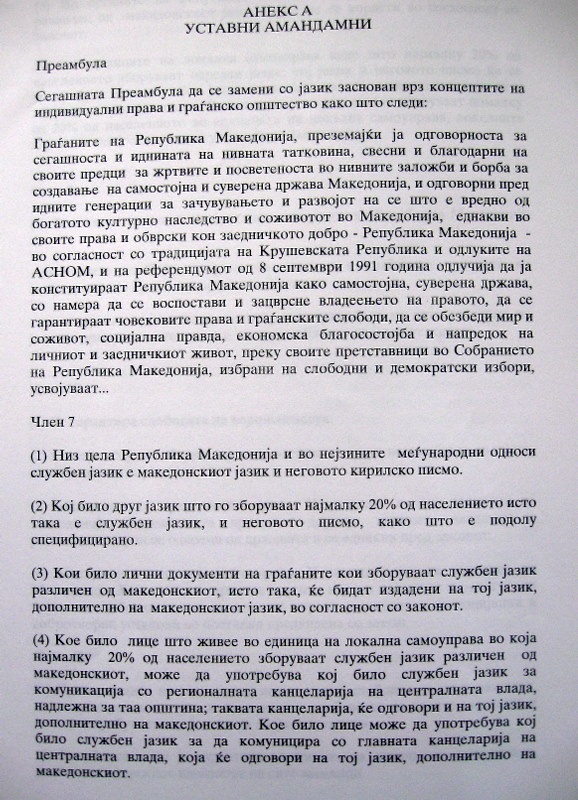
However, it sparked controversies and serious political and legal debates even then, as political parties and individuals questioned its constitutionality, particularly regarding the expanded use of the Albanian language in state institutions.
Even the then-President of the country, Gjorge Ivanov, refused to sign the decree promulgating the adopted Law on the Use of Languages, citing what he described as the law's repressive content and the violent manner in which it was passed.
The law was published in the Official Gazette in 2019 with only the signature of the parliamentary president, Talat Xhaferi, and a footnote where the president's signature should have been, explaining that Ivanov refused to sign.
Currently, the Constitutional Court is reviewing a total of 13 initiatives filed by VMRO-DPMNE, Levica, as well as civil sector organizations and professors.
The President of the Constitutional Court of North Macedonia, Darko Kostadinovski, previously announced discussions on repealing three provisions from the Law on the Use of Languages related to the Albanian language. Kostadinovski’s initiative was directly supported by VMRO leader Hristijan Mickoski, as well as the Albanian coalition VLEN, which ensured that the law would not be repealed entirely but only certain provisions. On the other hand, the Democratic Union for Integration (DUI) strongly opposes the repeal of these provisions.
Critics argue that the law could disrupt the balance between ethnic communities and create administrative burdens, as it would require a significant number of translators and additional resources, especially in rural areas and smaller towns where Albanians are not the majority.
Any amendments to the law by the Constitutional Court could provoke new political turmoil, warn some, while others, like Prime Minister Hristijan Mickoski, suggest that nothing will happen on Monday.
“They are harassing both Albanians and Macedonians, trying to divide them and divert attention. Therefore, I urge all citizens to remain calm. This is a case of mass corruption that will soon be uncovered. No matter how fierce or determined they are, we will defeat them. The public must uncover the truth about these political profiteers,” Mickoski stated.
The atmosphere was further inflamed by Kosovo’s Prime Minister Albin Kurti, who stated during a press conference with Mickoski that there is no law on the use of the Albanian language in North Macedonia.
“Albanian is not endangered. As far as I understand, this is a matter currently before the Constitutional Court of North Macedonia. Three provisions on language use were referred to the Venice Commission, which, paradoxically, have neither been implemented nor annulled. It is now up to the Constitutional Court of North Macedonia to decide,” Kurti said.
This statement drew numerous criticisms, with the strongest opposition coming from DUI. The party’s leader, Ali Ahmeti, stated yesterday that the Constitutional Court should reject discussions and attempts to remove the Albanian language from official use, warning, “There will be no peace in North Macedonia.”
“The Ohrid Agreement must be respected and not tampered with, as it is at the heart of the Albanians,” Ahmeti said.
Conversely, the VLEN coalition’s coordination body and party leaders held a meeting yesterday, assuring Albanians to remain calm as their language would be protected.
They criticized DUI for initially passing the Law on Languages with significant flaws, then referring the same law to the Venice Commission, which contested the legality of three key provisions, and ultimately, after realizing they would be in opposition, using connections in the Constitutional Court to incite interethnic tensions to avoid accountability for their corrupt officials.
“Now they want to present themselves as saviors of the Albanian language,” VLEN coalition representatives stated.
Diverse views on the law’s implementation were shared with Kosovo Online by analysts, who nonetheless agree on one premise: the dispute has become more political than reflective of coexistence in North Macedonia.
“The Constitutional Court of the Republic of North Macedonia is currently more focused on domestic laws and does not take international conventions into account. Above all, the role of the Constitutional Court is to protect the human rights and freedoms of all citizens of the Republic of North Macedonia. Language is one of the basic and fundamental values of a nation, and I don’t believe the issue is constitutional or legal,” said Bashkim Selmani, a professor at the Faculty of Law at the State University of Tetovo, for Kosovo Online.
He added:
“But who is bothered by the language? If you ask the citizens, no one. This is more of a political moment than a reflection of coexistence among citizens. The Constitutional Court should not fall into such traps,” he insisted.
He argued that political parties are not working in the state’s interest and that Macedonians should respect the language.
“Everyone outside, whether it’s Greece or Bulgaria, has challenged our history; we haven’t challenged anything. And now instead of being rewarded, this is an attack, but not by Macedonians. That’s why I say political parties are not working in the state’s interest, and that’s not right. I don’t believe there will be complications if political parties don’t want to use the same issue,” Selmani said.
Kurti’s claim that there is no law on the Albanian language in the country was seen as a “friendly act,” but Selmani noted that no external party could challenge North Macedonia’s laws.
“Every country has its laws and provisions, and there’s no need for such statements as they are not in the interest of the citizens or the state. No one can dispute whether laws exist or not. The Albanian language is a natural language spoken by people, but it hasn’t been implemented, which is proven here. The law exists; they can comment that it hasn’t been implemented, but not that it doesn’t exist. That’s incorrect,” said the professor from Tetovo.
On the other hand, political analyst Sotir Kostov described the law on the use of languages in North Macedonia as a “factory defect” and expressed hope that the Constitutional Court would demonstrate awareness and resolve the political elites' misunderstandings, which he said are primarily about securing positions on the political scene.
Kostov welcomed the Constitutional Court’s decision to address this law because, as he stated, the law surpasses the Macedonian constitution.
“We have a positive atmosphere for the coexistence of the Macedonian people and other minorities in the Republic of North Macedonia. I expect professionalism, expertise, and objectivity to prevail among the constitutional judges, and that they will decide according to what is sought in the initiative,” said Kostov.
He assessed that communities would react both positively and negatively, regardless of the decision made by the Constitutional Court.
He reminded that the Venice Commission made several observations, turned them into recommendations, and stated that this law exceeds European and global standards for the use of minority languages.
"Additionally, a number of experts from Strasbourg provided guidance indicating that this law does not integrate but disintegrates. Let us recall the case of the unfortunate director of the Toxicology Clinic, appointed to a very important position, who did not know the Macedonian language and spoke only Albanian. This was not an isolated case; there are many such examples," said the interlocutor.
He emphasized that he personally supports the use of the Albanian language and considers Albanians as brothers but believes that "there is a law, a Constitution, and order in the country."
He stated that recently "someone is trying to impose the idea that Macedonia is a lawless land or someone's private estate."
"Things need to return to normal. This is not about the Albanian language; it’s about the use of Macedonian, Albanian, Turkish, Romani, Bosnian, Vlach, Serbian languages. If I missed any, I apologize. Simply put, Albanians have every right to live in this community and this multicultural society. Albanians are not oppressed, as some runaway political elites try to claim and present. Albanians have universities, secondary education in their Albanian language, and primary education. What more?" he asked.
According to him, this law is flawed—a "factory defect."
"The President of the Republic of Macedonia did not sign it; it was signed by some deputy secretary-general of the Parliament. Formally and legally, this law is not correct, and I expect constitutional judges to demonstrate high awareness and overcome all political, and if you will, confessional misunderstandings—though I believe it is merely a conflict of political elites fighting for positions on the political scene—and to act as expected, as professionals, because that’s why they were chosen," the analyst noted.
He reminded that the judges were appointed by DUI and SDSM, yet now DUI is complaining that the court will bring injustice to Albanians.
"I assure you, I have four sons and one daughter. My eldest son is a blood brother with an Albanian from Tetovo. Let there be no misunderstanding: we are not nationalists, as we are labeled because of our views. We must defend Macedonia a little, and I would conclude with this. In Germany, there are five million Turks—is Turkish an official language? Absolutely not. In America, let’s not even talk about Hispanic Americans and African Americans. Are their languages official in America? No. Let us not turn Macedonia into an experiment and a linguistic Frankenstein," Kostov stated emphatically.
He "welcomed" Kurti's statement that there is no law on the Albanian language in North Macedonia.
"Indeed, there isn’t. There is a law on the use of languages, and to be honest, I was a bit pleasantly surprised by Kurti. Kurti is referred to as the Kosovo, Balkan, and European Nelson Mandela. Honestly, I don’t share that sentiment. But Kurti, with that statement and some other calming remarks in the context of Macedonia and the relations between Albanian and Macedonian political elites, pleasantly surprised me. That is encouraging, as it puts the correct lens on the glasses. Let us remove the glasses of Semyon Semyonovich; it is a paradox and a myth when we wear rose-tinted glasses and everything seems fine. But reality is ugly. When we take off the glasses, we see the real truth. Kurti conveyed the real truth, which he often brings to Macedonia: that Albanians in Macedonia live well, that Macedonia does not differ from other Balkan countries, and that Macedonia is fighting for its rightful place under the sun," Kostov concluded.

0 comments