
Albanians in North Macedonia and the elections in Kosovo: Divided blocs and clear preferences on both sides
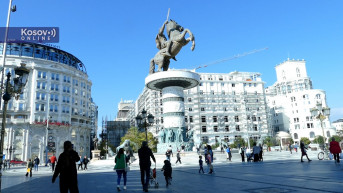
The upcoming snap parliamentary elections in Kosovo, to be held on Sunday, 28 December, are also affecting developments within the Albanian political bloc in North Macedonia. The positions of the ruling and opposition parties of the Albanian political spectrum in North Macedonia toward the elections in Kosovo mirror the situation in Kosovo itself and confirm deep internal political divisions.
By: Darko Savanovic
While parties of the ruling VLEN coalition support “Self-Determination” and hope that Albin Kurti will remain in power, the bloc around the Democratic Union for Integration (DUI) is linked to the Kosovo opposition.
Ahead of last year’s parliamentary elections in North Macedonia, Kurti directly supported the then newly formed VLEN coalition, which emerged as an “anti-DUI bloc.”
Its main electoral goal was to send DUI into opposition, accusing it of clientelism, corruption, and crime, as well as of having caused the greatest harm to Albanians during its many years in power.
Unlike VLEN, DUI, a party founded and for decades led by one of the founders of the Kosovo Liberation Army, Ali Ahmeti, is connected through a shared history and a similar path of formation with the Democratic Party of Kosovo, founded by Hashim Thaci, as well as with other opposition parties.
Political analyst Sefer Selimi believes that elections in Kosovo can always have an impact on internal political developments within the Albanian bloc in North Macedonia, due to geographical proximity and close ties.
“In the past, there has always been undisclosed mutual support among political actors that has at times caused turbulence on our political scene. There is a clear preference among ruling parties that support Self-Determination in Kosovo, while on several occasions we have seen Ahmeti in the role of mediator between opposition political parties in Kosovo. The blocs are divided, and preferences are clear on both sides of the border,” Selimi told Kosovo Online.
Asked whether it is possible to organize or encourage voting by Albanian citizens in North Macedonia who also hold Kosovo citizenship to vote in Sunday’s elections, Selimi answered affirmatively.
“Certainly. We have seen public calls and visits by candidates for the Assembly of Kosovo who came here and posed with local party leaders, which represents direct or indirect support. Political parties have organized to mobilize supporters and have even offered infrastructure for their transport to Kosovo during the last local elections, so they could vote in line with their preferences,” Selimi said.
He added that he expects this to happen again due to the strong polarization in Kosovo, since it is very important for local officials from the ruling Albanian bloc in North Macedonia that Albin Kurti and Self-Determination remain in power there.
Journalist Nazim Rashidi says that, in general, attention to developments in Kosovo is very high, not only among political parties but also among citizens, because the citizens of North Macedonia, especially Albanians, are “very closely connected to Kosovo, both historically and through recent events.”
“Without a doubt, whatever has happened in Kosovo has always been reflected here as well, both positively and negatively. So the political dynamics there are sometimes followed here almost as a copy. Not in a negative sense, but as a kind of model and also as a kind of reflection of the conflicts you are talking about,” Rashidi told Kosovo Online.
He notes that attention sometimes shifts depending on which political subject supports which political option, so the Albanian political class that is part of the government in North Macedonia supports Self-Determination more, and the Kosovo prime minister directly supports them as well, while another part, mainly DUI, supports other political actors, that is, opposition parties.
“What I want to emphasize is that a large part of the citizens do not want institutions to create policies based on party preferences. Institutions should be led by people who represent everyone, and citizens want, regardless of who wins in Kosovo or in Macedonia, communication to be directed toward the benefit of citizens, independent of existing preferences. This is what dominates in the eyes of citizens,” Rashidi notes.
According to him, a large number of political actors in North Macedonia clearly know whom they support.
“What everyone here wants, both citizens and political actors, is for the process to unfold as well as possible. This is often taken as a model because there have truly been correct processes, especially due to the fact that results were accepted by everyone. That also happens in North Macedonia. It is not that it has never happened otherwise, but it is not like the case of Albania, where the electoral process drags on and institutions that conduct the process are called into question. So expectations are for a fair electoral process. Then, political actors who are close to parties in Kosovo certainly want those parties to win there,” Rashidi said.
He also believes that organizing or encouraging voting by citizens who also hold Kosovo citizenship is possible, but adds that personally he does not know of, nor has he noticed, any organized departures for the Kosovo elections.
“Yes, encouragement exists and it is natural, because Kosovo media are followed here as well and everyone is informed about when elections are held and what they mean. So those who have the right to vote will go to vote as citizens of Kosovo, but that is simply the most normal process, because it has always happened that way. However, there has been no recorded direct organization, or at least I have not noticed that anything will be organized, but there will certainly be calls. Because this is part of the entire electoral battle taking place in Kosovo, which is followed closely and where each side hopes for a certain outcome,” Rashidi said.


0 comments