
Borders under pressure: Carriers issue warnings, economists point to consequences
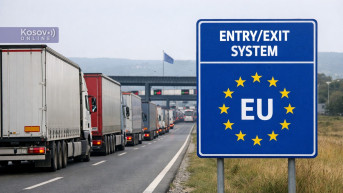
The European Commission has yet to offer a solution to remove restrictions on the length of stay of professional truck drivers from the Western Balkans in Schengen Area countries. Carriers from Serbia, North Macedonia, Bosnia and Herzegovina, and Montenegro are expected to meet in Skopje on Tuesday to coordinate a joint approach toward the Commission, while Kosovo Online's interlocutors believe that the European Commission has mechanisms available to resolve the problem and that truck drivers could be granted an exemption similar to those already available to workers in river or air transport.
Written by: Darko Savanovic
Kosovo Online's interlocutors are urging carriers to avoid blockades, stressing that a solution to the problem of EU rules governing drivers' stays must be sought through negotiations with Brussels. Possible solutions mentioned include granting drivers a special status, such as a type D visa, technical changes to the method used to calculate the length of stay, and privileged status for professional drivers.
Carriers from Serbia, North Macedonia, Bosnia and Herzegovina, and Montenegro have announced a meeting in Skopje on Tuesday to coordinate their joint approach toward the European Commission in seeking a solution to the problem.
Biljana Muratovska, Secretary General of the Macedonian Transport Association Makam-trans, told Kosovo Online that the purpose of the meeting would be to define further steps in communication with the authorities in Brussels regarding a possible solution.
She recalled that, at a meeting held on August 4, the European Commission Working Group was presented with a temporary model that would not require legislative amendments—calculating the time spent by Western Balkan drivers in the Schengen Area in hours, which would allow approximately 80 percent of drivers to remain there for longer than the currently prescribed 90-day limit.
"This could be achieved solely by specifying the method of calculation, without any need to amend the legislation. A meeting of representatives of carriers from North Macedonia, Serbia, Bosnia and Herzegovina, and Montenegro has tentatively been agreed for August 11, 2026, in Skopje, with the aim of defining the associations' next steps and further communication with the administration in Brussels," Muratovska said.
Bojan Stanic, Assistant Director at the Chamber of Commerce and Industry of Serbia, warned that a potential blockade of border crossings organized by transport companies from the Western Balkans would not have a major impact on the European Union, but could paralyze the Serbian economy, particularly export-oriented companies.
"Border blockades are the last thing we need right now, and they would genuinely paralyze our economy, particularly the export-oriented segment, given that we are far more dependent on the European market, namely the EU market, than the EU is on us. Of course, they are also dependent on us to some extent, considering that our suppliers are reliable partners for their companies and contribute to their competitiveness," Stanic told Kosovo Online.
He appealed to carriers to refrain from blockades, stressing that they would cause the greatest damage to Serbia's economy and to the carriers themselves.
"We are currently facing pressure on our competitiveness, but negotiations between Serbia and the European Commission are ongoing, as are bilateral talks between Serbia and individual EU member states. Blockades are therefore something that should really be avoided at this point," Stanic said.
Asked how severely border blockades would disrupt regional supply chains, he said they would create serious problems because goods would be unable either to enter or leave the country, while the Serbian economy has far more companies dependent on imports than companies dependent on exports.
"This would represent an enormous loss for the economy. Given that one blockade has already taken place, the question is whether European customers, seeing that something like this could happen again, might decide to terminate long-term supply agreements with our companies. That would result not only in daily losses but also in long-term losses for our exporters," Stanic said.
According to him, a prolonged blockade would cause major disruptions.
"However, if it lasted only briefly, as happened last time, companies would of course suffer losses, but there would be no drastic consequences for the economy. We still hope there will not be even a single day of blockades, simply because that would genuinely damage Serbia's reputation not only as a supplier but also as an investment destination," Stanic said.
Asked how he assessed the European Union's response to truck drivers' demands regarding the rules governing stays in the Schengen Area, Stanic said that they were generally dissatisfied but emphasized that possible solutions were clear.
"The long-term solution, and the one most acceptable to us, would be to provide some form of privileged treatment, similar to the exemptions that already exist for workers in river and air transport. There is no reason why truck drivers should not receive similar treatment," Stanic said.
He added that they were generally dissatisfied with the European Union's handling of the issue, particularly given that Serbia is an EU candidate country, has a free trade agreement, and continues to record growing exports to the EU market.
According to Stanic, if the discussion concerns privileged access to the EU single market, as proposed by Berlin and Paris, it would send a positive signal if the EU showed understanding for the specific circumstances of Serbia, North Macedonia, and Bosnia and Herzegovina.
"If there is some flexibility on the part of the European Union—or, rather than flexibility, I would say understanding for the specific position of Serbia, Bosnia and Herzegovina, and North Macedonia, which are effectively landlocked countries and where more than 90 percent of the transport of goods from Serbia and the region to Europe, and vice versa, is carried out by road—that would be very important," Stanic said.
Granit Sokolaj, founder and Executive Director of Albania's Alert Consumer Protection Center, believes that the EU has mechanisms available to resolve the restrictions on the length of stay for drivers from the region, stressing that the introduction of a special regime, such as a type D visa, could significantly facilitate the functioning of the transport sector.
According to him, the European Commission, in cooperation with major companies, could compile a list of drivers who have worked in international transport for years and allow them to move freely without their time in the EU counting toward the 90-day limit.
"The European Commission can take action. This is not something impossible. The type D visa option would be quite a good solution, and through major companies, Brussels could maintain a list of people who are permitted to cross EU borders without the three-month period of stay in the EU being counted. Brussels could create a list within its systems and identify these individuals, and this could provide a solution allowing them to move freely without visas and without the 90-day period being counted," Sokolaj told Kosovo Online.
He warned that the current rules affect not only drivers and transport companies but the entire supply chain across the Western Balkans.
Speaking about regional reactions to the introduction of the Entry/Exit System (EES) for border controls, Sokolaj expressed regret over the lack of an organized response in Albania. He believes that chambers of commerce and business associations should become more actively involved in resolving the issue and join regional initiatives.
He noted that while there have been reactions in Serbia, North Macedonia, and Montenegro, nothing is happening in Albania.
"They should join this regional initiative because it concerns all countries outside the EU. Albania is being penalized by these rules as well. The Serbs are speaking up, the Macedonians are speaking up, and the Montenegrins are doing the same, while the Albanians remain silent. Later, when this problem is resolved, they will benefit from it. But if the European Commission does not adopt a favorable decision for the Balkan countries, they will regret not having contributed. By then, however, it will be too late," Sokolaj said.
At the end of January, Serbian carriers and their counterparts from other countries in the region blocked freight terminals at border crossings with Schengen countries for several days in protest against the implementation of the EU's new Entry/Exit System (EES), which, they said at the time, was causing them serious problems.
Full implementation of the European Union's new Entry/Exit System (EES) began on April 10 this year, following its phased introduction in 29 European countries starting in October last year.

0 comments