
The Brussels Agreement 10 years later: What was agreed and why was it not fulfilled?
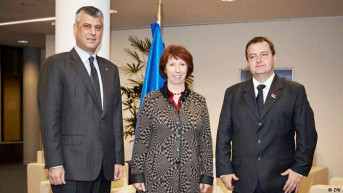
The enthusiasm, that ten years ago accompanied the signing of the First Agreement on Principles Governing the Normalization of Relations between Belgrade and Pristina, has long since disappeared. The six items of this document that refer to the Community of Serb-majority Municipalities remained only on paper, initialed by the Prime Ministers of Serbia and Kosovo at the time, Ivica Dacic and Hashim Thaci. Governments in Pristina changed, but none of them dared to do what was written as an obligation of the Kosovo side - to form the CSM.
"Determination and courage" that the high representative of the European Union for foreign policy, Catherine Ashton, in whose presence the agreement was signed, praised on April 19, 2013, have been lost somewhere.
The items for which the Serbian side was in charge, stipulated that all the police in the north of Kosovo be integrated into the framework of the Kosovo Police; that the judicial authorities function within the legal system of Kosovo, and that the municipal elections in the northern municipalities in 2013 be organized in accordance with Kosovo law, have been fulfilled.
"Consensus not to implement the CSM"
Stefan Surlic, assistant professor at the Faculty of Political Sciences in Belgrade, tells Kosovo Online that the goal of the First Agreement on the Normalization of Relations was to build trust between the two sides, for Belgrade to accept the integration of northern Kosovo into the government system in Pristina, and to hold the first local elections. according to the laws of Kosovo, and that in return the Serbian community receives realized autonomy in the form of the CSM.
"That opportunity, however, was permanently squandered. Instead of a greater degree of trust, now, despite international pressure, the Serbs in Kosovo do not believe that the CSM will ever be implemented and formed; they doubt that the authorities in Pristina will try to make it function normally. I have the impression that then, as now with the European proposal, it only bought time to force Belgrade to integrate the Serbs into the Kosovo system, and that there was never any real pressure on Pristina to implement the CSM. On the internal political level in Kosovo, the political options competed to see who would demonize the Community more and present it as something that threatens Albanians. After ten years, we have the paradox that those who signed the Brussels Agreement and who supported it, because it was also adopted in the Kosovo Assembly, are now the main critics of Albin Kurti, who was then in the opposition and opposed the CSM. They are now attacking him that he will betray national interests if he implements the CSM, which tells us that there is a broad consensus among Albanian political representatives that the CSM should not be implemented," Surlic tells us.
Even if the CSM is formed, he adds, it is questionable how it will function.
The first agreement was signed under the auspices of the EU, and from a distance of a decade, Surlic says that the EU has lost its credibility as a mediator because the Brussels Agreement was not fully implemented and because the most powerful EU members were indifferent to the implementation of the CSM.
"In this last phase of the dialogue, we saw that the CSM was once again brought back as a topic for the negotiating table, but primarily due to the pressure of the US. The EU and the leading countries of the union had already given up on the CSM and did not see it as an obligation and something that actually calls into question their credibility as mediators. Also, they were never fundamentally convinced that the CSM is something that is good and that guarantees the rights of the Serbs in Kosovo, but the Community was always offered as a card that would convince Belgrade to accept painful compromises, that is, something that would make Belgrade happy. to continue to make concessions," Surlic says.
When asked whether we should expect a change in the approach of the EU, our interlocutor says that the Serbian side's insistence that the CSM is the first condition, among other things, opens up the possibility that the CSM will be implemented in the foreseeable future if international actors really care about the agreement between Belgrade and Pristina.
"International actors are now aware that Belgrade will not fulfill the other items of the agreement until the CSM is implemented, so it is now up to Pristina to implement it, and according to the current political situation, I would not say that it will happen by the end of the year. Maybe some initial steps will be organized, but it seems unrealistic that we will have a fully functional CSM by the end of the year. Even if there is goodwill, it is impossible to implement it in the right way in that period," Surlic says.
"The citizens themselves are not ready for complete normalization"
Allen Meta, a political analyst from Pristina, tells Kosovo Online that for ten years we have been witnessing a diplomatic marathon between the EU and the US, which are pushing for the normalization of relations at all costs, but that complete normalization is prevented either by geopolitical changes or by the internal politics of Kosovo and Serbia.
"As a result, there should not be high expectations, especially in the Western Balkans, because the citizens themselves are not quite ready for full normalization, and this affects politicians who calculate by measuring the pulse in both countries. Geopolitical changes are also one of the factors that influenced the prolongation of the process of normalization of relations. However, recently, with the beginning of the war against Ukraine, attention has again turned to the region of the Western Balkans, especially to Kosovo and Serbia, in an attempt to reach an agreement due to the possibility of an escalation of the situation, especially in the north of Kosovo," Meta says.
He nevertheless concludes that rapprochement between the parties exists, although this process will take time.
"Steps towards the normalization of relations will continue. All agreements so far, from the civil aspect, are aimed at improving the living conditions of both nations and that certainly takes time. Without a doubt, politicians should pay more attention to the normalization of relations, more than they have done so until now," Meta says.
According to analyst Dusan Janjic, the overall result of the Brussels Agreement is poor, especially regarding the CSM, and as he states for Kosovo Online, the positions of the two parties are divided regarding something that does not exist anywhere in the agreement.
"It does not say that the CSM should have executive power. The Albanian side claims that it is a well-known Serbian program where the desire is to create a Republika Srpska on the territory of Kosovo, and in Serbia there have always been politicians, today less than before, who thought that it would not be bad - to create a republic and keeps the conflict open. But there is no such thing anywhere in the agreement," Janjic says.
"The upcoming elections in the north will discredit the idea of the CSM"
Janjic also points out that the Serbian side saw in the CSM a special guarantee for the survival of the Serbs, both politically and for everyone else, and that it was neglected that the Serbs already have some rights according to the Constitution of Kosovo - at least 10 representatives in the parliament and seats in the administration.
"They ignored what has now appeared in the European proposal, in paragraphs 2, 6, and 7, where it is stated that the position and status of the SOC, the status of cultural and religious heritage, and the right of the Serbian community to develop its identity should be regulated. Now Kurti would only want minority autonomy or self-management, not the Community," Janjic says.
According to his opinion, if all the documents and everything accepted were put on the table, the work could be completed in a month. He also indicates that the upcoming elections in the north of Kosovo will lead to the discrediting of the whole idea - both the CSM and normalization, and he hopes that it will pass in a silent boycott by the citizens of the north of Kosovo, which would strengthen Serbia's position.
"This is a mistake. We will get mayors, one of whom may be a Serb, and the whole idea of the Brussels Agreement from 2013 is the representation of the Serbs in the institutions to enable integration without which there is no normalization. This is a much bigger blow to the CSM than the political disputes were, whether or not we want the Community of Serb-majority Municipalities," Janjic concludes.
What is in the agreement?
The first Brussels agreement has 15 items, the first of which reads, "There will be a Community of Serb-majority Municipalities in Kosovo. Membership will be open to any other municipality, provided that the members agree". The agreement further stipulates that the CSM will have a president, vice-president, Assembly, and Council... and will have full supervision over the areas of economic development, education, health, urban planning. and rural development.
Item 9 of this document defines in detail the organization of the police in four municipalities in the north of Kosovo.
"There will be a regional police commander for four municipalities in the north where the Serbs make up the majority population (North Mitrovica, Zvecan, Zubin Potok, and Leposavic). The commander of this region will be a Kosovo Serb appointed by the Ministry of Internal Affairs from a list submitted by four mayors on behalf of the Community/Association. The composition of the Kosovo Police in the north will reflect the ethnic composition of the population of these four municipalities. (There will be another regional police commander for the municipalities of South Mitrovica, Srbica, and Vucitrn). The regional commander of the four northern municipalities will cooperate with other regional commanders," the agreement says.
As planned, ten municipalities should join the CSM - Leposavic, Zvecan, North Mitrovica, Zubin Potok, Partesj, Ranillug, Novo Brdo, Gracanica, Strpce, and Klokot.

0 comments