
Can Albanians in North Macedonia lose their veto right on the adoption of certain laws?
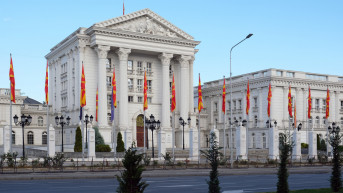
The idea of Justice Minister Igor Filkov about revising the Badinter principle in North Macedonia is interpreted by some as an attempt to prevent the abuse of this rule, while others see it as a new step toward dismantling the Ohrid Agreement.
Written by: Milorad Vesic
Will Albanians in North Macedonia lose the possibility of a veto on the adoption of certain laws, primarily concerning national identity, is the question raised by Justice Minister Igor Filkov with his statement that the Badinter principle should be reconsidered.
Although Prime Minister and VMRO-DPMNE leader Hristijan Mickoski, answering journalists’ questions on whether the government intends to do so, said that the Badinter principle is part of the Ohrid Framework Agreement, which is a closed issue, Albanian—primarily opposition—politicians in that country expressed a series of criticisms toward the authorities, stating that this is a new attempt at dismantling the 2001 Ohrid Agreement.
From some Albanian parties, such as the “Populi” movement, which is part of the opposition European Front gathered around the strongest Albanian party DUI, but also the Alliance for Albanians, which recently left the ruling coalition, came accusations that Mickoski’s government is monoethnic and discriminates against Albanians, and that it lacks ethnic legitimacy.
The latter refers precisely to the Badinter principle, according to which the adoption of laws and decisions affecting the rights of minority ethnic communities requires a double majority in parliament. In addition to the majority of the total number of MPs, it is also necessary that the regulation be supported by a majority of MPs or councilors from the ethnic community to which the regulation relates. Apart from the Assembly, this principle is applied in other state institutions, as well as in local self-governments, with the aim of ensuring interethnic equality and preventing decisions made solely in the interest of one ethnic group.
That the current government has a problem securing a majority among Albanian MPs is shown by the fact that several important laws have not recently passed, among the latest being amendments to the Election Law, ahead of the local elections scheduled for October 19. This was the reason for Justice Minister Igor Filkov, otherwise a member of the ZNAM Movement, a smaller coalition partner of VMRO-DPMNE, in an interview with the newspaper “Fokus,” to state that he hopes the Assembly will do its job, but that if this does not happen, it means that the “Badinter majority is being abused” and that perhaps it is time to consider revising that rule.
Prime Minister Mickoski did not support Filkov’s idea, but his statement did not calm Albanian politicians. All the more so because he underlined that another rule, called the “balancer,” which was once introduced to ensure equality in public sector employment, and which the Constitutional Court annulled last autumn, represented an institutional problem.
The abolition of that rule is also now used by Albanian opposition politicians as one of the arguments for claims that the government is step by step dismantling the Ohrid Agreement. On the other hand, some analysts assessed that because of that rule the quality of state administration declined, as attention was often paid more to nationality than to the qualifications of candidates for certain positions.
Day-to-day political messages before the elections
Analysts are divided also when it comes to the seriousness of the announcements about revising the Badinter principle. Analyst Blagojče Atanasovski told Kosovo Online that the Government of North Macedonia does not intend to abolish the Badinter principle.
“These are certain statements aimed at day-to-day political points before the local elections, since it is a provision defined by the Ohrid Framework Agreement. I think that for such a thing there must be a general national consensus among all ethnic communities and all politically represented parties. Apart from DUI’s reaction, I think that even the VLEN coalition, which is in power, would not accept the abolition of the Badinter principle. I think that they will absolutely not go in the direction of abolishing a provision of the Ohrid Framework Agreement, something that has not happened in the past 24 years,” Atanasovski believes.
He agrees, however, with the assessment that there is a problem when it comes to the application of the Badinter principle in practice.
“We see that during the adoption of laws with the Badinter majority, institutions of the system can at any moment be blocked, and this is a sort of flaw in Macedonia’s Ohrid framework democracy. I absolutely agree that this is the case, in political science this is called consociational democracy,” Atanasovski said.
“But to believe that a political climate will be created for abolishing the Badinter principle… I think that at this given moment there are no political and social conditions for that, for the simple reason that I think no ethnically Albanian political party would agree, that is, it would immediately veto such a law or leave the ruling majority,” he added.
This was also confirmed by the coalition of Albanian parties VLEN, which remained in government even after three MPs from the Alliance for Albanians left it and went into opposition, thereby further complicating the government’s path to a majority among Albanian MPs, necessary for the adoption of certain laws. Thus, Deputy Prime Minister for Administration in the Government of North Macedonia Arben Fetai wrote on his Facebook account after Filkov’s statement that the Badinter principle is “untouchable.”
He reminded that without the support of Albanian MPs, any initiative to change the Badinter principle is legally impossible and that discussions in this direction are only a distraction from real priorities.
Still, that there are also objections in VLEN, which before last year’s elections had received public support from Albin Kurti’s Self-Determination Movement in Kosovo, about the representation of Albanians in state institutions, is shown by Fetai’s earlier statement, when he pointed out that although the Albanian language is also official in North Macedonia, according to the country’s constitution in international relations only Macedonian is the official language. He also said that in public institutions about 21 percent of employees are Albanians, but that there are still institutions without any Albanians, noting for example that the security sector is monoethnic.
Possible consequence – change of the political system
Although Prime Minister Mickoski has for now put an end to Minister Filkov’s idea of revising the Badinter principle, the story has not stopped, and political analyst Sefer Selimi told Kosovo Online that both Mickoski and other representatives of VMRO-DPMNE, while in opposition, had on several occasions announced the possibility of revising or withdrawing the Badinter principle, so the minister’s statement is not a surprise to him. He pointed out possible consequences of such an act.
“Badinter is the essence and the most important pillar of the Ohrid Agreement. And the Ohrid Agreement is one of the two pillars on which Macedonia’s unitary political system rests. The withdrawal of Badinter could be carried out if other changes in the political system are also put on the table, which may include, for example, a bicameral parliament or territorial autonomies where Albanians are the majority,” Selimi said.
According to him, the tendency of political revision of the Ohrid Agreement and the legal and political rights Albanians have achieved brings us back to a time when, as he put it, “unfortunately, Macedonia resembled Serbia under Milosevic’s leadership more than a European state that takes care of all its citizens.”
“All this will bring us back to a situation where the trust of Albanians in this country will be destroyed. We will return to a time when Albanians in this country saw an adversary, and not someone who protects them and takes care of them, and we will return to a time when topics that should have been resolved with the Ohrid Peace Agreement will be reopened. It seems to me that the Government actively and deliberately played a role in destabilizing this country. This will serve neither us as Albanians, nor Macedonians, nor the state, nor our perspective, which is already stuck regarding European integration,” Selimi assessed.
When asked whether he thinks there is a possibility for any kind of revision of the Badinter principle, since no one, not even Filkov, mentioned its abolition, Selimi replied that the tendency is clear, but he does not know whether this is preparing the ground for such a thing, and again pointed out the possible consequences.
“The abolition of Badinter will open new issues, and these issues may even include federalization, a new arrangement of the state. Because these agreements, which were achieved after such great investment and human sacrifice and political capital, we as a society have worked for 20 or more years to rise above such tendencies for domination, that is, political marginalization of a particular community. These issues should be left in the past. This government led by Mickoski, instead of focusing on creating a model or finding ways to abolish already achieved agreements, should find ways to improve them and to connect us more closely with the state. The loyalty of this country and all its citizens cannot rest on the wishes of one prime minister, and that is too high a price we will all have to pay together,” Selimi concluded.
Otherwise, the Badinter principle was included in the Constitution of North Macedonia after the signing of the Ohrid Agreement, which was reached with the mediation of the EU and US, following months of armed conflict between Albanian paramilitary formations under the name National Liberation Army and Macedonian security forces.
This rule provides for a double majority in the adoption of laws and decisions that directly affect the rights of ethnic communities. In addition to a general majority of MPs, it requires a majority of votes from MPs belonging to communities that are not the majority in the country.
The Badinter principle is applied in the Parliament, municipal councils, and other state institutions, particularly in areas such as language, symbols, education, and culture, and it was introduced to ensure interethnic equality.



0 comments