
What connects and what burdens the cooperation between Serbia and North Macedonia?
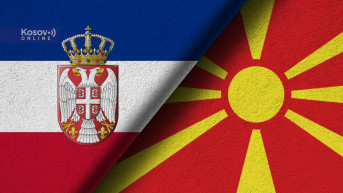
Exactly one year ago, Serbian President Aleksandar Vucic and the President of North Macedonia, Gordana Siljanovska Davkova, declared their intention to strengthen relations between their two countries. The terrible tragedy in Kocani in March this year united the region but also demonstrated the practical results of that cooperation. Interviewees for Kosovo Online agree that bilateral relations are on the rise and that both countries share a vision for the future, despite differing views on the issue of Kosovo.
Written by: Djordje Barovic
“Serbia and North Macedonia will continue to develop and carefully build their relations with mutual respect, working on concrete projects,” said Vucic during a joint press conference on August 2, 2024, at the Prohor Pcinjski Monastery near Vranje.
President Siljanovska Davkova stressed the need for “mutual understanding” at the time.
“If we do not understand each other, we cannot expect others to understand us. That’s why we must do everything to solve our problems ourselves and not allow some ‘green tables’ to decide for us. We are neighbors, and it’s not a coincidence that we live side by side,” said Siljanovska Davkova.
The nightclub tragedy in Kocani on March 16 claimed 62 young lives and injured over 200 people.
The Government of Serbia declared March 18 a day of mourning, but the event also showed how the two countries can respond swiftly in such situations. Serbia was involved not only in rescue operations but also in treating the injured.
“Thank you for housing a large number of patients and doing everything necessary. Your ministers were among the first to contact us—Prime Minister Vucevic and Minister Marko Đuric—not only to show empathy but to offer support and assistance. The solidarity of your state, doctors, and people was evident. I pray for the health of these people, and thank you and your medical staff for what you are doing for us,” said North Macedonia’s Foreign Minister Timco Mucunski.
The Kocani Tragedy
For Mijat Kostic from the New Third Way initiative, the Kocani tragedy was a sad but concrete example of improved cooperation between the two countries.
“Unfortunately, the first indicator of that cooperation was already evident in March when members of the Serbian Ministry of Interior participated in the evacuation and treatment of the injured following the accident in North Macedonia. Those people were then treated in Serbian hospitals, which is another indication of the functionality of this cooperation. Sadly, it took a tragedy to see that cooperation in action,” Kostic told Kosovo Online.
He also pointed out that just last month, the two countries signed an agreement to facilitate the faster movement of people and goods across border crossings.
“A single-stop system was introduced, so when crossing at Presevo or Tabanovce, there is now just one checkpoint instead of two, making travel easier for tourists and improving the flow of goods and capital, in line with the Open Balkan agreement, which promotes regional economic integration,” said Kostic, adding that completing Corridor 10, particularly the Nis-Skopje section, will connect not just the Western Balkans but also Europe.
“Bilateral cooperation between Serbia and North Macedonia benefits not only regional integration but also Europe as a whole,” Kostic stressed.
He noted that the main point of contention remains North Macedonia’s recognition of Kosovo, which gives Serbian diplomacy “added motivation” to seek a change in Skopje’s position.
“This is a key dispute, but just as past issues—like the church schism—have been resolved after decades, I am convinced that remaining disagreements will also be resolved through diplomatic or bilateral agreements, if both countries genuinely choose to support one another in the integration process,” he added.
He is convinced there is diplomatic will.
“And this doesn’t apply only to North Macedonia, but to other Western Balkan countries as well. This type of bilateral agreement will intensify in the coming years,” concluded Kostic.
Fear of a ‘Serbian World’
Former Mayor of the Centar Municipality in Skopje, Sasa Bogdanovic, told Kosovo Online that despite the fact that “some don’t like it” or fear the idea of a “Serbian world,” bilateral relations between Serbia and North Macedonia are on an upward trajectory.
“Some might not like that Serbia and Macedonia have good relations. You can hear it in some statements. I’m deeply disappointed by opposition politicians who define any rapprochement with Serbia and the Serbian people as some kind of ‘Serbian world,’ even though North Macedonia has no issues with Serbia—unlike with Bulgaria, which is blocking its EU accession,” said Bogdanovic.
He believes that bilateral relations are becoming “increasingly close and better,” supported by Serbia’s principled approach.
“It’s clear that Serbia has a principled attitude toward Macedonia and no open issues, unlike Macedonia’s other neighbors,” he said.
He sees development in all areas: from economic and infrastructure to cultural and sports cooperation.
“We also see increased interest from Serbian companies entering the Macedonian market. I hope that cooperation continues to grow. I also hope the Open Balkan initiative and its mechanisms will keep delivering results,” Bogdanovic said.
The tragedy in Kocani, he emphasized, demonstrated real solidarity between Serbia and North Macedonia.
“That major tragedy in Kocani showed that Serbia is always there, one of Macedonia’s closest countries. It received perhaps the highest number of injured people in need of assistance. We now see that help extending in other ways as well, and the two sides are getting closer and closer,” said Bogdanovic.
On the different views regarding Kosovo, Bogdanovic called North Macedonia’s recognition of Kosovo “a step against the most fraternal nation” to it—Serbia.
Deep-rooted Friendship
Professor Dejan Antic from the Faculty of Philosophy in Nis emphasizes that the relationship between Serbia and North Macedonia is marked by deep-rooted friendship and shared heritage, and that the future should focus on economic and educational cooperation.
Those were also the key messages of the presidents during last year’s meeting.
“It was a political act of great significance, not only for strengthening bilateral relations but also as a testimony to the deep-rooted friendship and shared roots of the two nations. The meeting confirmed a forward-looking approach by Belgrade and Skopje, aiming for continued economic cooperation and joint work toward regional stability,” Antic told Kosovo Online.
He emphasized North Macedonia’s recognition of Kosovo as the most sensitive issue.
“That topic remains undoubtedly the most delicate and complex in overall bilateral relations. Serbia has not and will never give up on Kosovo and Metohija—the cradle of its statehood, identity, and spirituality,” said Antic.
He added that it is encouraging that the majority of Orthodox Christians in North Macedonia do not support the recognition decision.
“It’s encouraging that most Orthodox citizens of North Macedonia disagree with their government’s stance, which is largely a result of foreign political pressure. They still see Kosovo and Metohija as part of Serbia. This stance remains a key foundation for maintaining the historical and spiritual bonds between the Serbian and Macedonian peoples,” the historian noted.
The most visible cooperation in the past year, Antic said, was after the Kocani tragedy when Serbia offered full support to North Macedonian citizens.
“That fraternal gesture was not isolated—it was followed by new agreements on mutual aid in crisis situations and coordination among health institutions,” he observed.
He added that Serbia and North Macedonia have also intensified cooperation in infrastructure—especially road and railway connections—as well as in improving the integrated border crossing at Presevo–Tabanovce.
“This cooperation continues in the field of culture and heritage preservation. In April this year, a Macedonian Cultural Center opened in Belgrade, and a Serbian Cultural Center is expected to open in Vardar soon,” Antic noted.
In current geopolitical conditions, Antic sees economy and education as the key areas of future cooperation.
“Although trade exchange is growing, investment stimulation is needed, including joint energy projects and support for SMEs. There is also room for cooperation in digitalization,” said Antic.
In the field of education, he proposed stronger institutional links between Serbian and Macedonian systems.
“We need to institutionalize the exchange of students and young researchers, as they share Slavic and Orthodox cultural backgrounds. These new generations must be the carriers of long-term friendship. Joint educational programs and scholarships would be a strong step in that direction,” Antic emphasized.
When asked how much the two countries could support each other in EU integration, the historian responded: “Only one who has a brother can rely on someone when times get tough.”
“Serbia and Macedonia are there for each other. They must count on one another at a time when some EU members impose conditions unrelated to reforms but driven by geopolitical ambitions. In such an environment, fraternal states have no greater support than each other. Serbia and North Macedonia have no closer partner in the Balkans—historically, culturally, or emotionally,” Antic said.
He explained that the two countries and peoples are connected by a shared past marked by the struggle for freedom, suffering, and solidarity.
“But also a shared vision of a future in which sovereignty, national identity, and stability are preserved. Instead of yielding to the dictates of great powers, Belgrade and Skopje must support one another in dialogue with Europe and in defending legitimate national interests, economic cooperation, and regional collaboration. Serbian-Macedonian friendship is political capital. It is our strategic advantage and a prerequisite for a dignified place on the world stage,” Antic concluded.
Unresolved Issues
Security studies researcher Nikola Vujinovic agrees that bilateral relations—especially economic exchange—are on the rise but warns of numerous unresolved issues between Serbia and North Macedonia, including Kosovo, the position of the Serbian community, and Serbian cultural heritage and church property.
Vujinovic noted that one of the two key goals set by the presidents a year ago has been achieved.
“The presidents set two key goals. The increase in economic cooperation has been successfully achieved. Once all statistical data is in, we’ll see that trade has reached nearly two billion euros. However, the goal I personally find more significant—infrastructure cooperation—hasn’t advanced much. That includes the Belgrade–Skopje–Thessaloniki railway, an idea presented during their talks,” said Vujinovic.
Asked how the two countries could support one another in EU accession, Vujinovic sarcastically said that North Macedonia is a “great example” for Serbia.
“North Macedonia is a ‘great example’ for Serbia in EU negotiations because it has faced everything Serbia is likely to face—especially from EU members like Bulgaria and Greece. They demanded that Macedonia change virtually everything to be allowed to join, and even then, it didn’t progress. I expect Serbia’s EU neighbors to impose similarly unacceptable demands,” Vujinovic warned.
He believes the Kosovo issue will be resolved once geopolitical conditions change.
“Like Montenegro, North Macedonia recognized Kosovo under pressure from global powers. When those pressures change, it’ll just be a matter of who retracts recognition first—Montenegro or North Macedonia,” he predicted.
Among other unresolved issues, Vujinovic highlighted the question of Serbian identity and the status of Serbian cultural heritage and Orthodox Church property.
“Unfortunately, there’s a long history of how Macedonian Slavs perceive their identity. Recently, cultural heritage listed in international registries as Serbian has been rebranded as Macedonian,” he warned.
He believes Serbia is aware of this but cannot “fight on a hundred fronts.”
“We already face major issues and can’t deal with this fully, but public attention should be raised. Monasteries of King Marko Mrnjavcevic or King Milutin are being renamed as Byzantine churches and monasteries,” said Vujinovic.

0 comments