
Can the Assembly elect a new President of Kosovo within 34 days?
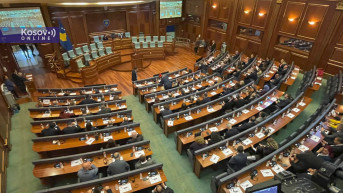
Following the decision of the Constitutional Court, members of the Kosovo parliament have 34 days at their disposal to attempt to elect a new President of Kosovo. However, according to interlocutors of Kosovo Online, the chances of an agreement between the ruling parties and the opposition are minimal. They assess that it is more likely that, upon the expiry of the deadline set by the Court, new elections will be called. They also point to a possible new point of contention regarding whether the interrupted parliamentary session of March 5 on the election of the president will resume where it left off, with the same proposed candidates.
Written by: Dusica Radeka Djordjevic
Following the publication of the Constitutional Court’s decision, the largest Albanian parties did not a priori reject the possibility of reaching an agreement on a new president within 34 days. However, for now, they are not offering solutions on how to achieve a compromise, instead shifting the responsibility onto one another.
The head of the parliamentary group of the Self-Determination Movement, Arberie Nagavci, stated that new elections are not necessary, as she expects the same outcome.
“This is the time to put all disagreements aside and elect a president,” Nagavci said.
MP of the Democratic Party of Kosovo, Xhavit Haliti, also stated that all parties and MPs should engage in finding a consensus, but that the greatest responsibility lies with Self-Determination and its leader Albin Kurti.
The president of the Democratic League of Kosovo, Lumir Abdixhiku, shares the view that responsibility remains with the parliamentary majority.
If a president is not elected, calculations on when new elections could be held were presented by Besnik Tahiri, MP of the Alliance for the Future of Kosovo. In his assessment, they could take place in mid-June.
“Push and pull”
Former Vice President of the Constitutional Court, Kadri Kryeziu, told Kosovo Online that there will be “political games” in the coming period.
“In the next 34 days, there will be games, a ‘push and pull.’ Only elections are the solution and a way out of this situation,” Kryeziu believes.
He emphasized that he is not certain whether Self-Determination will have new presidential candidates and that a compromise among political parties is necessary.
“I am not sure whether Self-Determination has new candidates. In any case, new candidates should be proposed, for the sake of political compromise,” he stated.
Another question for the Constitutional Court?
According to Milos Pavkovic, Director of Strategy at the Center for European Policies in Belgrade, the question of whether the candidacies of Self-Determination representatives — Glauk Konjufca and Fatmire Kollçaku — presented at the parliamentary session that began on March 5 and was interrupted the same evening due to a lack of quorum, are still “valid,” or whether the process must start anew, could become a new point of dispute among parties.
“The Constitutional Court was not explicit on whether the session of the Assembly of Kosovo will continue with the same proposed candidates or whether MPs need to propose new names. The position of Self-Determination was that the process had not even begun. Therefore, according to their interpretation, they are free to start the process from the beginning and propose new candidates. We will see whether this leads to a new dispute and possibly another question for the Constitutional Court,” Pavkovic told Kosovo Online.
If the interrupted session on the election of the president resumes, it is certain that Self-Determination has already used 60 MPs’ signatures for its two candidates and cannot nominate a third. A new name could only emerge if other political options unite and gather 30 signatures.
Dragisa Mijacic, Coordinator of the National Convention on the EU for Chapter 35, assesses that it is unrealistic for any political option to gather 30 signatures, nominate a candidate, and secure both a majority and a two-thirds quorum under the current parliamentary composition.
He is also not optimistic that the already proposed candidates, Konjufca or Kollçaku, could be elected.
“That has already been attempted. It failed. In the meantime, situations have occurred that have further distanced political actors from one another, so there is no basis for any cooperation on this issue. Frankly, I do not believe it is possible to elect a president in such a parliament, and it is most likely that we will see a new round of parliamentary elections in Kosovo,” Mijacic stated for Kosovo Online.
Aleksandar Sljuka, associate of the NGO New Social Initiative, also believes that, despite the Constitutional Court’s decision to allow an additional deadline for electing the president of Kosovo, the more realistic scenario remains the calling of snap elections rather than reaching an agreement.
“We do not see that anything substantial has changed on the political scene in terms of an agreement that should emerge. We have seen certain turbulences in the Kurti–Osmani relationship, and now the question is whether Osmani is forming or has already become part of a new bloc, and whether someone else will support her candidacy for president. However, neither bloc currently has the capacity to independently secure a quorum, especially in the first and second rounds of voting, and even the third round is questionable. This means that both sides can effectively continue to boycott the work of that special session, as happened on March 5, when the first attempt failed because opposition MPs did not attend the session. Therefore, this problem may persist,” Sljuka stated.
Who benefits from elections?
At this moment, according to Sljuka, elections do not necessarily suit the ruling side, but they could present an opportunity for the opposition if it acts in a unified manner.
“It will also be important that elections could be held before the summer, that is, before the arrival of the diaspora, which could potentially affect the result. It is well known that the presence of the diaspora can influence election results, so its absence could weaken support for Self-Determination. Elections likely do not suit Kurti, as it is difficult to repeat the previous result, while on the other hand, they may suit the opposition—provided it acts in unity,” Sljuka believes.
The final outcome, he concludes, will also depend on the potential consolidation of the opposition.
“It is important whether Osmani will manage to form a broader bloc, possibly with parties such as the Democratic League of Kosovo and the Alliance for the Future of Kosovo, that is, whether there will be a consolidation of the opposition. This will determine who stands to benefit more from going to elections,” Sljuka points out.
Asked whether he believes the parties will manage to reach an agreement and elect a president, Pavkovic noted that it is quite possible that Kurti will not be willing to compromise.
“It is very difficult to assess at this moment because Kurti is quite rigid and firm in his stance, and it is entirely possible that he will not be open to any compromise with opposition parties. On the other hand, the opposition may again deny him a quorum, which would lead to parliamentary elections. Another important factor will likely be Kurti’s own assessment of how he would perform in potential new elections. Based on that, he will decide whether to enter negotiations with opposition parties or not,” Pavkovic concluded.
Court’s reasoning
The decision of the Constitutional Court, announced yesterday, was adopted following an appeal by MPs from Self-Determination and the Government of Kosovo against the decree of President Vjosa Osmani dated March 6, by which she dissolved the Assembly because a new president had not been elected 30 days before the expiration of the incumbent’s mandate.
The Constitutional Court ruled that this decree produces no legal effect and that MPs have 34 days to complete the procedure for electing the president. If the Assembly fails to elect a president within this period, the Assembly will be dissolved and early elections will be held within 45 days, as stated in the Court’s decision.
The figure of 34 days was derived by reference to Article 82 of the Constitution, which provides that the Assembly shall be dissolved “if a president is not elected within 60 days from the day the election procedure was initiated.”
“The Court finds that the Assembly failed to use the 60-day deadline for electing the president. Accordingly, and in the context of the necessity to ensure the continued functioning of state institutions, the President and the Assembly, the Court finds that the Assembly has an additional 34 days at its disposal to continue and complete the procedure for electing a new president,” the decision states.



0 comments