
Sljuka: Constitutional Court decision postponed the crisis, elections a more realistic scenario
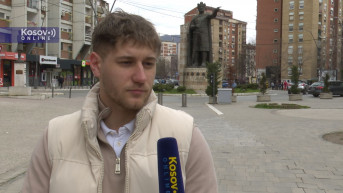
Associate of the NGO New Social Initiative, Aleksandar Sljuka, stated that the Constitutional Court’s decision to allow an additional deadline for the election of the President of Kosovo has postponed the political crisis, but also opened the question of who benefits most from such a delay, assessing that calling early elections remains a more realistic scenario than reaching an agreement.
Sljuka pointed out that current relations on the political scene, including tensions between the prime minister and the president, do not indicate a near possibility of reaching consensus on the election of the president.
“It is unlikely that anything will be resolved, given that we do not see any significant changes on the political scene in terms of an agreement that should be reached. We have seen certain turbulences in the Kurti–Osmani relationship, and now the question is whether Osmani is forming or has already become part of a new bloc, as well as whether someone else will support her candidacy for president. However, at this moment neither bloc has the ability to independently secure a quorum, especially when it comes to the first and second rounds of voting, and even the third is questionable, and to elect a president. This means that both sides can effectively continue to boycott the work of that special session, as happened on March 5, when the first attempt failed because opposition MPs did not attend the session. So we can still have that problem,” Sljuka told Kosovo Online.
Sljuka emphasizes that this is a specific situation, which is why the Constitutional Court left an additional deadline for the election of the president.
“I think that is precisely why the Constitutional Court issued such an opinion. It stated that this situation is specific, but that in all other cases the 30-day deadline from Article 86 of the Constitution will primarily be observed, which in this situation would mean automatically going to elections. However, it was emphasized that this is a specific case, because the Assembly did not have a total of 60 days to attempt to elect the president, as provided for in Article 82 of the Constitution,” he explains.
He adds that part of the deadline has already expired, leaving institutions with limited time to reach an agreement.
According to him, without significant political changes, it is difficult to expect the election of a president within that period.
“Still, without some change and restructuring on the political scene, I do not see consensus being reached on the election of the president. It is possible that something happens within 34 days, but I believe we are closer to a scenario in which nothing significant will change and that after that deadline the Assembly will be dissolved. Elections are not called automatically, but the Assembly is dissolved, and then elections should be called and organized within 45 days,” our interlocutor said.
Sljuka also assesses that the Constitutional Court’s decision could have political consequences for certain actors.
“If we take into account the situation in which Osmani issued a decree that the Constitutional Court declared null and void, that is, without legal effect, while Kurti and MPs from Self-Determination challenged it, this can be seen as a small, temporary victory for Self-Determination. This showed that what Osmani did had no legal basis and was an arbitrary interpretation. In the context of future elections, this could have some significance, because part of the public might see her as someone who tried to exceed her powers, and even, as some claimed, to carry out a kind of coup, that is, to dissolve the Assembly on her own without the right to do so. This could affect her image,” Sljuka points out.
Sljuka reminds that Self-Determination still has the largest support among voters, but that the timing of elections could influence the result.
“It will also be important that elections could be held before summer, that is, before the arrival of the diaspora, which could potentially affect the result. It is known that the presence of the diaspora can influence election results, so its absence could weaken support for Self-Determination,” Sljuka believes.
The final outcome, he says, will also depend on possible opposition unification.
“It is also important whether Osmani will manage to form a broader bloc, possibly with parties such as LDK and AAK, that is, whether opposition consolidation will occur. That will determine who benefits more from going to elections. In a situation where there is no consensus, elections were already a likely outcome, and now it is clear that there is an additional deadline. However, everything will depend on how political forces reorganize, primarily within the opposition spectrum,” Sljuka notes.
He concludes that elections at this moment do not necessarily suit the ruling side, but could be an opportunity for the opposition if it acts in unity.
“Elections probably do not suit Kurti at this moment, because it is difficult to repeat the previous result, especially considering that the diaspora will not be present to the same extent. On the other hand, this could suit the opposition, but only if it acts united. If the opposition once again runs divided and in a similar manner as before, its chances remain small. However, if consolidation occurs and an organized bloc is formed, the opposition could have better chances, and in that case elections would suit it more,” Sljuka said.



0 comments